BuildNot yet confirmed elsewhere1 publisher2 min readPublished
Mac Studio M5 Ultra vs DGX Spark: capacity says what fits, bandwidth says what you wait for
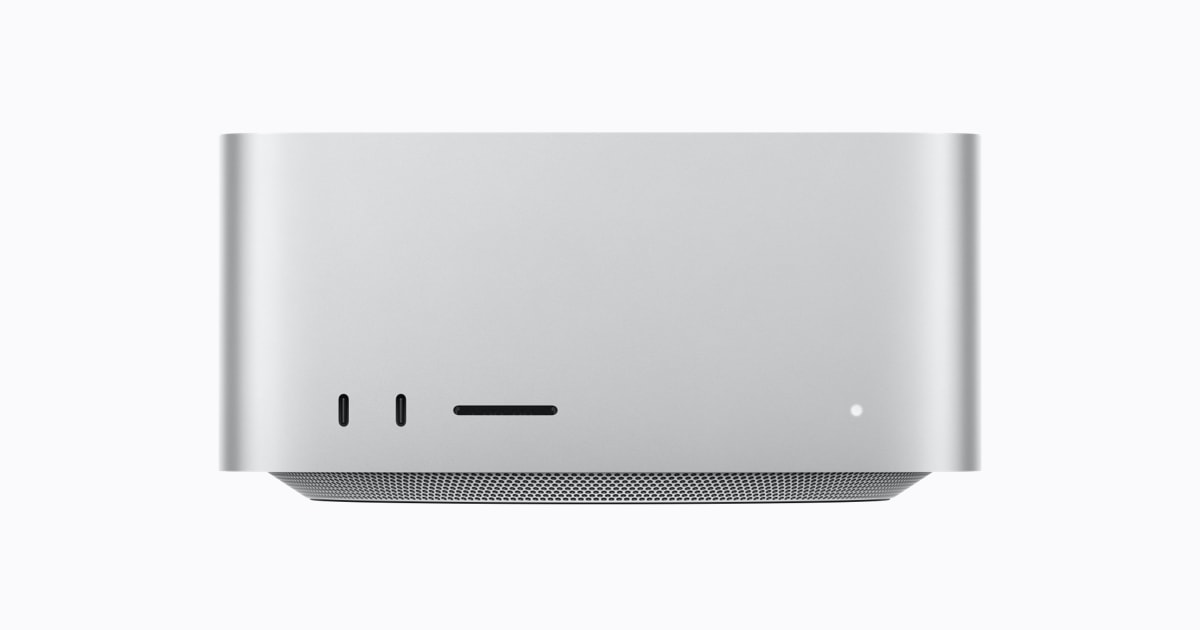
The bandwidth gap is 4.4x and the capacity gap is 4x, which is why these two boxes are not really competing. One decides whether a model fits; the other decides whether it is usable.
The Engineer · Build desk
What happened
- NVIDIA's DGX Spark is shipping now at $4,699 with 128GB of coherent LPDDR5x at 273GB/s and the full CUDA stack.
- That puts Apple roughly 4.4x ahead on memory bandwidth, 1.2TB/s against 273GB/s.
- NVIDIA's own published figure for a Llama 3.3 70B QLoRA fine-tune on DGX Spark peaks at 5,079 training tokens per second.
- Reviewers of the first DGX Spark reported a 100W cap and thermal throttling, with John Carmack naming the gap to the petaflop marketing.
Why it matters
- decision Memory capacity and bandwidth settle the buy only when the job is serving tokens. For tuning work, the software stack settles it and the memory numbers become decoration.
- cost What either box replaces is a metered cloud bill or a used-GPU build the author found unbuildable on consumer VRAM prices and electricity, so the $5,500 is bought against a recurring cost, not a...
- contradiction A 240W datasheet envelope and a reported 100W ceiling, 42 percent of it, describe different machines; until that closes, vendor throughput numbers read as peaks rather than sustained rates.
- capability For buyers who can wait on a price, half a terabyte of fast unified memory makes higher precision and long context on very large models a desk-side option rather than rented capacity.
Take the configuration both vendors point at and divide. A 200B-parameter model at 4-bit weights is roughly 100GB of memory [21], and decode produces one token at a time, with a full pass over the weights for each one [3]. That makes the memory bus a hard ceiling: 273GB/s across 100GB is about 2.7 tokens per second on DGX Spark [26], while 1.2TB/s across the same weights is about 12 [27]. Both figures sit before KV cache traffic and everything else a runtime does, so read them as the rate no benchmark will beat. NVIDIA's advertised support for up to 200 billion parameters [12] is a claim about what fits, and it holds. The quoted petaFLOP of FP4 [6] is compute for prefill and training, not for the token you are waiting on.
Price per gigabyte then crosses over. Spark is $4,699 for 128GB, or $36.71 per gigabyte [16]. The base Mac Studio is $5,499 for 96GB, or $57.28 [17], the worst ratio in the comparison. Apple's 256GB step costs $4,000 on top of base [9], so that machine lands at $9,499 and $37.10 per gigabyte [18], within about one percent of Spark [19] with the bandwidth advantage attached. The 512GB tier has no price and does not ship until late October [8], which is the part a purchase order cannot act on. Note also what the headline number actually is: 1.2TB/s is a 50 percent step over M3 Ultra's 800GB/s [22], so the ceiling moves 50 percent and the arithmetic above moves with it.
One caution on all of it. This comparison comes from a single dev.to analysis whose author states he has used neither machine and worked from Apple's newsroom, NVIDIA's datasheet and third-party DGX Spark reviews [13]. Spec sheets are precisely where sustained behaviour hides, which is what the Spark throttling reports were about.
So the jobs separate. If the work is generating tokens from a large model at a rate a person will sit through, the bus decides and there is one machine here. If the work is tuning, or anything that assumes CUDA, the spec sheet stops mattering: the inference servers people actually deploy were born on CUDA, and MLX remains Apple-only and slower to get day-one support for new open models [5]. Both boxes run off a standard wall outlet [14], so the constraint that used to settle this argument at home is gone, and the two memory numbers are what is left.
What to watch
- Apple's price for the 512GB tier, which decides whether the dollars-per-gigabyte parity found at 256GB survives above it.
- Whether shipping DGX Spark units hold the quoted 240W envelope under sustained inference, or repeat the first batch's throttling.
- Independent decode benchmarks on M5 Ultra with 200B-class models, to see how far real tokens per second falls below the bandwidth ceiling.
Clarity's read
What the record supports and how the coverage leans. The claims behind it follow.
Reality
- Evidence38
- Adoption32
- Hype gap+25
- Incentives42
- Confidence35
Claim ledger
Ranked by verification strength, evidence, and original report placement.
- [1]
Apple announced a new Mac Studio with M5 Ultra offering up to 512GB of unified memory at 1.2TB/s of memory bandwidth, starting at $5,499 with 96GB.
- [2]
Mac Studio M5 Ultra starts at $5,499 with 96GB of unified memory.
- [3]
In the decode phase of LLM inference the model generates one token at a time and every token requires a full pass over the weights; once the model is loaded, inference is almost entirely a memory-bandwidth problem.
- [4]
NVIDIA's published numbers show a Llama 3.3 70B QLoRA fine-tune hitting a peak of 5,079 tokens per second of training throughput on DGX Spark.
- [5]
Serious inference servers such as vLLM and TensorRT-LLM were born on CUDA, while Apple's MLX ecosystem is Apple-only, smaller, and slower to receive day-one support for new open models.
- [6]
NVIDIA quotes up to 1 petaFLOP of FP4 for DGX Spark.
- [7]
512GB fits vastly more than 128GB, or fits big models at higher precision with long context; Apple's pitch is that enormous LLMs run entirely on device.
- [8]
The 512GB Mac Studio configuration ships late October and Apple has not priced it.
- [9]
The 256GB memory upgrade on Mac Studio M5 Ultra costs $4,000 on top of the base configuration.
- [10]
NVIDIA DGX Spark has 128GB of coherent LPDDR5x at 273GB/s, costs $4,699, is shipping now, and runs the full CUDA stack.
- [11]
Apple's machine has roughly 4.4x the memory bandwidth of DGX Spark: 1.2TB/s versus 273GB/s.
- [12]
128GB fits a 200B-parameter model at 4-bit quantization, which is what NVIDIA advertises for DGX Spark: support for up to 200 billion parameter models.
- [13]
The author of the comparison discloses he has used neither machine and worked from Apple's newsroom, NVIDIA's datasheet and independent DGX Spark reviews.
- [14]
Both machines are desk-side boxes that run off a standard wall outlet, and neither needs a circuit upgrade.
- [15]
The author priced out running a 200B-parameter model at home without cloud tokens and found the used-GPU route dead-ending, because a card with enough VRAM either does not exist at consumer prices or breaks the budget on electricity.
- [16]
DGX Spark costs $36.71 per gigabyte of memory.
- [17]
The base Mac Studio M5 Ultra costs $57.28 per gigabyte of memory.
- [18]
A 256GB Mac Studio M5 Ultra costs $9,499, or $37.10 per gigabyte.
- [19]
At 256GB the Mac's price per gigabyte is within about one percent of DGX Spark's.
- [20]
The Mac Studio's top memory configuration holds 4x the capacity of DGX Spark.
- [21]
A 200B-parameter model at 4-bit weights is about 100GB of weights in memory.
- [22]
M5 Ultra at 1.2TB/s raises the bandwidth ceiling by 50 percent over M3 Ultra's 800GB/s.
- [23]
DGX Spark is quoted at roughly 240W maximum power draw.
- [24]
The original DGX Spark launched to complaints that it capped at 100W and thermally throttled under sustained load, with John Carmack publicly calling out the gap between the petaflop marketing and shipping performance.
- [25]
The reported 100W cap on early DGX Spark units is about 42 percent of the quoted 240W maximum.
- [26]
DGX Spark's theoretical decode ceiling on a 4-bit 200B model is about 2.7 tokens per second.
- [27]
Mac Studio M5 Ultra's theoretical decode ceiling on the same 4-bit 200B model is about 12 tokens per second.
Sources
1 independent publisher whose own reporting we read for this story.
- dev.toMac Studio M5 Ultra vs NVIDIA DGX Spark: The $5,500 Local AI Bet
1 article · August 25, 2026
Topics and entities
Follow any of these and your For You feed starts watching them — no settings page required.
Topics
Entities
- AppleFollow
- NvidiaFollow
- Mac Studio M5 UltraFollow
- NVIDIA DGX SparkFollow
- Apple M3 UltraFollow
- CUDAFollow
- MLXFollow
- TensorRT-LLMFollow
- vLLMFollow
- llama.cppFollow
- NVIDIA NIMFollow
- Llama 3.3 70BFollow
- GPT-OSS 120BFollow
- John CarmackFollow
- Level1TechsFollow
- Hardware CornerFollow
- LM StudioFollow
- Thunderbolt 5Follow
- Core MLFollow