Invest1 publisher3 min readPublished
Seoul's 73,000-home promise now runs through the Gangnam greenbelt
Most sites for the public housing units held back on Aug. 13 sit in protected land near Gangnam, Songpa and Hanam. The ministry says it will name candidate locations by early October.
The Investor · Invest desk
Drafted by a language model from the sources cited here and checked against its claim ledger before publication. How we use AISend a correction
What happened
- Most of the sites for 73,000 new public housing units, held back under the government's Aug. 13 housing measures, have been confirmed to fall within greenbelt zones in the greater Seoul area.
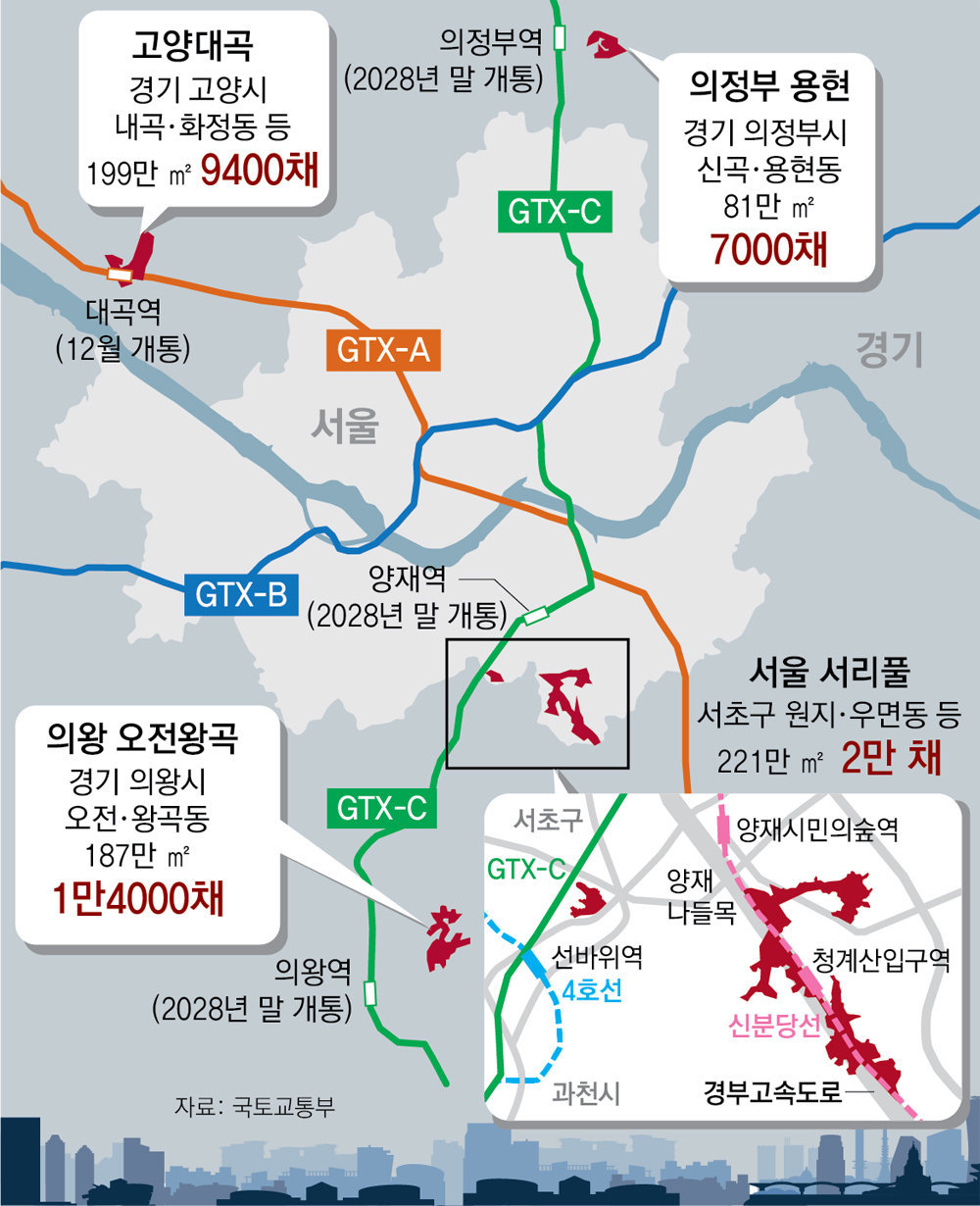
- Cited likely candidate sites include the Suseo rail depot, the Segok and Jagok neighborhoods of Gangnam District, the Bangi neighborhood of Songpa District, and the Gambuk and Choi neighborhoods of Hanam.
- MOLIT plans to announce sites in stages, starting with volumes for which consultations with local governments are complete.
- MOLIT plans to disclose candidate locations as early as early October, and by early October at the latest.
- The entirety of Yongsan Park is also under review as a site for supply in the city center.
Compiled by The InvestorSomething wrong?How this is made
Why it matters
The volume the Korean government withheld from its Aug. 13 housing measures has a location, and it is the politically hardest one available: most of the sites for 73,000 new public housing units fall inside greenbelt zones in the greater Seoul area [1]. The Ministry of Land, Infrastructure and Transport plans to announce sites in stages, starting with volumes where consultations with local governments are already complete, and to disclose candidate locations as early as early October [3][4].
The shortlist is specific enough to trade on. Cited candidates include the Suseo rail depot, the Segok and Jagok neighborhoods of Gangnam District, the Bangi neighborhood of Songpa District, and the Gambuk and Choi neighborhoods of Hanam [2]. The entirety of Yongsan Park is also under review as a city-centre supply site [5]. That is the substance of the choice: rather than push volume to the outer ring where land is cheap and politics are quiet, the ministry has gone to the most expensive perimeter in the country, where the landowners are organised and the protected-land designation is the reason the parcels are still empty.
Speed is the stated compensation. MOLIT says it will apply a fastest-track model that cuts the construction period to 37 months from the current 68 [6], a reduction of 31 months, or about 46 percent [7], with the goal of stabilising prices by building up latent demand [8]. Treat the 37-month figure as an ambition until a first shovel confirms it; nothing in the announcement changes the sequence in which greenbelt release, compensation and litigation normally arrive.
The demand side is moving the other way at the same time, which is the part operators should price. Bank of Korea Deputy Governor Yoo Sang-dae has said an additional rate hike is highly likely [9], and a Citi economist projects the base rate reaching 3.5 percent after quarter-point hikes in August and November and one more early next year [10]; some observers see 3.5 to 3.75 percent early next year [11]. From next year the Financial Services Commission will apply risk weights up to four times higher on mortgages for high-value homes and require an extra 1 percent of capital from each bank if household debt exceeds 80 percent of GDP [12], a burden the report puts at 10 trillion won ($7.2 billion) for the banking sector next year and likely to be passed through in mortgage pricing [13]. Jeonse loans for non-resident single-home owners in the greater Seoul area and regulated zones will be banned outright next year, potentially pushing about 9.3 trillion won ($6.7 billion) across 90,000 loans into mortgage demand [14], roughly 103 million won per loan [15].
Rates are already resetting. KB Kookmin Bank lifted its fixed-then-floating mortgage rate to 5.19 percent from 4.75 percent [16], a 0.44 point move [17], and floating rates at the five major banks now run from 4.09 to 5.69 percent [18]. Borrowers who took fixed-then-floating loans in July 2021 face increases of at least 0.5 to 0.8 point at reset [19]; Shinhan's jeonse rate rose 0.7 point to 4.51 percent at renewal [20], and home-purchase loan rates at secondary lenders such as Hyundai Capital have jumped by up to 1.9 points in a month [21].
Watch the October disclosure for two things: how much of the 73,000 arrives with local-government consultation genuinely finished [3], and whether Yongsan survives review as a supply site rather than a park [5]. Everything in the named districts will have repriced before the map is published.