InvestNot yet confirmed elsewhere1 publisher3 min readPublished
Korea's foreign tourists spend 22% more a head in a trade that ranks 109th on high-wage jobs
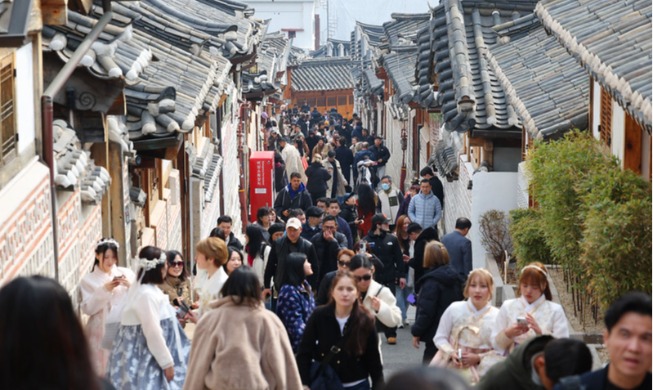
Foreign tourists' card spending in South Korea rose 48.5% to 14.018 trillion won in the first eight months, outpacing a 21.6% rise in arrivals. Each visitor now spends about 22% more, and the money passes a domestic travel trade that ranks 109th of 110 economies on high-wage jobs and loses many bookings to global platforms.
The Investor · Invest desk
Card spending per foreign arrival in South Korea rose from about 763,000 won a year earlier to about 931,000 won in the first eight months of this year, an increase of about 22%.
| Measure | Value | As of | Claim |
|---|---|---|---|
| Year earlier, first eight months | 763,000 won per arrival | 21 | |
| This year, first eight months | 931,000 won per arrival | 20 |
What happened
- Korea placed 12th of 110 economies in the World Economic Forum's 2025 Travel and Tourism Development Index, up one place from 13th.
- On the same index, Korea ranked 69th on labor productivity in accommodation and food services, a measure of value added per worker.
- Hanatour, Korea's largest travel agency, takes in about 600 billion won a year, while Japan's JTB books 10 trillion to 12 trillion won, roughly 17 to 20 times as much.
- A sizable share of foreign visitors book through global sites such as Booking.com before arriving, so the commission and the visitor data go to those platforms.
Why it matters
- cost For visitors who book through Booking.com and its peers, Korean agencies lose the commission and the customer data they would need to sell those visitors the K-beauty, K-food and K-content products Sedaily says the trade must build.
- constraint Arrivals growth alone can clear 30 million, so the government can meet its 2028 target while most travel agencies still employ fewer than 10 people.
- decision The government now has to choose whether tourism companies get manufacturing-style tax support and fund-raising programs, as Sedaily proposes, at a point when visitor numbers no longer need public money to grow.
Divide the 14.018 trillion won of card spending [2] by 15.05 million arrivals [1] and each foreign visitor put about 931,000 won on cards in eight months [20]. Working last year's base back out of the two growth rates gives roughly 763,000 won a head [21]. So Korea is getting more money from each visitor, on top of more visitors [21]. Sedaily's editorial on the figures still calls the boom "impressive on the outside, hollow within" [25].
Both can be true. Card spending counts what visitors pay. The margin goes to whoever sold the trip, and a sizable share of visitors buy theirs from a global site such as Booking.com [24]. Trip.com's revenue has topped 14 trillion won, roughly what foreign tourists have spent in Korea so far this year [12]. That revenue is more than 23 times Hanatour's and about 20 times the 700 billion won at the leisure platform Nol Universe [23] [9].
The domestic trade was built to send Koreans abroad. Even the large agencies earn commissions arranging airline tickets and lodging [13]. Most have fewer than 10 employees and live on cut-price package tours and shopping commissions [14]. Of roughly 23,000 travel companies, a substantial share employ one or two people, according to the industry [10]. Sedaily says this structure explains Korea's 109th-of-110 place on the share of high-wage tourism jobs [18] [5], and we agree. A one- or two-person firm paid a fee per booking has little room to pay more. The other job-quality scores are low as well: Korea comes 88th for its practices on hiring and dismissal, 80th for equality of opportunity in employment and 75th for the rights of workers [7].
Government funding has lagged too, and tourism has sat well down the list of policy priorities, the editorial says [17]. Korea comes 76th for how much of its public spending goes to tourism and 47th for its tourism policy and the conditions in place to support the trade [15]. Sedaily wants tax support and fund-raising programs on a par with manufacturing [16]. The 2028 visitor target [3] does not depend on that money. Run the eight-month total forward in a straight line and this year ends near 22.6 million arrivals, a crude figure that ignores seasonality [26]. Two more years at 21.6% would take that to about 33.4 million [27].
The likeliest path has arrivals clearing 30 million while foreign platforms keep the booking margin and Korean agencies stay small. The other possibilities are that a domestic platform at Nol Universe's scale wins a bigger share of inbound bookings, or that the state funds consolidation on manufacturing terms. We expect the first, because the record shows no Korean firm winning inbound share. The counter-case is that card spending is money spent inside Korea whoever took the booking fee [12]. If so, the commission that goes abroad could be a small slice of the 14.018 trillion won, and Sedaily does not put a number on it. If Korean agencies' inbound revenue started growing at anything near the 48.5% pace of visitor spending [2], we would be wrong.
What to watch
- Korea's rank on the share of high-wage tourism jobs in the next WEF Travel and Tourism Development Index, against 109th of 110 now.
- Whether the government extends manufacturing-level tax support and fund-raising programs to tourism companies and travel startups.
- Full-year arrivals against the roughly 22.6 million straight-line pace implied by the first eight months.
Clarity's read
What the record supports and how the coverage leans. The claims behind it follow.
Reality
- Evidence55
- Adoption
- Insufficient
- Hype gap+10
- Incentives
- Insufficient
- Confidence50
Claim ledger
Ranked by verification strength, evidence, and original report placement.
- [1]
Foreign arrivals to South Korea reached 15.05 million in the first eight months of this year, up 21.6% from a year earlier, according to the Ministry of Culture, Sports and Tourism.
- [2]
Card spending by foreigners on tourism over the same eight months rose 48.5% to 14.018 trillion won.
- [3]
The government initially set a target of 30 million foreign tourists by 2030, then moved it forward two years to 2028.
- [4]
In the World Economic Forum's 2025 Travel and Tourism Development Index, Korea ranked 12th overall among 110 economies, up from 13th in the previous edition.
- [5]
Korea placed 109th of 110 on the share of high-wage jobs in the tourism industry in the WEF index.
- [6]
Labor productivity in accommodation and food services, a measure of value added per worker, ranked 69th in the WEF index.
- [7]
Korea ranked 88th on hiring and firing practices, 80th on equal employment opportunity and 75th on workers' rights in the WEF index.
- [8]
Annual revenue at Hanatour, Korea's largest travel agency, is about 600 billion won.
- [9]
Leisure platform Nol Universe posts roughly 700 billion won in revenue.
- [10]
Of the roughly 23,000 travel companies in Korea, a substantial share employ just one or two people, according to the industry.
- [11]
JTB, Japan's leading travel agency, brings in annual revenue of 10 trillion to 12 trillion won.
- [12]
Revenue at Trip.com has topped 14 trillion won, roughly equal to what foreign tourists have spent in Korea so far this year.
- [13]
Korea's tourism industry has long concentrated on brokering commissions on outbound travel; even large agencies lean on a commission model built on arranging airline tickets and lodging.
- [14]
Most Korean travel agencies are small outfits with fewer than 10 employees that have relied on cut-price package tours and shopping commissions.
- [15]
In the WEF assessment, Korea ranked 76th on the share of government spending devoted to tourism and 47th on tourism policy and enabling conditions.
- [16]
Sedaily says tax support and fund-raising programs for tourism companies on a par with those for manufacturing deserve consideration.
- [17]
Government funding for tourism has lagged, and tourism has sat well down the list of policy priorities.
- [18]
Sedaily says a look inside Korea's tourism ecosystem, with its small firms, explains the low WEF rankings on job quality and productivity.
- [19]
Sedaily says Korean travel companies must develop high-value travel products built around K-beauty, K-food and K-content and win back the inbound market from global online travel agencies.
- [20]
Foreign card spending per arrival in the first eight months was about 931,000 won.
- [21]
A year earlier, spending per arrival was about 763,000 won, so spending per visitor rose about 22%.
- [22]
JTB's annual revenue is roughly 17 to 20 times Hanatour's.
- [23]
Trip.com's revenue is more than 23 times Hanatour's and about 20 times Nol Universe's.
- [24]
A sizable share of foreign visitors book through global online travel agencies such as Booking.com before coming to Korea, and both the commission income and the visitor data pass to the global platforms.
- [25]
"impressive on the outside, hollow within"
- [26]
A straight-line annualisation of eight months of arrivals gives about 22.6 million for the year, ignoring seasonality.
- [27]
Two more years of 21.6% growth on a 22.6 million base would reach about 33.4 million arrivals, above the 30 million target.
Sources
1 independent publisher whose own reporting we read for this story.
- en.sedaily.comKorea's Tourism Boom Masks a Cottage-Industry Travel Sector
1 article · October 11, 2026
Topics and entities
Follow any of these and your For You feed starts watching them — no settings page required.
Topics
- Online travel agenciesFollow
- Tourism labour marketFollow
- South Korea inbound tourismFollow
Entities
- Ministry of Culture, Sports and TourismFollow
- World Economic ForumFollow
- Travel and Tourism Development IndexFollow
- HanatourFollow
- Nol UniverseFollow
- JTBFollow
- Trip.comFollow
- Booking.comFollow