Invest1 publisherNot yet confirmed elsewhere3 min readPublished
Korea blocks nearly a full year's worth of fake cosmetics listings in eight months
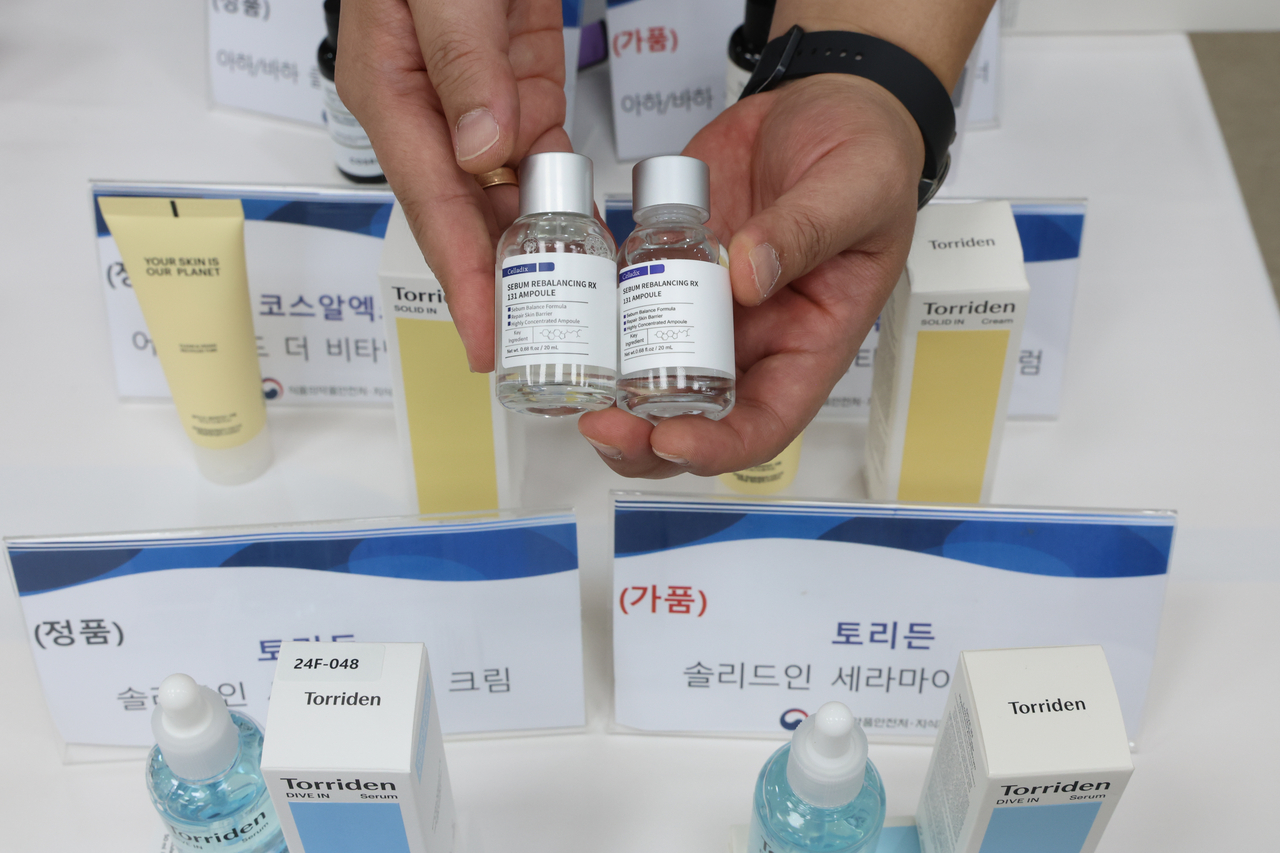
Korea's IP ministry blocked 37,544 fake Korean cosmetics listings in this year's first eight months, nearly matching last year's 39,295. IP specialists say the copies are now made in China for export, so takedowns of retail listings reach that trade only at its last step.
The Investor · Invest desk
What happened
- Blocked listings for fake Korean cosmetics in Europe rose from 145 last year to 2,224 this year, the sharpest increase of any region in the ministry's data.
- One factory raided in Guangxi held about 100,000 fake products, according to Mun Byung-hoon of the counterfeit-tracking firm IP Space.
- Korean brands hold 4% of China's cosmetics market and local labels more than half, according to a Chinese cosmetics industry association.
Compiled by The InvestorSomething wrong?How this is made
Why it matters
- exposure Counterfeiters now copy globally popular indie labels, so a Korean brand's overseas growth makes it a larger target for fakes built for export.
- constraint Because contents, containers and boxes come from separate suppliers in shared clusters, a raid on one factory takes out one supplier and leaves the assembler free to buy from the next.
- decision Brands with no China sales have to choose between funding monitoring and raids inside China, where the goods are made, and paying for takedowns one foreign platform at a time.
If the first eight months are carried forward, the ministry is on course for about 56,300 blocked listings this year, some 43% above last year [18]. That assumes the last four months match the monthly rate so far. Southeast Asia accounts for 21,266 of this year's blocks, or 56.6% [5]. Europe is about 6% of the total, but its count is roughly fifteen times last year's [19].
A blocked listing is a count of enforcement, and a rising count fits two readings. In one, more fakes are reaching the platforms. In the other, the ministry and the brands are searching harder or in more places, and Europe's climb from a small base is the figure most open to that reading [6]. The ministry's data, submitted to Rep. Baek Jong-hean of the People Power Party, do not separate the two [2]. The case that enforcement is falling behind weakens if most of the rise traces to wider monitoring. Korea JoongAng Daily, which reported the figures, wrote that the brands' stepped-up efforts "may amount to just a drop in the bucket" [21].
The physical counts favour the first reading. Korea Customs Service put cosmetics at 35.9% of the counterfeit Korean-brand items it seized at the border last year [7], or about 42,000 items [20]. The one Guangxi factory Mun described held roughly 2.4 times that [22]. Raids that once turned up 2,000 to 3,000 items now often run into the tens of thousands, Mun said at a Korea Cosmetic Association webinar [10].
Mun described production split across suppliers. "There are places that make boxes, places that make containers and places that make the contents, all divided up, and a central player that puts them together into the finished product," he said [12]. The suppliers sit in clusters in Guangdong, Shenzhen, Guangzhou and other large Chinese cities [11]. "Guangdong has the containers, the contents and the logistics all in one place," he said in an interview. "If someone sets their mind to it, they can copy any brand." [13]
Then there is the cash. Yang Hye-yun, who heads the IP team at Logos Law Firm, said the goods trade through sites like 1688, Alibaba's Chinese wholesale marketplace, and "go to open-market sellers in Southeast Asia, Europe and the United States" [4]. I think this is where the money and the enforcement separate. The counterfeiter is paid when a bulk lot sells at wholesale. The ministry's blocks land later, on individual listings on retail platforms at home and abroad [1].
The product line has followed the buyers. "Now they are being counterfeited for export, built around overseas sales from the production stage," Yang said. "Now it has expanded to globally popular indie labels such as Ma:nyo." [14]
Mun, who used to lead Amorepacific's China IP team, said many Korean beauty brands with no sales in China regard counterfeits produced there as a matter for others to deal with [15]. "But those fakes are not made for the Chinese market," he said. "They end up on Amazon in the United States and Shopee in Brazil." [16]
What to watch
- Whether the ministry's full-year figures separate listings found on newly monitored platforms and countries from those on platforms it already covered.
- Whether Europe's blocked-listing count keeps climbing next year from this year's level.
- Whether Korean brands that have stayed out of China start paying for raids in the Guangdong clusters.
Clarity's read
What the record supports and how the coverage leans. The claims behind it follow.
Reality
- Evidence60
- Adoption
- Insufficient
- Hype gap+10
- Incentives55
- Confidence62
Claim ledger
Ranked by verification strength, evidence, and original report placement.
- [1]
Korea's Ministry of Intellectual Property blocked 37,544 online listings for counterfeit Korean cosmetics on domestic and overseas platforms in the first eight months of this year, just shy of last year's full-year total; blocked listings have risen steadily since 2023.
ReportedSupportedSource: Korea JoongAng Daily, citing ministry data2 sources— create a free account to open themView cited source - [2]
The Ministry of Intellectual Property blocked 39,295 listings for counterfeit cosmetics on domestic and overseas platforms last year, according to data submitted to Rep. Baek Jong-hean of the People Power Party.
ReportedSupportedSource: Korea JoongAng Daily, citing data submitted to Rep. Baek Jong-hean2 sources— create a free account to open themView cited source - [3]
"Counterfeits are traded on Chinese business-to-business (B2B) platforms at a tenth of the genuine price," said Yang Hye-yun, head of the IP team at Logos Law Firm.
ReportedSupportedSource: Yang Hye-yun, Logos Law Firm2 sources— create a free account to open themView cited source - [4]
Yang said counterfeits are traded on sites like 1688, Alibaba's Chinese wholesale marketplace, and "go to open-market sellers in Southeast Asia, Europe and the United States".
ReportedSupportedSource: Yang Hye-yun, Logos Law Firm2 sources— create a free account to open themView cited source - [5]
Of the 37,544 listings blocked this year, 21,266, or 56.6 percent, were in Southeast Asia.
- [6]
Europe saw the sharpest rise in blocked listings, from 145 last year to 2,224.
- [7]
The Korea Customs Service seized 117,005 counterfeit Korean brand items at the border last year, with cosmetics the largest category at 35.9 percent.
- [8]
Of the 117,005 counterfeit Korean brand items seized by the Korea Customs Service last year, 97.7 percent were shipped from China.
- [9]
One factory raided in Guangxi held about 100,000 fake products, according to Mun Byung-hoon, CEO of IP Space, a Korean firm specializing in tracking down counterfeit goods.
- [10]
A single seizure in China used to involve 2,000 to 3,000 items but now often runs into the tens of thousands, Mun said in a webinar hosted by the Korea Cosmetic Association in January last year.
- [11]
Counterfeit production is split among separate suppliers for contents, containers and boxes and concentrated in manufacturing clusters in Guangdong, Shenzhen, Guangzhou and other large Chinese cities, making raids on individual factories insufficient to tackle the broader problem.
- [12]
"There are places that make boxes, places that make containers and places that make the contents, all divided up, and a central player that puts them together into the finished product,"
- [13]
"Guangdong has the containers, the contents and the logistics all in one place," ... "If someone sets their mind to it, they can copy any brand."
- [14]
"Now they are being counterfeited for export, built around overseas sales from the production stage," ... "Now it has expanded to globally popular indie labels such as Ma:nyo"
- [15]
Many Korean beauty brands that do not sell in China treat fakes made there as someone else's problem, said Mun, who previously led Amorepacific's China IP team.
- [16]
"But those fakes are not made for the Chinese market," ... "They end up on Amazon in the United States and Shopee in Brazil."
- [17]
Korean brands account for 4 percent of China's cosmetics market, while local labels occupy more than half of it, according to the China Association of Fragrance, Flavor and Cosmetic Industries.
ReportedSupportedSource: China Association of Fragrance, Flavor and Cosmetic Industries, via Korea JoongAng DailyView cited source - [18]
At the eight-month pace, blocked listings would reach about 56,300 this year, roughly 43% above last year's 39,295.
- [19]
Europe's 2,224 blocked listings are about 5.9% of this year's 37,544 and about 15.3 times last year's 145.
- [20]
Cosmetics seized by Korea Customs Service last year came to about 42,000 items.
- [21]
Korean cosmetics companies are stepping up efforts to protect their brands against fakes, but their efforts "may amount to just a drop in the bucket."
- [22]
The single raided Guangxi factory held roughly 2.4 times the counterfeit cosmetics Korea Customs Service seized at the border in a year.
Sources
1 independent publisher whose own reporting we read for this story.
- koreajoongangdaily.comInside the China counterfeit trade taking K-beauty for a ride
1 article · October 8, 2026
Topics and entities
Follow any of these and your For You feed starts watching them — no settings page required.
Topics
Entities
- Ministry of Intellectual Property (South Korea)Follow
- Korea Customs ServiceFollow
- IP SpaceFollow
- Mun Byung-hoonFollow
- Logos Law FirmFollow
- Yang Hye-yunFollow
- WegofairFollow
- Kim Jong-myunFollow
- AlibabaFollow
- 1688Follow
- AmorepacificFollow
- ShopeeFollow
- AmazonFollow
- Ma:nyoFollow
- China Association of Fragrance, Flavor and Cosmetic IndustriesFollow
- Baek Jong-heanFollow
- Korea Cosmetic AssociationFollow