Science1 publisher2 min readPublished
Engineered E. coli show that microbe-made putrescine lengthens fruit-fly life
Researchers in Japan engineered gut E. coli to make or withhold putrescine, and the producing strains raised male fly lifespan to 13.8 days from 11.0. The design isolates a microbial metabolite as a cause, though the effect broke down in females.
The Scientist · Science desk
What happened
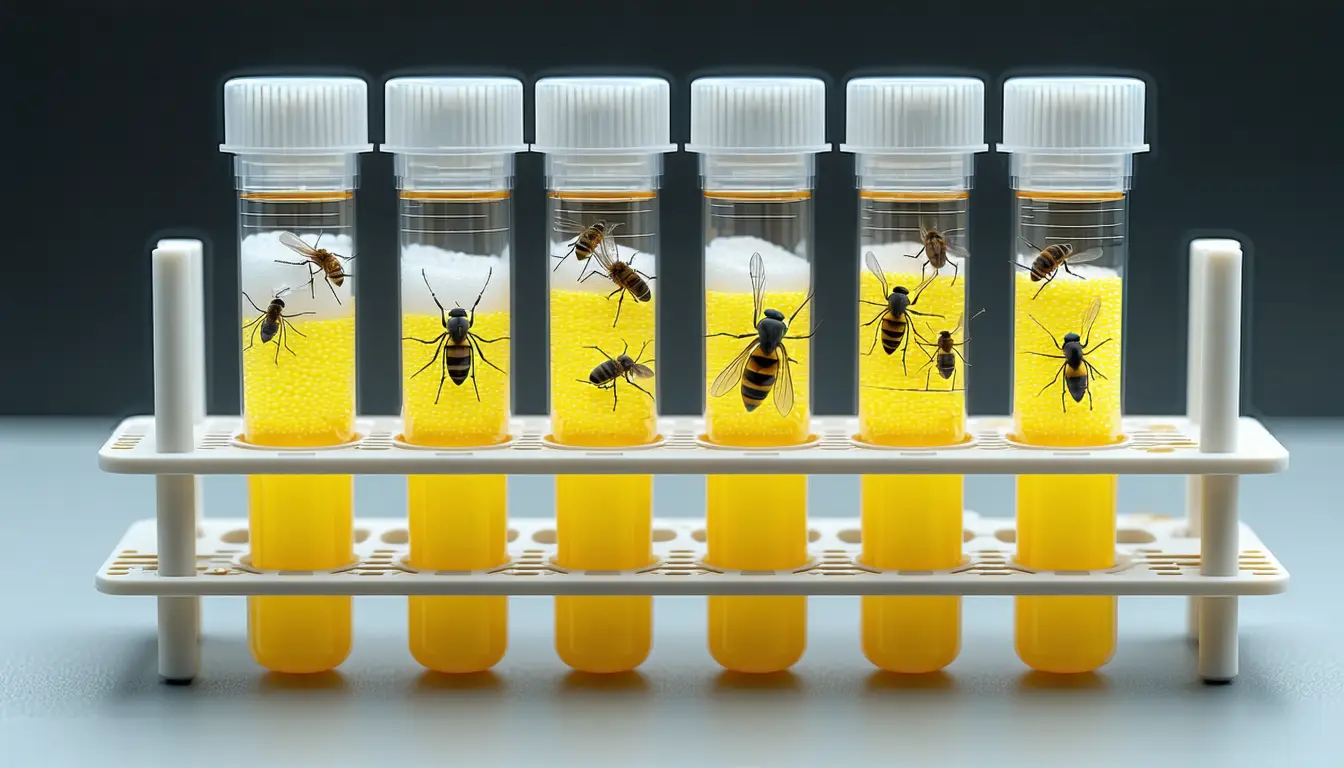
- To isolate a single microbial metabolite, the team raised germ-free flies and colonized them with E. coli engineered either to make putrescine or to lack it, all on a polyamine-free diet.
- Germ-free flies fed putrescine or spermidine lived 20.8 and 21.1 days on average, longer than the 18.2 days of flies kept on a polyamine-free control diet.
- Flies carrying the putrescine-making strains SK929 and SK931 accumulated the metabolite at about 1.2 and 1.3 nmol/mg, while it stayed below detection in flies carrying the knockout strain SK930.
- Males carrying the two putrescine-making strains lived 13.8 and 12.6 days, both significantly longer than the 11.0 days of males carrying the knockout.
Compiled by The ScientistSomething wrong?How this is made
Why it matters
- capability Toggling one gene in a gut bacterium while holding the diet and the rest of the microbiome constant lets a lab attribute a lifespan change to that single metabolite.
- constraint The clean causal story holds for males; because the complemented strain failed to lengthen female lifespan, the study cannot claim putrescine extends life regardless of sex.
- precedent The swap-in, swap-out bacteria give a template for testing the effect of any single microbial metabolite on host physiology, not just polyamines.
The strongest causal test is one strain, SK931. The team built it by putting back the three putrescine-biosynthesis genes it had deleted to make the knockout SK930, so the two bacteria differ only in whether they can make putrescine [7]. If restoring the genes restores lifespan, putrescine is responsible and not some side effect of the deletion. In males it worked: flies carrying SK931 and the wild-type SK929 both outlived flies carrying the knockout [10]. In females it did not. SK929 females outlived the control, but the complemented SK931 gave the shortest average lifespan of the three groups [11].
The flies did more than harbor what the bacteria made. Putrescine appeared in the bodies of flies carrying the producing strains and stayed below detection in flies carrying the knockout, while spermidine turned up in all three groups [8][9]. Flies synthesize their own spermidine, so finding it everywhere is expected; the surplus putrescine in the colonized producers is the sign that the host absorbed the bacterial metabolite and converted some of it onward [9].
Measured against the polyamine-free control, the wild-type strain raised male lifespan by about a quarter [14]. The dietary arm points the same way, with fed flies outliving unfed controls by roughly 14 and 16 percent [15].
What produced the gain is less settled. Flies exposed to the producing bacteria showed lower expression of two genes, TotM and Halo; TotM feeds the JAK/STAT stress pathway that rises with age, so damping it could help, though the authors call the mechanism unclear [12]. The work is in flies. It does not test whether a bacterium engineered to make putrescine would extend a mammal's life.
Pinning a lifespan change on one microbial metabolite had been hard, because the many metabolites bacteria export cross into host tissue together [16]. "Polyamines, including putrescine and spermidine, are known gut microbial metabolites associated with improved biological functions and lifespan extension. We wanted to understand whether polyamines produced specifically by gut bacteria can directly influence the lifespan of a host, independent of polyamines obtained from the diet," Kurihara said [4]. He described the method as general-purpose: "This experimental approach allows us to examine how individual metabolites produced by gut bacteria influence the lifespan of the host," Kurihara said [13].
What to watch
- Whether the putrescine effect reproduces in mammals, where lifespan and the microbiome are far more complex than in gnotobiotic flies.
- Why the complemented strain rescued male but not female lifespan, and whether dose or sex differences explain the split.
- Whether lowering TotM and JAK/STAT signaling causes the longer life or merely accompanies it.