Science1 publisher3 min readPublished
Mangrove carbon credits pay only for the carbon a restored forest stores
Pakistan's 350,000-hectare Indus delta mangrove project turns a growing forest into carbon credits for distant companies. The storm shelter and fish nurseries it gives 60 villages have no market of their own, a gap the analysis expects to surface at COP31 in Antalya.
The Scientist · Science desk
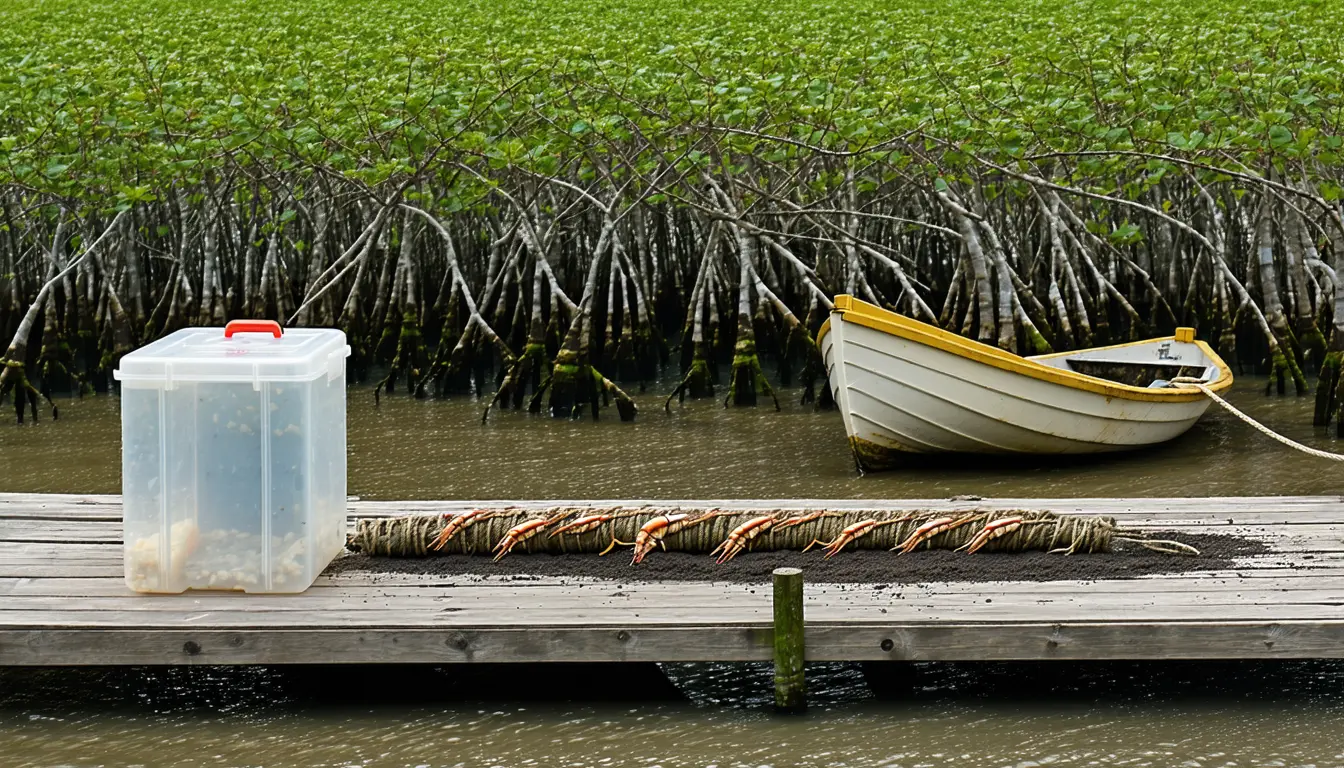
What happened
- Mangrove projects earn credits as a growing forest absorbs carbon, with each credit equal to a set amount of carbon that companies pay for.
- Of 47 carbon-credit project documents reviewed by the nonprofit Carbon Market Watch, 15 mentioned benefit sharing and four showed evidence of it reaching local or Indigenous communities.
- Only a tenth of carbon-market intermediaries disclose what profits they make, according to the analysis.
- At COP30 last year, governments called for adaptation finance from wealthy countries to at least triple by 2035.
Compiled by The ScientistSomething wrong?How this is made
Why it matters
- decision A company buying mangrove credits that insists on documented benefit sharing would have to turn away most projects: about 91% of the Carbon Market Watch sample showed no evidence of it.
- constraint Because so few intermediaries publish their profits, nobody outside the chain can calculate how much of a credit's price ends up in a village.
- precedent If a tripled adaptation budget is routed through the channels built for carbon, the authors expect it to reach what can be measured and traded, leaving storm protection and fish habitat underfunded.
Carbon Market Watch's review narrows fast. Four documents in 47 is about 8.5% [1], and four of the 15 that raised benefit sharing at all is about 27% [2]. For a buyer, the project document is usually the main record of where money went. The thing this doesn't tell you is whether the other 43 projects [3] shared nothing or simply wrote nothing down.
Each credit equals a set amount of carbon stored or kept out of the air [2], and only that sellable value has a market built around it [5]. What residents get from the forest is storm protection, fish nursery habitat, wood, honey and thatch [4]. A carbon score does not track those. The analysis describes how the two can come apart: dredged channels and replanting in tidy single-species blocks can produce a forest that "scores well on a monitoring form" but no longer resembles the one people knew how to live in [12].
The ecology points the same way. A 2021 global analysis of 88 mangrove restoration studies found that restored forests often recover fewer ecological functions than comparable natural forests, and the authors add that the wait can impose real short-term costs on communities living alongside them [14]. Those costs are specific. Protecting stored carbon can mean closing a fishing ground, and planting for biodiversity can mean species that yield no firewood or fruit [11]. The authors describe costs that are "immediate, local and certain" set against benefits that are "deferred, distant and uncertain" [13]. Between buyer and village sits a chain of verifiers, brokers, aggregators and certifiers, each taking a share first [8].
On the Indus delta itself, the evidence is thinner than the argument. The article uses the project to set the two kinds of value side by side [1][5]. It does not report the project's benefit-sharing terms, who earns from its credits, or what residents have given up. The Carbon Market Watch counts cover credit projects in general and cannot be read as a verdict on this one [10].
The authors argue that local knowledge should help decide which species are planted where. They cite the Sundarbans of India and Bangladesh, where stories of the forest guardian Bonbibi protect those who enter out of need and punish those who come out of greed [16]. Where that knowledge is sidelined, researchers have described the result as green colonialism, the article says [16].
At COP31 the question is adaptation money. In the authors' account, a decade of climate finance has built channels that run "toward whatever can be measured, traded and exported," and adaptation money poured in will come out where those channels already exist [15]. In my view the credit data support the first half of that claim well, because carbon value is documented and community benefit mostly is not [1]. The second half is a forecast. Whether a tripled adaptation budget [7] follows the carbon route depends on how it is channelled, which the authors expect COP31 in Antalya to address [6].
What to watch
- Whether COP31 in Antalya sets rules that route tripled adaptation finance outside carbon-credit channels.
- Publication of the Indus delta project's benefit-sharing terms, or independent data on what its 60 villages receive.
- Wider profit disclosure by verifiers, brokers and certifiers, which would let the share reaching communities be calculated.