Science2 distinct publishers2 min readPublished
UC San Diego's cryo-EM structures show E. coli's transcription enzyme accepting hachimoji letters, with a companion paper finding it needs no hydrogen bonds to do so. Neither experiment happened inside a living cell.
The Scientist · Science desk

Compiled by The ScientistSomething wrong?How this is made
The mechanism sits in a moving part of the enzyme. The title of the companion paper in PNAS carries it plainly: a hydrophobic unnatural base pair promotes trigger loop closure and catalysis in cellular RNA polymerase, independent of hydrogen bonding [5]. The trigger loop is the enzyme's mobile element, and the paper couples its closure to the chemistry that follows; the reported result is that a pair with no hydrogen bonds between its two halves still gets that closure [5][6]. Geometry, on this reading, was sufficient.
Hachimoji is the name of the alphabet in the Nature Communications paper [2], and the count follows simple arithmetic: the four natural letters, plus two synthetic pairs contributing two letters each, make eight [13].
The load-bearing word in both write-ups is "accurately" [1]. Neither reports an error rate, a kinetic comparison, or a yield measured against a natural template [14]. A structure shows how a complex is arranged in the moment it was caught doing the right thing, without indicating how often the enzyme does the wrong thing, and for a diagnostic built on an expanded alphabet [9] the misincorporation frequency is the number that decides feasibility.
Both papers concern transcription, which the researchers describe as the first step in gene expression [7]. That is a defensible place to start, because transcription is where a host enzyme first meets the new letters. But nothing in these two accounts follows an eight-letter template further down the expression path, or into a living cell [14]. The enzyme-compatibility question and the living-cell question are not the same question, and only the first one has an answer here.
The two publisher accounts also trace back to the same source. ScienceDaily notes that its materials were provided by UC San Diego and originally written by Lizelda Lopez [10], and the phys.org version reports the same two studies and the same findings, credited to the same group [11]. The ScienceDaily summary calls the enzyme's handling of the synthetic letters surprisingly similar to its handling of natural ones [12], which is the university's characterisation, not an independent assessment.
What the imaging supplies is a picture of which contacts the enzyme actually reads [4], from cryo-electron microscopy resolving detail below the width of a single atom [3]. Read narrowly, the finding is that one bacterial enzyme treats eight letters much as it treats four [1][4], and that holds for this enzyme under these conditions rather than for a cell [14].
Ranked by verification strength, evidence, and original report placement.
Researchers at UC San Diego demonstrated that RNA polymerase can accurately read and transcribe an eight-letter genetic alphabet, doubling the four letters used by all known life on Earth.
The Nature Communications study, titled "Structural basis of transcription of the hachimoji eight-letter alphabet by E. coli RNA polymerase", was published on Sept. 2, 2026 and led by Dong Wang, PhD, professor at the UC San Diego Skaggs School of Pharmacy and Pharmaceutical Sciences.
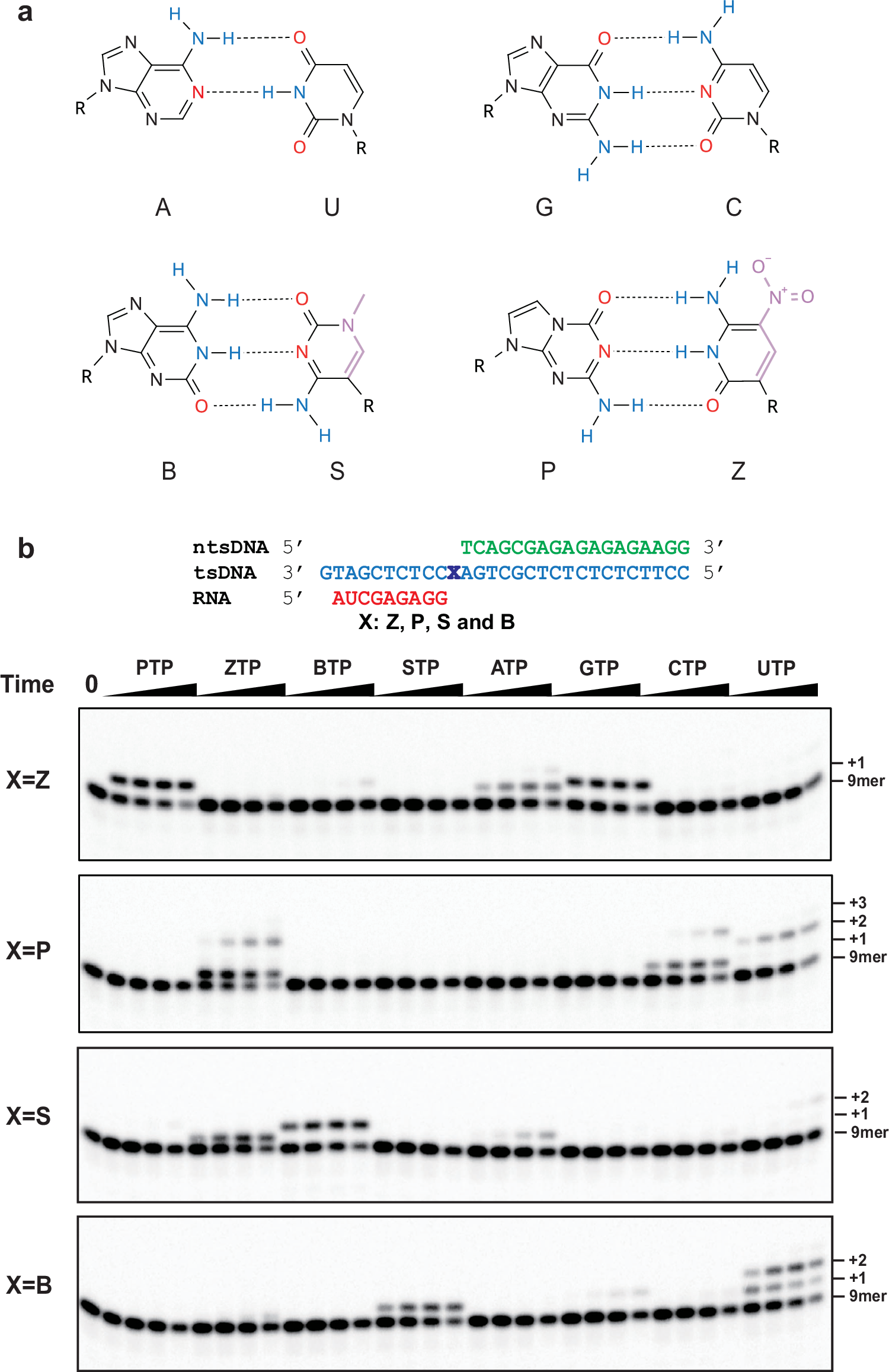
The team combined biochemical experiments with high-resolution cryo-electron microscopy capable of resolving structures at scales smaller than the width of a single atom, capturing E. coli RNA polymerase as it recognized and incorporated two synthetic base pairs that are not found in nature.
The structural snapshots showed that the enzyme recognizes the synthetic DNA letters through the same biochemical and structural signals it uses for natural base pairs, which the authors offer as an explanation for faithful transcription of expanded genetic information.
A related study by the same team, "Hydrophobic unnatural base pair promotes trigger loop closure and catalysis in cellular RNA polymerase independent of hydrogen bonding", was published in PNAS on Aug. 12, 2026 and also led by Wang.
In the PNAS study the researchers found that RNA polymerase can also recognize another pair of synthetic base pairs even though those pairs lack the hydrogen bonds that normally help hold DNA base pairs together.
Distinct publishers with included, body-backed reporting in this cluster.
1 article · September 2, 2026
1 article · September 4, 2026
Follow any of these and your For You feed starts watching them — no settings page required.
science
Transcription caught mid-act in fly embryos, and it does not match the test tube1 distinct publisher
science
Liquid crystals squeeze growing bacterial colonies into single-file chains1 distinct publisher
security
Sixteen of 285 AI-Designed Phages Were Viable, and Screening Moves to the Synthesis Order1 distinct publisher
science
Church's lab frees 14 codons by rewriting the ribosome's lock instead of the genome2 distinct publishers
Evidence-backed comparisons of source perspectives and observed adoption signals. Read the methodology
Which Builder, Operator, and Investor concerns the observed source mix emphasized—not a truth score.
Evidence, demonstrated adoption, hype gap, incentives, and confidence are assessed independently, each on its own current evidence. How these are measured.
Structures are peer-reviewed; the reporting on them is a press release
Two peer-reviewed papers sit under this with volumes, DOIs and full author lists that ScienceDaily prints and phys.org leaves out, so a reader can pull the primary work and judge the structures. The word 'accurately', which carries both headlines, rests on data neither write-up shows: no fidelity figure, no rate or yield comparison against a natural template, nothing measured in a cell. What is well evidenced is the structural mechanism; what is asserted is the performance.
Nothing beyond the originating bench is reported
Both accounts stop at the purified enzyme. The only use named is earlier synthetic DNA said to recognise liver cancer cells, credited to nobody in particular, alongside applications framed as future possibilities. Two dated papers from one group record publication, not uptake, and neither outlet points to another lab, strain or product working with hachimoji templates.
Headlines describe cells, but the work never left the test tube
ScienceDaily's 'Scientists just made 8 work' and phys.org's 'accurately transcribed by a natural enzyme' both describe purified E. coli polymerase imaged mid-incorporation. The finding the papers actually title themselves on is narrower and more interesting than alphabet-doubling: the same recognition cues serve unnatural pairs, and catalysis survives the loss of hydrogen bonding entirely. Overstatement here comes from compression of the release rather than from any misreport of the science.
University communications wrote the copy both outlets ran
ScienceDaily discloses it: materials from UC San Diego, original text by Lizelda Lopez, edited for length. phys.org runs the same paragraphs without saying so. An institution promoting its own Nature Communications paper is ordinary, but it means the applications passage about diagnostics and therapeutics is the university's pitch rather than a result, and neither version discloses funding, grant support or any patent interest in the base-pair chemistries the authors work on.
What was published is clear; how well it worked is not established
Titles, journals, volumes, dates and authors are precise, so there is little doubt about what exists or who did it. Judging significance is harder: our coverage contains no outside structural biologist, no competing group on unnatural base pairs, and two write-ups that cannot corroborate each other because they share a source. The mechanistic claim is credible on the strength of peer review; everything about performance rests on the release's own adverbs.