Kilo Code's gateway talk ties AI agent adoption to a trust ladder
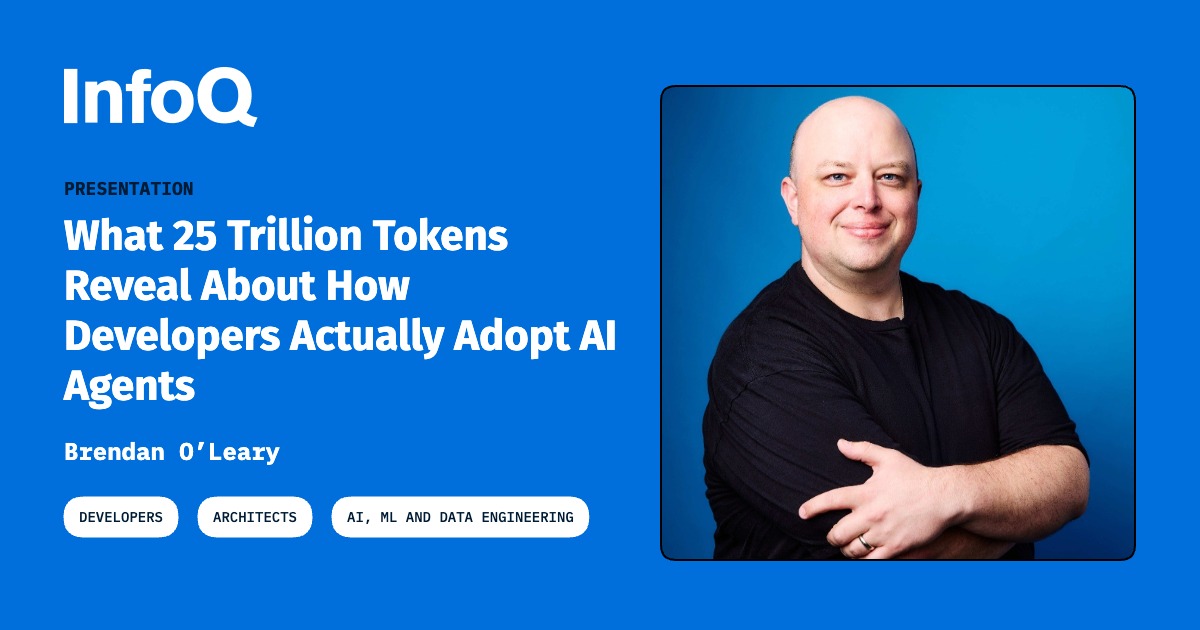
Kilo Code's Brendan O'Leary says its gateway data ties AI coding agent adoption to developer trust. The talk is titled for 25 trillion tokens, he says that figure is not quite right, and the excerpt stops before any usage numbers appear.
The Engineer · Build desk
What happened
- He frames the industry story as one about capability: benchmark scores and context window sizes.
- His alternative is a trust ladder that runs from autocomplete to chat with agents in code to orchestration of many agents at once.
- He names three points where adoption breaks: context construction, model routing and feedback loops, and says each has a concrete fix.
Why it matters
- decision A team sequencing an agent rollout would test the bottom rung first. If completions are slow or the agent edits the wrong file, orchestration pilots have little chance of being used.
- capability Context construction, model routing and feedback loops are all settings a team controls in its own harness, so each can be instrumented before any vendor data arrives.
- exposure The claim that benchmarks barely predict adoption rests, in this excerpt, on the speaker's observation of teams. A team that picks models by benchmark has no measured counterexample from this talk yet.
The ladder is a dependency chain. O'Leary describes autocomplete first, then chat with agents in code, then orchestration of many agents at once [11]. His claim is that a failure low on the chain blocks everything above it. Slow suggestions, a wrong feeling, or an agent that edits the wrong file are his examples, and in his words the upper rungs "really don't get a chance because the trust is broken" [12].
He then names three places where adoption breaks: how context is constructed, how models are routed, and what feedback loops exist. He says the data shows a consistent pattern at each and that each has a concrete fix [13]. We think this is the part of the talk most likely to transfer. All three are properties of a team's own harness. They do not depend on who the users are.
The usage numbers are harder to carry over. O'Leary works for an open-source competitor, and he put his position this way: he sits at "an uncomfortable intersection" between what Kilo can see and what larger vendors say [5]. The data comes from Kilo's gateway, which sits behind a CLI, a VS Code extension and cloud agents [c2, c3]. For a figure from that gateway to match your rollout, your developers would have to reach models through similar surfaces. They would also have to resemble people who chose an open-source agent tool in the first place.
His case against benchmarks is anecdotal so far. He describes the industry story as capability: one model beats another on a benchmark, another has a bigger context window [7]. He says a gain of "0.02 points" on human eval has "very little to almost nothing to do with whether developers can actually adopt those models" [8]. As evidence he offers what he has seen: "I've watched teams get access to the best models, the best capabilities, best benchmarks, and not use them at all" [9]. He puts the gap down to trust [10].
The headline figure carries its own caveat. Of the title's 25 trillion tokens, O'Leary said: "We'll see in a minute that's not quite right" [2]. The excerpt's outline ends at the third point, trust, before any chart or count [6]. We can report the framework. We cannot report what the gateway data shows.
What to watch
- Whether the full talk shows the actual token count behind the 25 trillion title, and what the correction is.
- Whether the charts break adoption out by surface (CLI, VS Code extension, cloud agents) or pool them.
- Whether the fixes for context construction, model routing and feedback loops come with measured effects on usage.
Clarity's read
What the record supports and how the coverage leans. The claims behind it follow.
Reality
- Evidence20
- Adoption
- Insufficient
- Hype gap
- Insufficient
- Incentives60
- Confidence35
Claim ledger
Ranked by verification strength, evidence, and original report placement.
- [1]
O'Leary said: "It's all real-world data from our gateway."
- [2]
O'Leary said of the title's 25 trillion tokens: "We'll see in a minute that's not quite right."
- [3]
Brendan O'Leary is a founding developer relations engineer at Kilo Code.
- [4]
Kilo Code is an open-source agentic engineering tool with surfaces in a CLI, a VS Code extension, and cloud agents.
- [5]
O'Leary describes Kilo as an open-source competitor in a highly competitive space and himself as sitting at "an uncomfortable intersection" between what Kilo's data shows and the story larger industry players tell about AI adoption.
- [6]
The transcript excerpt's outline section ends at the third point, trust, before any usage figures are shown.
- [7]
O'Leary describes the industry narrative as a capability narrative: one model scoring better than another on a benchmark, another having a given context window size.
- [8]
O'Leary said a new release beating the old one on human eval by 0.02 points has "very little to almost nothing to do with whether developers can actually adopt those models" in an agentic tool.
- [9]
O'Leary said: "I've watched teams get access to the best models, the best capabilities, best benchmarks, and not use them at all."
- [10]
O'Leary attributes the gap between model capability and actual use to trust, saying "I think it really is a lot about trust."
- [11]
O'Leary describes a trust ladder: autocomplete, then chat with agents in code, then orchestrating many agents at once.
- [12]
O'Leary says that if the lower rungs are shaky (slow suggestions, the wrong feeling, the wrong file or path edited), the upper rungs of adoption "really don't get a chance because the trust is broken".
- [13]
O'Leary names three technical points where adoption can predictably break: context construction, model routing, and available feedback loops. He says there is a consistent pattern in the data and each has a concrete fix.
Get this ledger inside ChatGPT. Ask about any of our stories and the answer brings its figure, each claim’s verdict and the sources. Free, no account.
Sources
1 independent publisher whose own reporting we read for this story.
- infoq.comPresentation: What 25 Trillion Tokens Reveal About How Developers Actually Adopt AI Agents
1 article · October 15, 2026
Topics and entities
Follow any of these and your For You feed starts watching them — no settings page required.
Topics
- AI Coding AgentsFollow
- AI AdoptionFollow
- Developer trust in AIFollow