Joe Grand found swapped chips in two Trezor wallets that generated preset seed phrases
Joe Grand told Trezor in August that two of its wallets carried hardware implants, zetter-zeroday.com reports. Trezor's commercial chief has since written that there is no evidence of compromise as the company trims its authorized sellers.
The Watch · Security desk
Trezor One buyer: about $50 left his account. Third-party sellers sold both implanted wallets. Owners buy the discontinued models from third parties. Attackers put modified open-source code on their own chip. Trezor cuts authorized sellers; its CCO says no evidence of compromise.
- exposure Trezor One buyer Became suspicious when about $50 got transferred out of his crypto account, claim 3
- exposure Third-party sellers Nonauthorized sellers, not authorized ones, sold the implanted Trezor One and Model T, claim 8
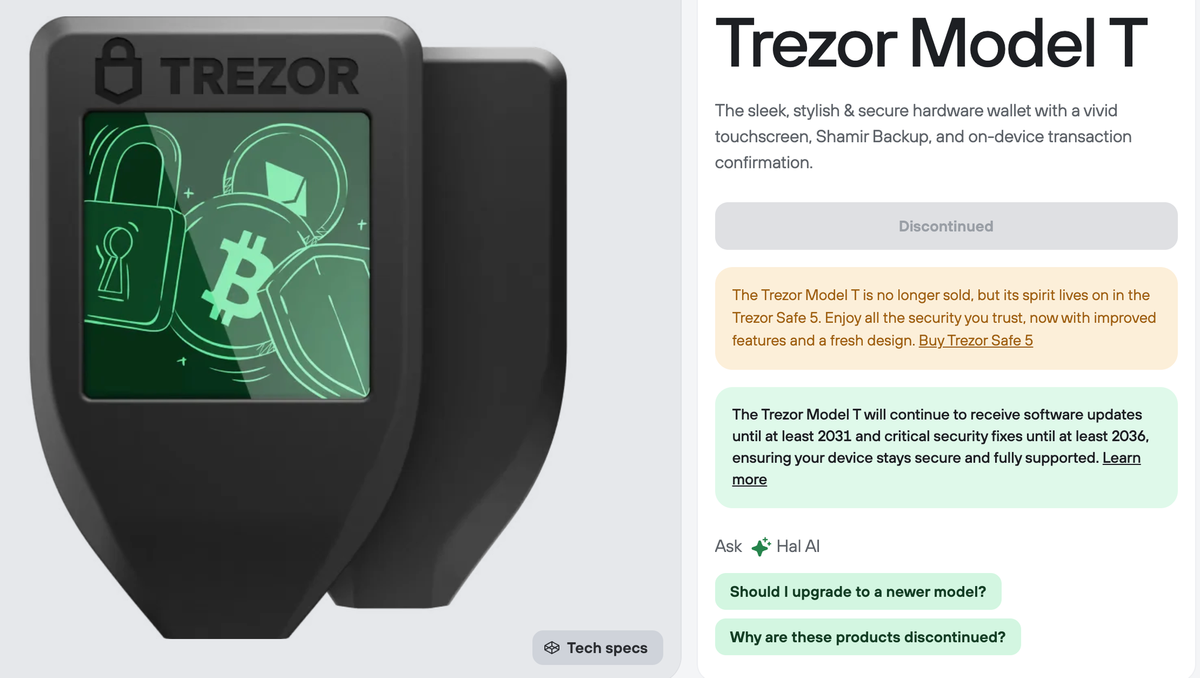
- exposure Trezor One, Model T owners Discontinued models bought from third-party sellers; security updates run until 2036, claim 4
- capability Attackers Obtained the open-source code, modified it and put it on their own unsecured chip in place of the real one, claim 7
- decision Trezor Reducing the merchants authorized to sell its devices, out of an "abundance of caution", claim 14
- contradiction Danny Sanders, Trezor CCO Wrote there was "not a single piece of evidence" that Trezor devices have been compromised, claim 15
| Who | How | Kind | Claim |
|---|---|---|---|
| Trezor One buyer | Became suspicious when about $50 got transferred out of his crypto account | exposure | 3 |
| Third-party sellers | Nonauthorized sellers, not authorized ones, sold the implanted Trezor One and Model T | exposure | 8 |
| Trezor One, Model T owners | Discontinued models bought from third-party sellers; security updates run until 2036 | exposure | 4 |
| Attackers | Obtained the open-source code, modified it and put it on their own unsecured chip in place of the real one | capability | 7 |
| Trezor | Reducing the merchants authorized to sell its devices, out of an "abundance of caution" | decision | 14 |
| Danny Sanders, Trezor CCO | Wrote there was "not a single piece of evidence" that Trezor devices have been compromised | contradiction | 15 |
What happened
- Grand's Model T came from Facebook Marketplace in Canada some time in 2025, and his Trezor One came from a TikTok shop in August.
- The Trezor One buyer became suspicious when about $50 was transferred out of his crypto account.
- In both wallets the attackers replaced the microcontroller so it produced one of a dozen or so preset seed phrases instead of a random one.
- Because Trezor's firmware is open source, the attackers could obtain and modify it, then program it onto their own unsecured chip.
- About three years ago Kaspersky Lab found an implant in a Trezor wallet sold on a popular Russian marketplace.
Why it matters
- exposure Buyers of used Trezor One and Model T units carry the risk. Both models are discontinued but supported to 2036, so the secondary market for them has years to run.
- constraint Chip code protection, which Grand says exists to stop code changes, does not protect against a replaced chip.
- contradiction Sanders's blanket no-evidence line sits against Grand's August report. Both can hold only if the statement covers Trezor's own channel and nothing sold outside it.
- decision Trezor's authorized-seller list is now shorter, so a buyer has fewer vetted places to buy. Marketplace sellers sit outside any vetting.
In our view the limit on this attack is distribution. Each swapped unit hands the attacker a short list of candidate seeds, so the work per victim is small [5]. The hard part is getting the unit to a buyer, and in both of Grand's cases a third-party seller outside Trezor's authorized list did that [8].
Sanders's wording is categorical. He wrote that there was "not a single piece of evidence that Trezor devices have been compromised" [15]. The zetter-zeroday.com author answered that "this isn't exactly true," citing Grand's August notification [17][1]. The statement holds if "Trezor devices" means units sold through Trezor's own channel, since both of Grand's came from outside it [8]. As quoted, though, the sentence covers Trezor devices without qualification. The available material does not include Trezor's response to Grand's notification.
The Ledger cases set the sequence. According to zetter-zeroday.com, Grand initially found implants in four Ledger devices sold by unauthorized merchants that looked like fly-by-night sellers [12]. Implants later appeared in devices from authorized Ledger resellers and were used to steal $100 million in crypto [11]. The Trezor cases match the first stage.
Trezor announced its seller cut on X out of an "abundance of caution," and Sanders called it a "preventive step" to have better control over its supply chain [14][16]. The zetter-zeroday.com author offers another explanation. The Trezor findings might be a precursor to implants in units from authorized resellers, the author wrote, and the cut suggests Trezor shares that worry [18].
Add Grand's two cases to the earlier Kaspersky find and Trezor tampering now spans three sales venues over roughly three years: a Russian marketplace, Facebook Marketplace and a TikTok shop [13][10].
What to watch
- A swapped-chip Trezor from an authorized seller. That would move Trezor from the first stage of Ledger's sequence to the second.
- Whether Trezor names the sellers it dropped and says what it did after Grand's August notification.
- Any link between Grand's two units, the earlier Kaspersky case and a single group.
Clarity's read
What the record supports and how the coverage leans. The claims behind it follow.
Reality
- Evidence50
- Adoption
- Insufficient
- Hype gap−10
- Incentives55
- Confidence50
Claim ledger
Ranked by verification strength, evidence, and original report placement.
- [1]
Joe Grand found implants in two Trezor wallets and notified Trezor about them in August.
- [2]
Grand found an implant in a Trezor Model T that someone bought via Facebook Marketplace in Canada some time in 2025, and in a Trezor One that someone obtained from a TikTok shop in August.
- [3]
The buyer of the Trezor One became suspicious when about $50 got transferred out of his crypto account.
- [4]
The Trezor One and Model T are discontinued, but Trezor will keep distributing software updates until 2031 and security updates until 2036, and customers still buy them from third-party sellers.
- [5]
In both wallets the attackers replaced the microcontroller so that, instead of generating random recovery seed phrases, it generated one of a dozen or so pre-determined seed phrases coded into it, allowing the attackers to guess the recovery seeds for the accounts.
- [6]
Grand says the legitimate microcontrollers in Trezor devices have code-protection features meant to prevent someone from accessing and changing the code.
- [7]
Because Trezor's code is open source, it was easy for the attackers to obtain it, modify it and program it into a new, unsecured device by replacing the legitimate chip with their own.
- [8]
The Trezor One and Model T implants Grand found were sold by third-party nonauthorized sellers, not by authorized sellers.
- [9]
Ledger and Trezor have both warned customers for years to buy directly from their own web sites or from authorized merchants.
- [10]
Three years ago, Kaspersky Lab found an implant in a Trezor wallet sold on a popular Russian marketplace; Kaspersky called it a fake wallet, but it was a real Trezor wallet that had been compromised.
- [11]
The Ledger implants became news because they were sold in devices distributed by authorized Ledger resellers and were subsequently used to steal $100 million in crypto from owners of compromised devices.
- [12]
Grand initially found implants in four Ledger devices sold online by unauthorized Ledger merchants that appeared to be fly-by-night sellers who popped up in online marketplaces and disappeared after days or weeks.
- [13]
Trezor implant cases now span three sales venues over roughly three years: a Russian marketplace, Facebook Marketplace and a TikTok shop.
- [14]
Trezor announced on X that it would reduce the number of merchants authorized to sell its devices, out of an "abundance of caution."
- [15]
Trezor Chief Commercial Officer Danny Sanders wrote that there was "not a single piece of evidence that Trezor devices have been compromised."
- [16]
Sanders described the reduction in authorized sellers as a "preventive step" to have better control over Trezor's supply chain.
- [17]
The zetter-zeroday.com author wrote of Sanders's statement: "But this isn't exactly true."
- [18]
The zetter-zeroday.com author wrote that the Trezor discoveries might be a precursor to implants showing up in Trezor devices sold by authorized resellers, and that Trezor's de-authorizing of some resellers shows it may be worried the problem could spread to authorized sellers.
Get this ledger inside ChatGPT. Ask about any of our stories and the answer brings its figure, each claim’s verdict and the sources. Free, no account.
Sources
1 independent publisher whose own reporting we read for this story.
- Trezor Wallets Also Compromised with Implants
zetter-zeroday.com
1 article · October 13, 2026
Topics and entities
Follow any of these and your For You feed starts watching them — no settings page required.
Topics
- Cryptocurrency theftFollow
- Hardware Wallet SecurityFollow
- Supply-chain tamperingFollow