Invest1 publisher3 min readPublished
The long end is doing the pricing now, and Cramer's "gulf" is the receipt
A 30-year yield above 5.33% and Iran-driven oil prices are overwhelming good numbers from good companies. Walmart down 9% and Micron down 20% from its highs tell the same story.
The Investor · Invest desk
Drafted by a language model from the sources cited here and checked against its claim ledger before publication. How we use AISend a correction
What happened
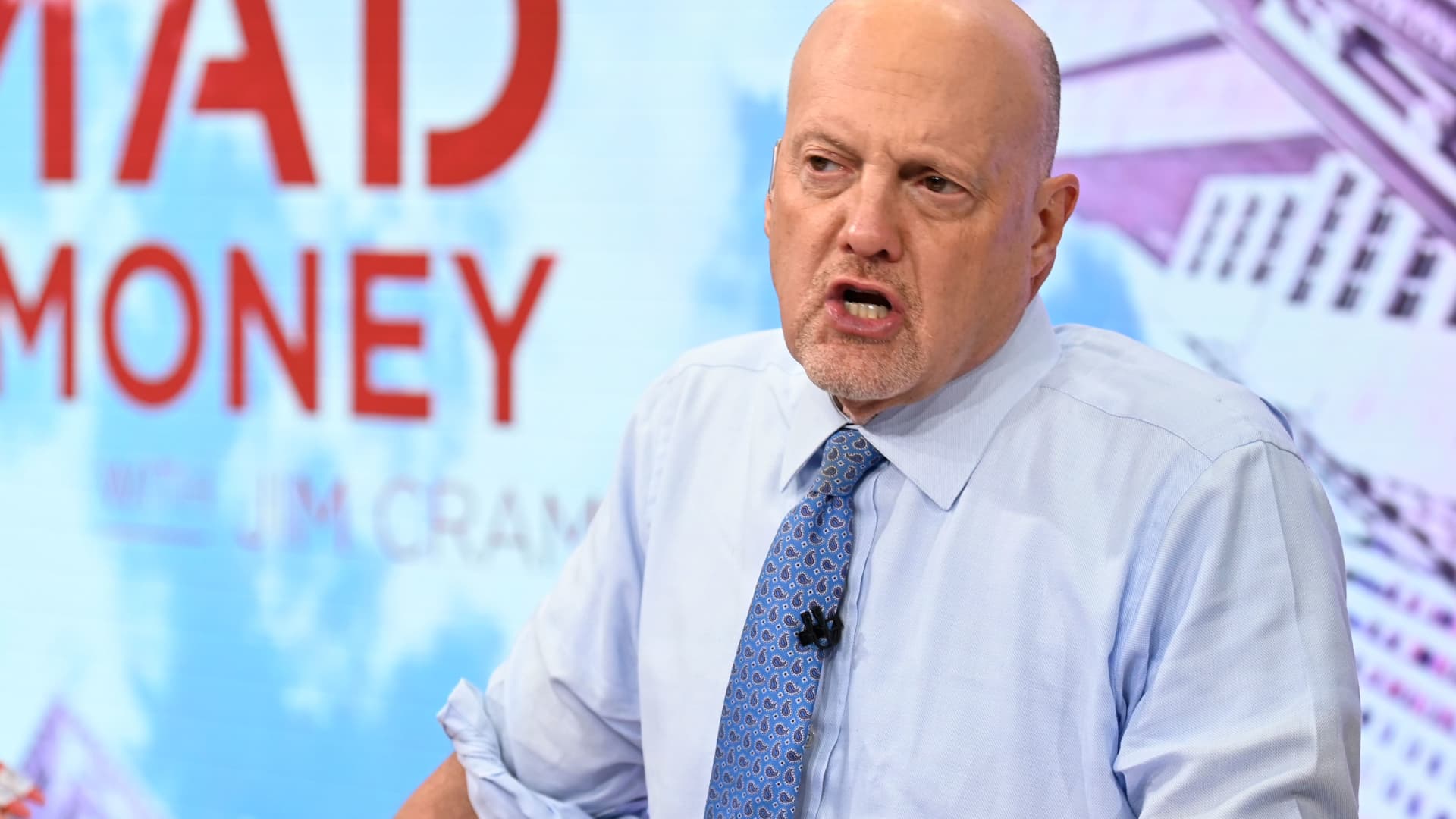
- CNBC's Jim Cramer said Thursday that broader economic concerns are making it difficult for investors to reward companies whose underlying businesses remain strong.
- Cramer, host of "Mad Money", said: "There's an incredibly jarring gulf between stock prices and reality."
- On Thursday the Dow Jones Industrial Average dropped 1.3%, the S&P 500 fell almost 0.9%, and the Nasdaq gave back 1%.
- Bond yields pushed higher, wiping out the declines that followed Wednesday's announcement from the Treasury Department of a plan to subdue market rates.
- Earlier in the week, the 30-year Treasury yield topped 5.33%, a level not seen in nearly two decades.
Compiled by The InvestorSomething wrong?How this is made
Why it matters
The Dow fell 1.3% on Thursday, the S&P 500 nearly 0.9% and the Nasdaq 1%, while bond yields pushed back up and erased the decline that followed the Treasury Department's Wednesday announcement of a plan to subdue market rates [3][4]. Jim Cramer called it an "incredibly jarring gulf between stock prices and reality" [2], which is a colorful way of saying the discount rate has taken pricing away from earnings.
The mechanism is not mysterious. Earlier in the week the 30-year Treasury yield topped 5.33%, a level not seen in nearly two decades, and CNBC attributes the move to inflation concerns made worse by Iran war-elevated oil prices [5][6]. Oil feeds headline inflation, inflation feeds the term premium, and the term premium sets the denominator under every equity multiple. Strong operating results do not change that sequence; they just get repriced by it.
Treasury Secretary Scott Bessent told CNBC on Thursday that his plan to buy more longer-dated government debt could exceed the top of the $4 billion range floated the day before [14]. Cramer's objection is arithmetic: "When America has $40 trillion in debt, a $4 billion buyback has the Treasury Secretary looking like the Little Dutch boy with his finger plugging the dike" [15]. On those two figures, the intervention is about 0.01% of the debt stock [1]. Thursday's yield move suggests the market did the same math.
The consumer read came from Walmart, which lost 9% after missing Wall Street expectations on quarterly comparable sales and on sales guidance [11]. Cramer's account is that higher gasoline prices weighed on shoppers late in the quarter while Walmart kept prioritizing low prices and market share over near-term profit [12], and that gas above $4 a gallon leaves less money for everything else, with the Iran conflict making the timing of relief unknowable [13]. That is the part operators should sit with: the oil shock is not only a rates story, it is a demand story arriving through the fuel pump with a lag.
Against that, Cramer reported from the construction site of Micron's new semiconductor fabrication plant in Boise, Idaho, where thousands of workers are building capacity for memory chips used in artificial intelligence [7]. Micron finished up 4% on Thursday [10] and Cramer's Charitable Trust owns the stock [9]. He still conceded the constraint: "you can't take your eye off the broader market even if you think, as I do, that Micron's stock is radically undervalued... In the end, we always have to look at stocks through the market's prism" [8]. Micron remains up for the year but roughly 20% below its June all-time highs [10]. His own framing undercuts the manufacturing-boom narrative: two-thirds of the U.S. economy is service-based [16], and "there are another 499 stocks in the S&P 500 and the prism made a lot of them look downright awful" [17].
Practical consequence: a long end near 5.33% resets hurdle rates, refinancing assumptions and any 2026 plan built on cheaper money, regardless of how good the order book looks.
Watch whether Treasury's buyback size actually moves the 30-year or gets absorbed without effect [14][5]. Watch pump prices against the $4 line, because that is the variable Walmart blamed and the one Iran controls [13]. And watch whether Micron's 20% drawdown from June deepens on days its own results are fine [10].