InvestNot yet confirmed elsewhere1 publisher3 min readPublished Updated
ESA prices three rocket startups on milestones, not flights
The European Launcher Challenge pays nothing up front and releases cash only against milestones, which makes ESA a tranched investor that takes no equity, and gives Isar, RFA and PLD until 2028 to reach orbit.
The Investor · Invest desk
What happened
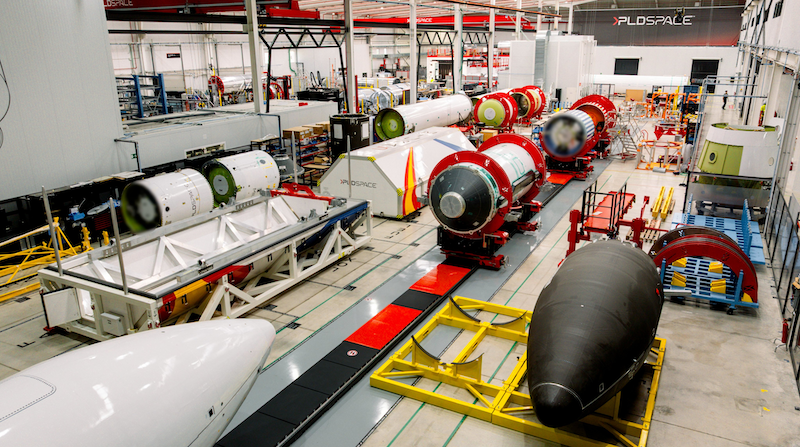
- ESA announced its first three European Launcher Challenge contracts on Thursday, signed with Isar Aerospace, Rocket Factory Augsburg and Spain's PLD Space.
- Spectrum has flown once, for 30 seconds in 2025, from a dedicated pad at Andoya Spaceport in Norway before coming back down.
- None of the money is paid up front: companies free up funds only as they reach milestones agreed with the agency.
- Every provider must complete an orbital launch before 2028, a condition ESA applied identically across all three signed contracts.
Why it matters
- cost The bill lands on individual treasuries rather than a pooled line, with Germany underwriting the biggest position and Spain carrying PLD's, which means the sponsor most exposed to a failure is also the one that chose the entrant.
- constraint Because milestone cash follows the spend that earns it, the companies must raise against a calendar ESA set, and every engineering decision between now and orbit is taken with a financing date attached to it.
- capability Money that takes no equity and no board seat lets these founders defer a priced round, and it leaves the state-stake option Schwarz floated available for later rather than exercised now.
- exposure Existing investors in three cap tables now hold positions marked to a single dated binary, where a slip and a failure look identical to a fund but not to an agency.
Divide each award by the payload its vehicle is advertised to carry and one programme resolves into three quite different prices. Isar's €197.8 million against 1,000 kg to low Earth orbit [4][6] is about €198,000 per advertised kilogram; Rocket Factory Augsburg's €186.9 million against 500 kg to a 500 km sun-synchronous orbit [8] is about €374,000; PLD Space's €158.9 million against 540 kg [9] is about €294,000 [21]. ESA is paying roughly 1.9 times as much per promised kilogram at RFA as at Isar [22], which reads less as a price for lift than as a price for keeping a second and a third entrant in the field.
Totalled, the three contracts come to €543.6 million [19], or about $640 million at the rate implied by Isar's own conversion of €197.8 million into $233 million, which is 0.16% of the roughly $400 billion at which SpaceX has been valued [14][24]. At that ratio, the money is doing less to fund a rival than to buy an option on having one, and Isar's 36.4% of the pot [20] is the largest single position ESA took.
The structure is the part worth studying. Nothing is paid up front and funds release as milestones are met [3], which is a tranched round in every respect except that the investor takes no equity and no board seat, and Andreas Schwarz of the German parliamentary budget committee has already said governments should weigh taking stakes in providers alongside long-term launch commitments [16]. Non-dilutive money is the cheapest capital on any cap table, but milestone cash arrives after the spend that earns it, so the working capital between a 30-second flight [5] and an orbital launch before 2028 [2] remains equity's problem, priced by investors working to a deadline they did not choose. Put the headline number over the flight record and you get roughly €6.6 million for every second Spectrum has spent off the pad [23], which is a price for a schedule rather than for a vehicle.
Isar's contract is funded mainly by Germany with contributions from Austria and Norway, and PLD's mainly by Spain with German support [7][9], so the competition Géraldine Naja described [13] runs between entrants drawing on separate treasuries rather than bidding against each other for the same euro. The fourth award, to MaiaSpace, has not closed; ESA says the process is nearing completion and expected to resume in the coming weeks [10]. One oddity in the account: proposals were due April 2026 and appraised on business case, engineering quality, resources, schedule and compliance [11], leaving under 21 months between appraisal and the deadline [26].
The version where this works has Isar's second Spectrum reaching orbit with payloads [6] and demand waiting behind it, chiefly the Airbus, Leonardo and Thales satellite combination carrying about €6.5 billion of annual revenue and due to begin operating in 2027 [15], against which all three launcher awards are 8.4% of one year of that revenue [25]. The version where it does not has all three slipping and ESA writing fresh milestones, and that is where the venture analogy fails, because a fund marks the position down while an agency reschedules it. This is probably wrong, but Lucia Linares saying that getting to space is "not easy and never guaranteed" [12] sounds like a deadline with give in it. What would prove it wrong: ESA letting an award lapse in 2028 rather than extending it, or a priced round at one of the three that treats milestone paper as booked revenue instead of a schedule obligation.
What to watch
- Whether MaiaSpace's fourth contract closes, and at what size relative to PLD Space's €158.9 million.
- The outcome of the second Spectrum's qualification flight, and whether its payloads reach orbit.
- Any priced equity round at Isar, RFA or PLD that shows what investors think a milestone contract is worth.
Clarity's read
What the record supports and how the coverage leans. The claims behind it follow.
Reality
- Evidence55
- Adoption22
- Hype gap+28
- Incentives72
- Confidence48
Claim ledger
Ranked by verification strength, evidence, and original report placement.
- [1]
ESA signed its first three European Launcher Challenge contracts with Isar Aerospace, Rocket Factory Augsburg and PLD Space, announcing the awards on Thursday.
- [2]
Each provider must complete an orbital launch before 2028 to prove it can deliver.
- [3]
The contracts pay no cash up front; companies free up funds only when they reach agreed milestones.
- [4]
Isar Aerospace took the largest award, worth €197.8 million, for its Spectrum rocket; the company described it as about €200 million ($233 million) in a statement on Thursday.
- [5]
Spectrum, a two-stage rocket 28 metres high with ten engines, flew for 30 seconds in 2025 from a dedicated pad at Andoya Spaceport in Norway before coming down.
- [6]
A second Spectrum is being prepared for a qualification flight with payloads Isar hopes to place in orbit; in its current form the rocket can carry up to 1,000 kg into low Earth orbit.
- [7]
Isar's contract is funded mainly by Germany, with contributions from Austria and Norway, according to ESA.
- [8]
Rocket Factory Augsburg took €186.9 million to develop RFA One, a three-stage rocket launching from the SaxaVord pad in the UK and delivering up to 500 kg to a 500 km sun-synchronous orbit.
- [9]
PLD Space procured €158.9 million, mainly backed by Spain with support from Germany; it flew its Miura 1 demonstrator from Spanish soil in 2023 and is developing Miura 5, which will launch from Europe's Spaceport in French Guiana with up to 540 kg to a sun-synchronous orbit.
- [10]
A fourth challenger, MaiaSpace, has not yet closed; ESA said its award process is nearing completion and expected to resume in the coming weeks.
- [11]
Proposals were due April 2026 and were appraised by an ESA board on business case, engineering quality, resources, schedule and compliance.
- [12]
Lucia Linares, ESA's head of strategy and launches for space transportation, said it is up to the challengers to prove they can deliver reliable launch services for Europe and compete, adding that getting to space is "not easy and never guaranteed".
- [13]
Geraldine Naja, ESA's director of space transportation, said the awards were meant to drive competition among European launch providers.
- [14]
Balderton Capital managing partner Bernard Liautaud said Europe's reliance on SpaceX was a "huge risk" and Europe needed to be "more self-sufficient"; SpaceX has been valued at around $400 billion.
- [15]
Leonardo, Airbus and Thales have agreed to merge their satellite businesses into a new company with annual revenues of some €6.5 billion ($7.5 billion), expected to start operations in 2027 pending regulatory approval.
- [16]
Andreas Schwarz, an SPD member of the German parliamentary budget committee, said launch capacity is an elementary interest of a state and that governments should look at options from long-term launch commitments to taking stakes in providers.
- [17]
ESA described the awards as a push to expand Europe's launch options and reduce reliance on SpaceX.
- [18]
Isar chief commercial officer Stella Guillen said Europe is putting serious resources behind its space sovereignty and that the ESA agreement is another proof point.
- [19]
The three signed awards total €543.6 million.
- [20]
Isar's €197.8 million is 36.4% of the €543.6 million signed so far.
- [21]
Per advertised kilogram of payload capacity, the awards price at about €197,800 for Isar, about €373,800 for RFA and about €294,300 for PLD Space.
- [22]
ESA is paying about 1.9 times as much per advertised kilogram at RFA as at Isar.
- [23]
Isar's €197.8 million against Spectrum's 30 seconds of flight is about €6.6 million per second flown.
- [24]
The €543.6 million of awards is about $640 million at the rate implied by Isar's own €197.8m to $233m conversion, equal to 0.16% of SpaceX's roughly $400 billion valuation.
- [25]
The three awards together equal 8.4% of one year of the merged Airbus, Leonardo and Thales satellite company's stated annual revenue.
- [26]
On the source's own process timeline, under 21 months separate the April 2026 proposal deadline from the start of 2028.
Sources
1 independent publisher whose own reporting we read for this story.
- cryptopolitan.comIsar Aerospace won €197.8 million for a rocket that has flown 30 seconds
1 article · August 27, 2026
Topics and entities
Follow any of these and your For You feed starts watching them — no settings page required.
Topics
Entities
- European Space AgencyFollow
- European Launcher ChallengeFollow
- Isar AerospaceFollow
- SpectrumFollow
- Rocket Factory AugsburgFollow
- RFA OneFollow
- PLD SpaceFollow
- Miura 1Follow
- Miura 5Follow
- MaiaSpaceFollow
- SpaceXFollow
- Andøya SpaceportFollow
- SaxaVordFollow
- Europe's Spaceport, French GuianaFollow
- Lucia LinaresFollow
- Géraldine NajaFollow
- Stella GuillenFollow
- Bernard LiautaudFollow
- Balderton CapitalFollow
- Andreas SchwarzFollow
- AirbusFollow
- LeonardoFollow
- ThalesFollow