Product8 publishers3 min readPublished Updated
Meta's Edits Assistant turns a creator's Instagram retention and share data into posting advice
Meta is rolling out Edits Assistant, a chatbot that reads creators' Reels retention, shares and follows, with higher usage limits sold from $14.99 a month. Free use stops at a daily cap Meta has not published, so creators cannot tell in advance where the paywall starts.
The Product Desk · Product desk
What happened
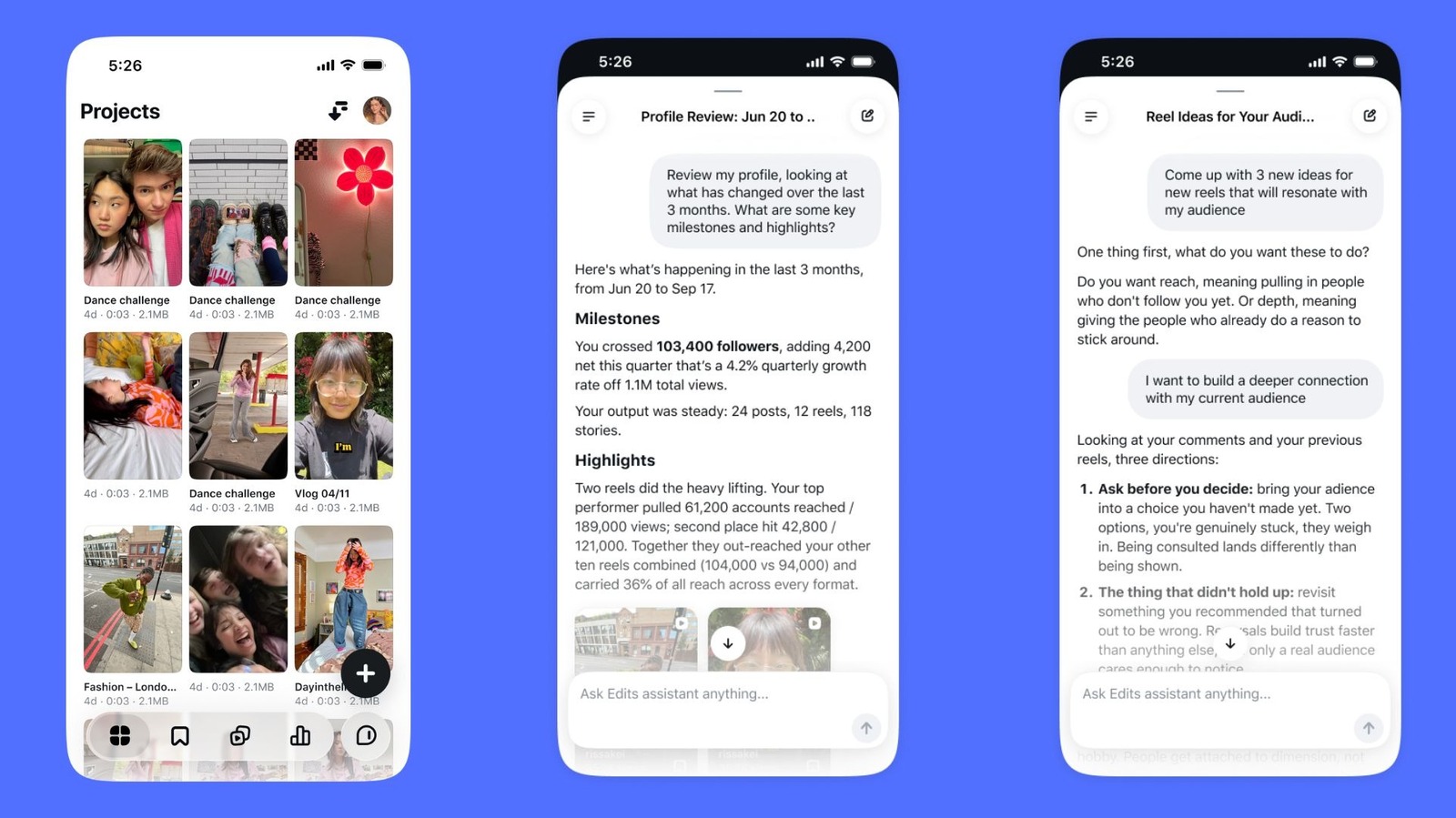
- Creators open it from a chat button on the Edits homepage and can ask why one reel worked and another did not, or request a profile review.
- Beyond diagnosis, the assistant suggests video concepts, hooks, captions, scripts and audio for future posts.
- Meta says a food creator in the test group found that a series of DIY videos performed better than the creator's cooking videos.
- The most expensive Meta One plan costs $499 a month, according to Engadget.
- Edits itself launched last year as Meta's creator video editor and its rival to TikTok's CapCut.
Compiled by The Product DeskSomething wrong?How this is made
Why it matters
- contradiction Meta pitches the assistant as analysis that leaves creative calls to creators while shipping script and hook drafting, so that boundary rests on each creator's own discipline.
- cost Creators who outgrow the free allowance pay at least $179.88 a year at the entry Creator price, a bill that lands on the assistant's heaviest users.
- constraint Its described inputs are Instagram's own metrics, so a creator who cross-posts the same video gets an explanation for one platform's audience only.
- decision Acting on its advice means deciding what counts as proof, since Meta's published test stories name the format that won but not the margin.
Meta says a beauty creator in its test group learned that adding a 7-second reel into her one-minute videos could boost engagement [6]. Instagram ran those tests with select creators for months [5]. She could have dug the same pattern out of her own numbers, and the assistant put it in plain words. It works from follows, shares, likes, views, video retention, comments and audience preferences [4]. Engadget reports that it looks for patterns across a creator's posts and does not build its advice around one video that did big numbers [13].
Meta used the word engagement for that result. Engagement can mean a like as easily as a minute of watching. Retention is the harder number, and the assistant already has it as an input [4]. A creator deciding whether to restructure every one-minute video should want the retention figure across several posts before changing anything.
Meta's press release calls the assistant a "creative partner" [12]. Brett Westervelt, head of the Edits app, described a narrower job. "One thing we heard consistently: creators want a tool that handles the analysis, not one that does the creative work for them. Edits Assistant does the digging for you. The creative calls are still yours," he said [7]. By Westervelt's account, that is what creators asked for. The product still ships drafting tools alongside the analysis [3].
Past the free daily limit [14], both reports describe what a Meta One subscription buys as higher usage limits [9]. So a paid plan gets a creator more questions. Paying makes sense only if the free answers were already changing what that creator posts.
Neither report discusses outside analytics tools, so the evidence here does not show Meta squeezing them. The metrics the assistant reads come from the creator's own Instagram account [4]. The new part is a plain-language explanation inside Meta's own editing app. Meta already runs a creator assistant on Facebook [8].
I'd use it for the question it was built to answer, why one reel beat another, and hold its scripts to the same test as any other draft. The tradeoff is speed. Checking a pattern across several posts takes longer than acting on the answer the day it arrives.
A 2x2 sorts the answers. One axis asks whether you can check the claim in your own post-level numbers. The other asks whether acting on it changes what you make or only how you package it, meaning the hook, caption or audio. A checkable packaging change is cheap: post it and judge it on retention. Uncheckable packaging is nearly as cheap to try. Format changes are where the cost sits. If you can check one, such as a claim that one series outperforms another, confirm it across several posts before the posting schedule changes. If you cannot check it, as with a new kind of video built on a trend read or an audience-preference claim, wait until your own numbers agree.
What to watch
- Meta publishing the free daily prompt limit, the figure that decides how often ordinary creators meet the Meta One paywall.
- Measured tester results, such as retention or follower changes, that go beyond the two anecdotes Meta has shared.
- Price or feature moves by independent creator analytics tools after the rollout, the first sign of whether they treat Meta's assistant as a competitor.