Science1 publisherNot yet confirmed elsewhere3 min readPublished
Osterman: 35% of US workers are disposable, and gig apps are barely 1 point of it
A new book from the MIT labor economist names a category he calls marginal workers: 17% of US employees who sit on the payroll while their employer plans not to keep them.
The Scientist · Science desk
Drafted by a language model from the sources cited here and checked against its claim ledger before publication. How we use AISend a correction
What happened
- Paul Osterman is the Nanyang Technological University Professor Emeritus at the MIT Sloan School of Management, where he is also a professor emeritus of work and organization studies, and a longtime labor economist whose work has focused on job quality and labor-market fairness.
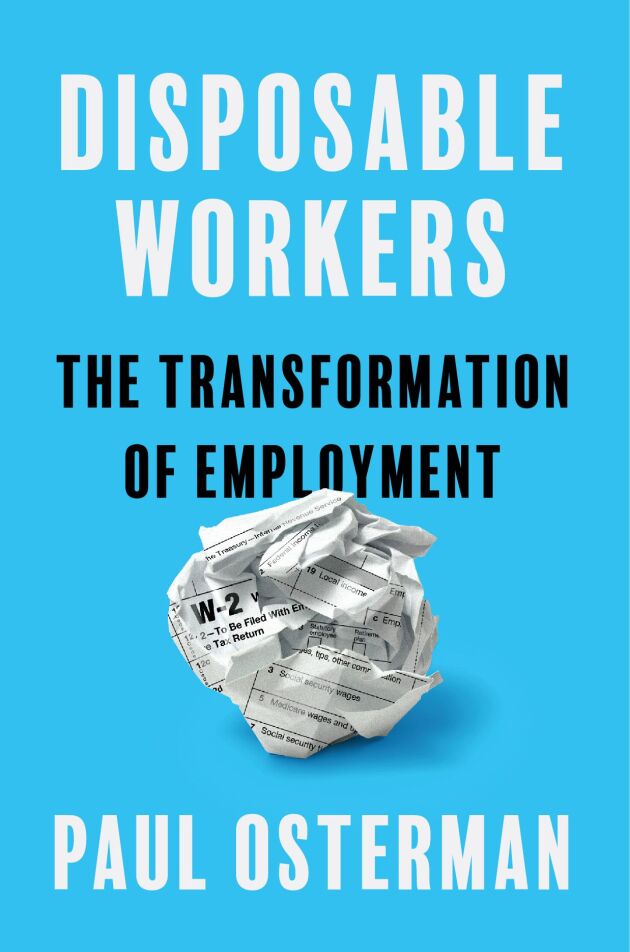
- Osterman's new book, "Disposable Workers: The Transformation of Employment," was published this month by Harvard University Press.
- According to Osterman's analysis, 35% of U.S. workers are either marginal employees, freelancers, contractors or gig employees finding work on online platforms like rideshare services.
- Osterman on the 35% figure: "That's a big number. That's over 55 million people in the American workforce."
- Gig workers, who draw work from online platforms such as rideshare services, account for a little more than 1% of the U.S. workforce.
Compiled by The ScientistSomething wrong?How this is made
Why it matters
Paul Osterman, professor emeritus of work and organization studies at the MIT Sloan School of Management, published "Disposable Workers: The Transformation of Employment" with Harvard University Press this month [1][2]. His headline count puts 35% of US workers, which he describes as over 55 million people, outside a conventional career track, while platform gig work accounts for a little more than one percentage point of the workforce [3][4][5].
The load-bearing idea is a definition. "Marginal workers are employees who have no career prospects at their organizations," Osterman says; they are employees of the firms they work for, "but the organizations do not intend to keep them," and they are much less attached to any career ladder [6]. He finds that about 17% of US employees fit that description, roughly one in six jobs [7]. Both the term and the category are his, and he says the group has been significantly overlooked; the count comes from an original survey of more than 6,000 workers [16][11].
The remainder of the 35% is more familiar. Roughly 12% are contract workers, often employed by staffing agencies and then assigned to varying locations [8]. Another 5% are what he calls organizational freelancers, working for firms without being part of the permanent staff, and that bucket contains the gig workers who draw jobs from platforms such as rideshare services at a little more than 1% [9][5]. Beyond those are freelancers working individually for multiple clients [10]. The three named shares sum to 34 of the 35 points, which is the point: the platform economy is a small line item inside a much larger reorganization [21].
Arithmetic on his own figures gives a sense of scale. If 35% corresponds to more than 55 million people, the implied workforce base is about 157 million [18]. That puts marginal employees alone near 27 million people [19], roughly 17 times the platform gig share [20].
The occupations are not confined to warehouses and delivery routes. Osterman's examples include staff attorneys at law firms, adjunct faculty, and many kinds of part-time employees with few opportunities for advancement [12]. What ties the categories together, he argues, is that each evolved as firms tried to cut labor expenses and gain flexibility and managerial discretion, leaving fewer workers with promotion prospects, health benefits and employment stability [13]. By mixing marginal, freelance and contract roles and making some of them part time, businesses built a system in which fewer employees have rising wages or additional benefits and the portion of firm revenues plowed back into paying workers can shrink [15]. He declines to moralize: the book, he says, does not argue that anyone is dishonest or evil, because "firms only care about one thing, which is to maximize profits, period, end of story" [14]. He also says it is a good thing that firms create jobs and develop new products [17].
Two things are worth tracking. First, whether the 17% survives contact with other datasets, since it rests on a category Osterman named and a survey he ran [16][11]. Second, the tension he flags himself: many scholars have found that short-term labor cost reductions can be counterproductive, and many firms have appeared to benefit from a more stable, committed and motivated workforce [22]. If that holds, the marginal-employee model is a cost decision that some employers are making against their own operating interest.