Product2 publishersIndependently confirmed3 min readPublished
Google's new Preferred Sources button hands publishers the recruiting job
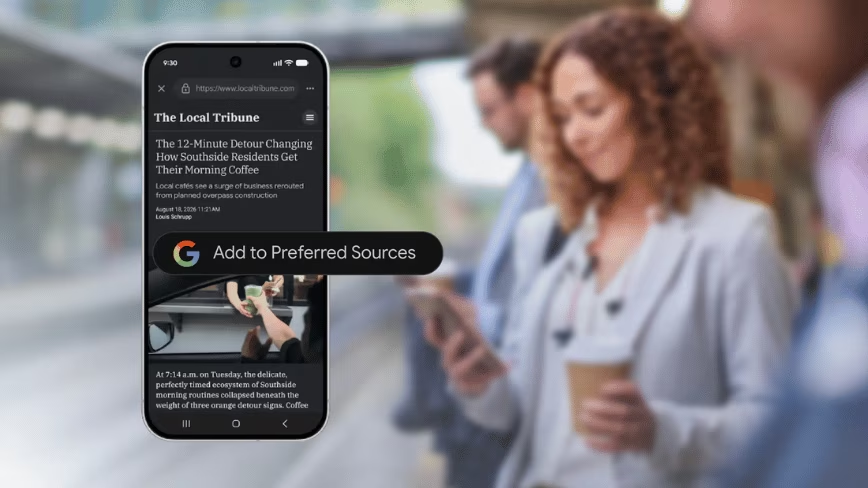
The embed code is free, the persuading is not. Google's one genuine fix is that readers now land back on the article instead of in a settings page.
The Product Desk · Product desk
Drafted by a language model from the sources cited here and checked against its claim ledger before publication. How we use AISend a correction
What happened
- Google is giving publishers an embeddable button for their own pages that adds the site to a reader's preferred sources on Google.
- The embed code sits in Search Central documentation, and both the installation and the asking fall to the publisher.
- Google says more than 600,000 unique sources have now been selected, against more than 345,000 reported in May.
Compiled by The Product DeskSomething wrong?How this is made
Why it matters
- cost Reader acquisition for Google's ranking signal now runs on publisher page real estate, publisher design time and publisher goodwill, with no per-install cost to Google.
- constraint Because the only public metric counts distinct sites rather than readers, no publisher can use it to judge whether the button worked for them.
- exposure The doubled click-through figure comes from Google's own earlier studies and applies only when the site already surfaces, so anyone budgeting against it is trusting an unaudited conditional.
- decision Sites that spent this year weighing whether to withhold content from Google are now asked to promote its preference system from their own articles instead.
The embed code is the cheap part. Google wrote a button; the publisher writes the pitch, chooses where on the page it goes, and convinces a reader to press something that changes a setting in a Google account [6]. The improvement over the badge Google shipped earlier this year is real but narrow: the reader is returned to the spot they left [4], rather than deposited in Google's source preferences tool and abandoned there, as Search Engine Journal noted of the earlier version [5].
The number Google offers as evidence of uptake is more than 600,000 unique sources selected [12], against more than 345,000 reported in May [7]. That is about 255,000 more distinct sites in three months, a rise of roughly 74 percent [13]. The Next Web's subhead calls this nearly doubling [1]; its own body text calls it roughly three quarters [2], and the body is right. More to the point, Google did not say how many people made those selections, and the figure counts distinct sites rather than readers, so a site chosen once and a site chosen a million times both add one [14]. Nothing in the headline count tells any individual publisher whether a single reader picked them.
What being picked buys is described in conditional terms. Google's documentation says preferred sites are more likely to appear in Top Stories, and can carry a "preferred" badge inside AI Overviews and AI Mode [15]. TechCrunch reports Google's claim, from earlier studies, that people are twice as likely to click through to a preferred source when one is available [8]. The qualifier is doing work: the uplift applies when Google has already decided to surface the site, and the study is Google's own.
Mrinalini Loew, who runs Google's Search ecosystem team, framed the changes as giving readers control while helping publishers build stronger, direct connections with their readers [16]. The connection actually created runs between the reader and Google's ranking systems, which store and honour the preference. Discover, one of the surfaces involved, recommends articles based on a reader's activity across Google's search engine and apps, and most people using it never opted into anything [17]. Set the two announcements side by side and the division of labour is plain: the Discover tuning chatbot lives inside Google's app, where Google builds and operates it [9], while the reader-acquisition widget lives on the publisher's page, where the publisher does.
The timing sits inside a harder argument. The Next Web reported in July that Reddit was weighing cutting Google off from its content, and that it was not alone [18]; Cloudflare gave AI crawlers a September deadline to pay publishers or lose access [19]. TechCrunch described the button as a bone thrown to publishers hurt by AI-driven traffic loss [10]. Measured against a blocking deadline or a licensing demand, a snippet of HTML costs Google nothing per install and transfers the conversion work to the party with the weaker hand.
What to watch
- Whether Google ever reports how many people set preferences, or gives publishers per-site counts instead of a tally of distinct sites.
- Whether any publisher publishes before-and-after referral data after installing the button, which would test the doubled click-through claim.
- Whether Google says which signal wins when a typed Discover request contradicts an existing follow or block.