Science1 publisher2 min readPublished
Tris storage buffer keeps mRNA nanoparticles potent through freezing
UT Austin, Eli Lilly and Boston University found a Tris buffer keeps mRNA nanoparticles potent through freezing, where citrate cannot. Only 5% to 10% of an mRNA dose reaches its target, so the storage solution shapes how much material a patient needs.
The Scientist · Science desk
What happened
- The University of Texas at Austin, Eli Lilly and Boston University set out to measure how freezing and the storage buffer change how well mRNA lipid nanoparticles deliver their cargo.
- The team compared how three storage buffers, Tris, histidine and citrate, affected the nanoparticles' internal structure, stability and delivery.
- Citrate buffer delivered mRNA more efficiently when the particles were kept refrigerated but failed to protect them through freezing.
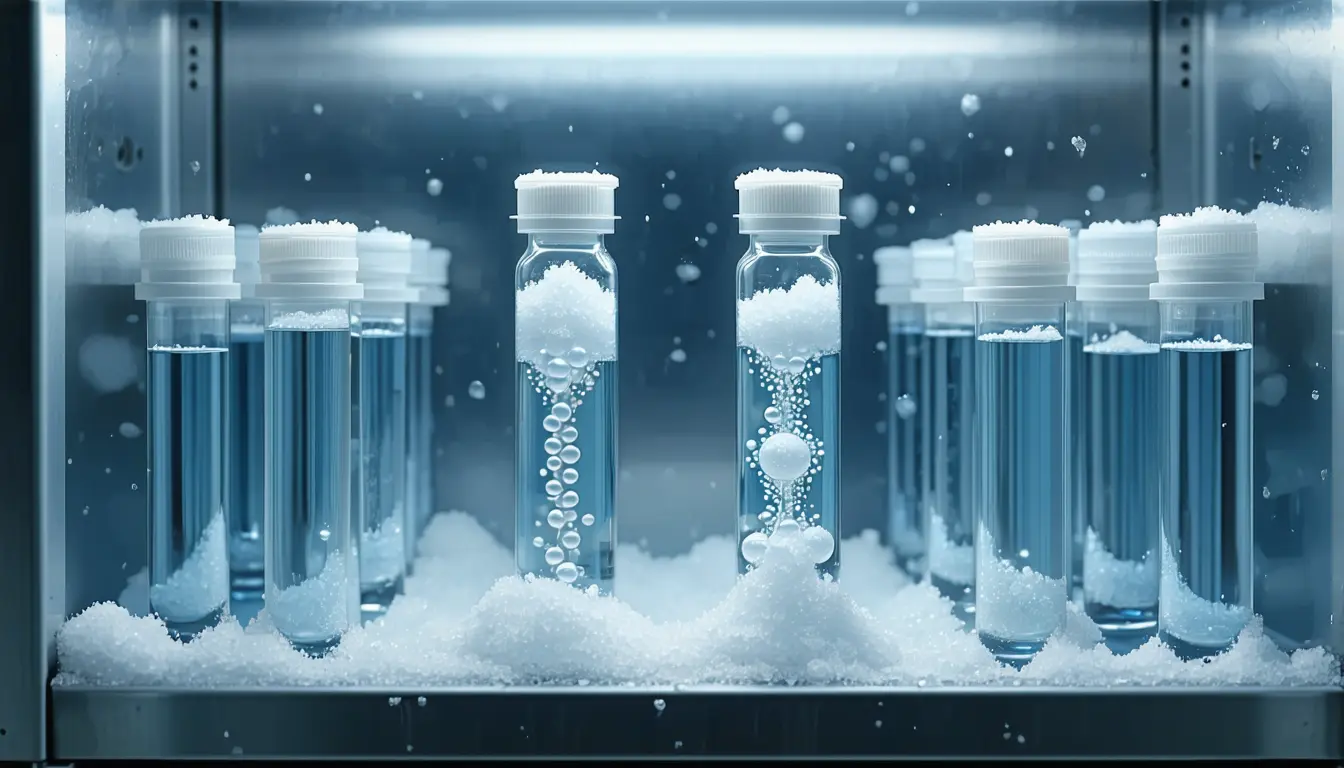
- Tris buffer improved potency after freezing and thawing, keeping the particles stable and their internal structure intact.
Compiled by The ScientistSomething wrong?How this is made
Why it matters
- decision The best buffer flips with the storage condition, so a manufacturer shipping some products cold and others frozen cannot standardise on one formulation.
- capability Lifting delivery above the 5% to 10% baseline could let the same result be reached with less mRNA per dose, which the researchers tie to fewer side effects.
- constraint The gains were shown in human cell culture, so any dose reduction in actual patients has not yet been demonstrated.
A lipid nanoparticle carries mRNA into a cell, and the buffer it sits in shapes how the particle is arranged inside [3]. That internal structure decides how much of the cargo reaches the cell and is translated into protein [3]. "Our study shows that something as simple as the storage solution can make a huge difference in how well mRNA medicines work," said Alex Marras, an assistant professor in the Cockrell School of Engineering's Walker Department of Mechanical Engineering and a lead author on the study [8][9].
Freezing is where that structure is most at risk. Meysam Mohammadi-Zerankeshi, a doctoral student in Marras' lab and the paper's first author, described the failure mode. "These lipid nanoparticles protect mRNA and help deliver it into cells, but the nanoparticles themselves are also sensitive to their storage environment," he said [10][12]. "If they become unstable during freezing and thawing, they can aggregate or lose their cargo, reducing delivery efficiency, and then the treatments don't work." [11] Both the type of buffer and its concentration changed how the particles came through a freeze and how they rearranged during delivery [5].
The starting point is low. Roughly 5% to 10% of the mRNA in even a good vaccine is properly delivered to its target [13], which leaves 90% to 95% that never arrives [19]. The usual workaround is to load more material into each dose. "One way to overcome inefficient delivery is simply to give more material, but higher doses can also increase side effects," Marras said [15]. "That's part of why you might feel rough for a day or two after an RNA vaccine," he said [16].
The findings came out of a multi-year collaboration between Marras' lab and Eli Lilly that also involves UT Austin chemical engineering professor Keith Johnston and related work on antibodies and siRNA [17]. That partnership let the group scale up nanoparticle synthesis and test the particles across four human cell lines [18].
What to watch
- Whether the buffer effects on delivery hold in animal or human trials, not only in cell lines.
- Whether manufacturers reformulate frozen mRNA products in Tris rather than citrate.
- Whether higher delivery efficiency translates into lower approved doses and fewer reported side effects.