Science1 distinct publisher3 min readPublished
A Southampton-led team models 100 million years of East Antarctic uplift and puts the ice sheet's origin in the deep Earth, not the atmosphere.
The Scientist · Science desk

Compiled by The ScientistSomething wrong?How this is made
The mechanism is unglamorous and that is the point. Mantle waves, identified recently by the same group, travel beneath continents after plates begin to pull apart, and have already been invoked to explain diamond volcanoes and otherwise unexplained episodes of continental uplift [8]. Applied to East Antarctica, they raise a plateau capped by the Gamburtsev Mountains [9]. The paper's load-bearing number is the elevation threshold: about 2 km, the height at which mountain glaciers can form and grow, crossed across large parts of East Antarctica by roughly 45 million years ago [6]. That is about 11 million years before the ice sheet itself, which the source dates to around 34 million years ago [4] [11].
The argument against a purely atmospheric account is one of symmetry rather than magnitude. Falling CO2 is widely accepted as an important trigger for Antarctic glaciation [12], but Gernon's objection is that a global forcing should have produced a roughly global response, and the Northern Hemisphere did not build large ice sheets until about the last five million years [5] [13]. That is a gap of roughly 29 million years between the two poles under, broadly, the same atmosphere [14]. Topography is the asymmetry available.
What the work actually delivers is a modelled surface history, not a measurement. The team reconstructed East Antarctica's surface evolution across 100 million years computationally [7], and the claim of success is that the models reproduce the three features that exist today: a two-kilometre coastal escarpment, the elevated plateau, and the inland mountains, in the words of co-lead Thea Hincks [10]. Reproducing present-day morphology from a chosen mechanism is a consistency test, not a discriminating one, and the paper is honest enough to be judged on whether independent elevation constraints agree with the 45-million-year crossing.
The consequence that reaches beyond palaeoclimate is about the bed. The East Antarctic Ice Sheet is the largest on Earth and holds enough water for roughly 52 metres of sea level rise [3]. If its origin depended on land standing above a threshold, then the height and shape of that land is a first-order control on the ice, and one that took more than 100 million years of deep-Earth work to build after Antarctica and Africa began separating in the Jurassic [2] [1]. Nothing in the paper says the ice needs the mantle to persist. It says the ice needed the mountains to start.
The uncomfortable read is the other direction. An ice sheet that owes its existence to elevation is an ice sheet whose stability argument cannot be made from CO2 alone, in either direction. The paper's own feedback loop makes the same point: once glaciers took hold, their bright surfaces reflected sunlight and cooled the region further [15]. A threshold crossed by slow uplift can be recrossed by other means, and the geology is not coming back to help on any timescale that matters.
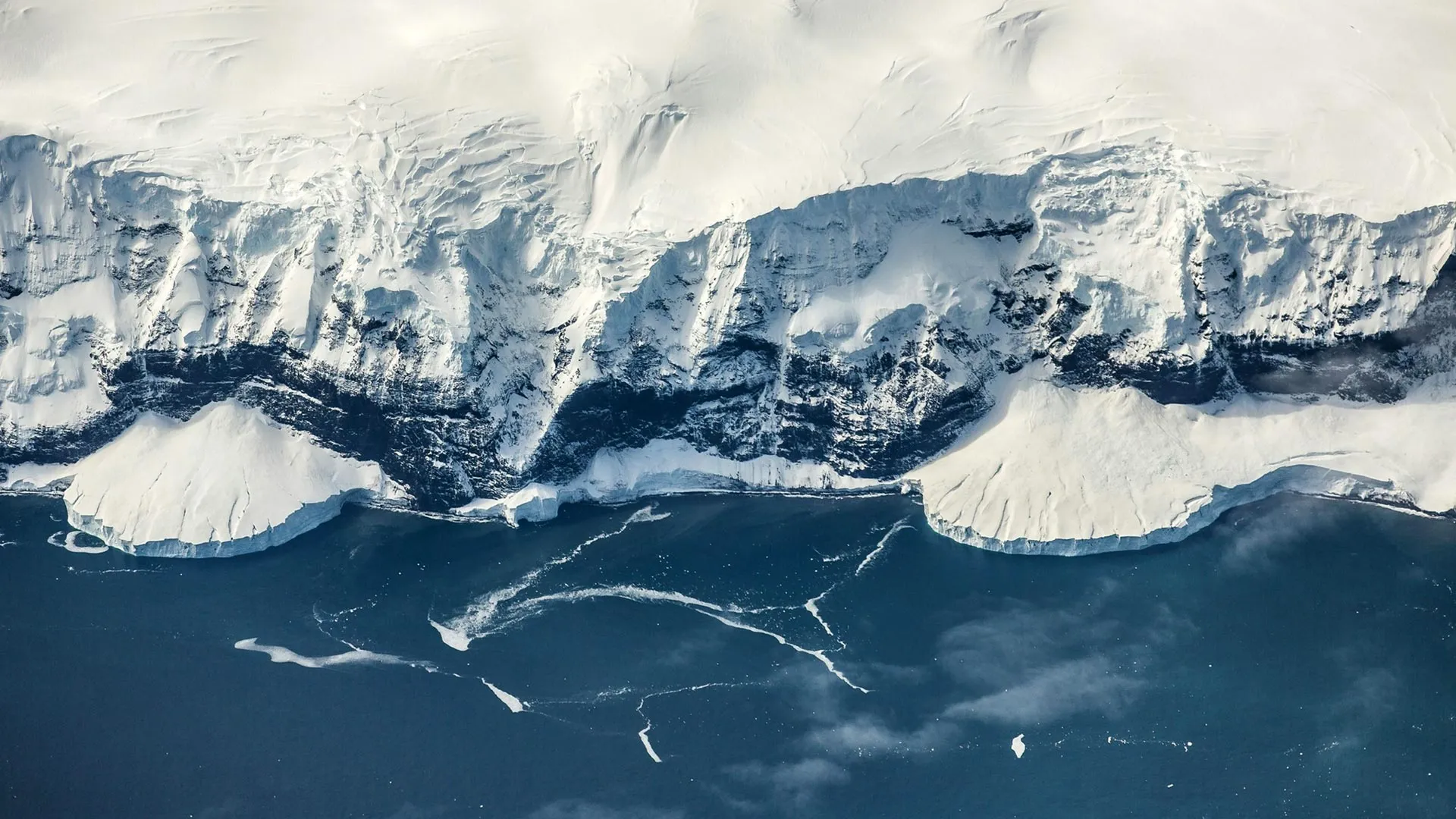
Ranked by verification strength, evidence, and original report placement.
Forces deep inside Earth gradually lifted much of East Antarctica over more than 100 million years, helping set the stage for ice sheet formation about 34 million years ago.
The simulations indicate that by about 45 million years ago, large parts of East Antarctica had climbed above the critical elevation, about 2 km, required for mountain glaciers to develop and expand.
Mantle waves, recently identified by Prof Gernon's team, travel beneath continents after tectonic plates begin to separate and have previously been linked to the eruption of diamond volcanoes and mysterious phases of uplift within continents.
Dr Thea Hincks of the University of Southampton, who co-led the study, said the models can realistically capture the evolution of the two-kilometre-high coastal escarpment, elevated plateau and inland mountains, eventually seeding the East Antarctic Ice Sheet.
Prof Thomas Gernon said that if falling CO2 acted alone you would expect the poles to respond more symmetrically, and that Antarctica gained a head start because geological processes had raised land to higher elevations, making it colder.
Once glaciers took hold, their bright surfaces reflected sunlight and helped cool the region further.
Follow any of these and your For You feed starts watching them — no settings page required.
Evidence-backed comparisons of source perspectives and observed adoption signals. Read the methodology
Which Builder, Operator, and Investor concerns the observed source mix emphasized—not a truth score.
Evidence, demonstrated adoption, hype gap, incentives, and confidence are assessed independently, each on its own current evidence. How these are measured.
Peer-reviewed venue, single promotional source
The findings are attributed to a paper in Science with named co-authors across six institutions and include specific, checkable quantities (2 km threshold, ~45 Ma, ~34 Ma, ~52 m sea-level equivalent, ~1C albedo cooling). But every detail in the cluster traces to one University of Southampton press release republished by ScienceDaily, with no DOI, no uncertainty ranges, no data or code pointer and no independent expert assessment.
No adoption surface
This is a paleoclimate modelling result. The supplied source records no releases, deployments, benchmarks, pricing or licensing changes, usage disclosures or third-party uptake of the models, so no adoption level can be measured without inventing facts.
Framing runs ahead of shown support
The release opens with 'scientists may have solved the mystery' and headlines a deep-Earth cause for Antarctic glaciation, while the demonstrated content is a single group's model reconstruction, using a mechanism that group itself recently proposed, presented without uncertainty ranges, validation detail or outside comment. The underlying numbers are specific and hedged in places ('results suggest', 'simulations indicate'), so the overstatement is moderate rather than severe.
Author-institution release, self-citing mechanism
The only source is a University of Southampton press release carried by an aggregator, credited to the institution that led the study. All five quotes come from co-authors, the explanatory mechanism ('mantle waves') is the lead author's team's own prior discovery, and no critical or independent voice appears - a strong promotional alignment between the source and the claims.
Internally consistent but uncorroborated
Confidence is limited by single-publisher, single-source coverage with a clear promotional incentive, and by the absence of uncertainty figures or outside review. It is not lower because the claims are internally consistent, quantitatively specific, attributed to named researchers at six institutions and tied to a peer-reviewed Science paper.
science
A kilometer-high cliff, not the river, may have stripped the Grand Canyon's basement2 distinct publishers
product
Geologic hydrogen's firmest numbers come from mine vents, not reservoirs1 distinct publisher
science
Graz group measures the geometry a single-molecule collision has to hit1 distinct publisher
science
Two Neanderthal pelvises suggest the strange hip belongs to the modern human male1 distinct publisher
Distinct publishers with included, body-backed reporting in this cluster.
1 article · August 25, 2026