Science1 publisher3 min readPublished
Graz group measures the geometry a single-molecule collision has to hit
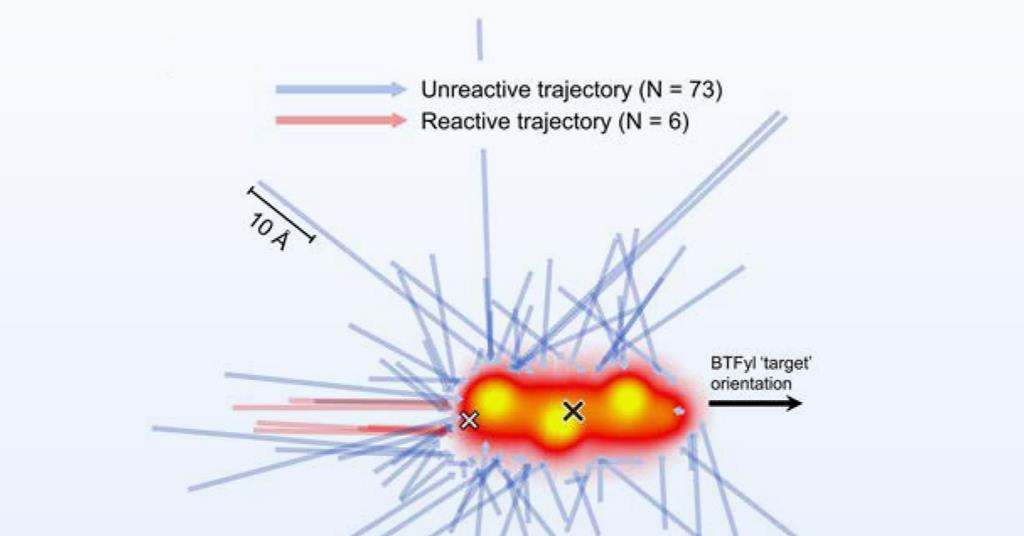
Six reactions out of 79 recorded collisions on a copper surface gave surface chemists a contact point, an impact parameter and a 15-degree orientation window instead of an averaged rate.
The Scientist · Science desk
Drafted by a language model from the sources cited here and checked against its claim ledger before publication. How we use AISend a correction
What happened
- A team at the University of Graz, Austria, observed molecular coupling reactions on a single-crystal surface.
- Leonhard Grill and post-doctoral researcher Matthew Timm used a scanning tunnelling microscope (STM) to project a molecule of difluorocarbene (CF2) onto a target radical (BTFyl) anchored to a copper surface.
- The set-up enabled the team to control the impact parameter by launching the CF2 molecules directly and in a straight line along different atomic rows on the surface.
- The researchers were able to control the orientation of the BTFyl target by rotating it around its anchor point.
- Grill: "For the first time, we have been able to directly observe in real space and with single molecules which collision geometry must be met for a successful reaction."
Compiled by The ScientistSomething wrong?How this is made
Why it matters
A group at the University of Graz has fired single difluorocarbene (CF2) molecules along the atomic rows of a copper surface at an anchored radical target and recorded, collision by collision, where the two reactants touched, how far off-centre the hit was, and how they were aligned [1][2][3][6]. That turns collision geometry from a quantity inferred from averaged reaction rates into three numbers measured on individual events, which is the difference between a statistical trend and a target a model can be tested against [5][6].
The setup matters more than the result here. Grill and post-doctoral researcher Matthew Timm used a scanning tunnelling microscope to project the CF2 onto a BTFyl radical bound to the copper [2]. Because the CF2 travels in a straight line along a chosen atomic row, the impact parameter, meaning how far the collision falls from the reactants' centre of mass, is set by which row is used rather than left to chance [3][6]. The target's orientation was set separately by rotating it about its anchor point [4]. Controlling the impact parameter, Grill says, was long treated as the "forbidden fruit" of reaction dynamics because of the technical difficulty of doing it, and the main challenge in this case was working with relatively large molecules that can adopt many adsorption orientations on a surface [11][12].
The yield is the informative part. Reactions occurred mainly when the CF2 approached along the same copper row to which the target was bound [8]. Of 79 observed collisions, six produced a reaction, a narrow band of impact parameters and about 7.6 per cent of events [9][17]. No reaction at all was seen when the orientations of the CF2 and the BTFyl differed by more than 15 degrees [10]. From this the authors conclude that reactions happen only within a "cone of reaction" set by a specific contact point and a limiting angle [7]. That conclusion rests on one reactant pair and 79 events, and the 15-degree figure is the bound observed in this dataset rather than a constant carried over to other systems.
Grill argues the picture changes what a collision has to satisfy: not only where one reactant strikes another, but the orientation of both, and he expects the cone to matter more as reactants get larger and carry side groups whose geometry has to be understood to predict rates [19]. The general problem is not new. Misaligned collisions have long been known to do nothing, and the point of impact has been hard to control because it requires confining reactants along precise paths [18]. What is new, on the group's own account, is seeing all three geometric parameters in real space for single molecules at once [5][6].
The work is published in Science, and the group says it is already running similar systems to test whether the behaviour generalises [13][14]. That is the number to wait for: a second cone, from a different reactant pair, with its own angular limit. Jonas Björk of Linkoping University, writing in a related article, suggests further measurements could show how molecular structure, reactive sites and environment shape reaction pathways, and could support single-molecule studies of how chirality affects reactivity by controlling the handedness and orientation of reactants directly [15][16].