Product1 publisher3 min readPublished
Geologic hydrogen's firmest numbers come from mine vents, not reservoirs
A decade of borehole data from Ontario's Kidd Creek mine puts about 140 tonnes of hydrogen a year escaping unused. That is roughly where the evidence stands.
The Product Desk · Product desk
Drafted by a language model from the sources cited here and checked against its claim ledger before publication. How we use AISend a correction
What happened
- Barbara Sherwood Lollar, a geochemist at the University of Toronto, descended into the Kidd Creek mine in northern Ontario in the 1990s; the mine cuts more than three kilometers into the ancient root of North America. Decades later she revisited her team's hydrogen data to assess whether the mine holds enough gas to be a useful source of zero-carbon fuel.
- At Kidd Creek, Sherwood Lollar's team found water confined underground for more than a billion years, an ancient brine hosting microbes that feed on hydrogen produced by reactions between the water and the rock.
- Producing hydrogen fuel typically generates lots of greenhouse-gas emissions and requires more energy than the gas contains; tapping ready-made underground reservoirs, so-called geologic hydrogen, would change the equation.
- Geologic hydrogen is produced underground when water molecules are split by chemical reactions with iron-rich rock or, as at Kidd Creek, by the radioactive decay of other elements.
- Researchers at the US Geological Survey have estimated that trillions of tons of H2 are produced within Earth's crust, and that if a small fraction could be recovered it could meet global hydrogen demand for centuries.
Compiled by The Product DeskSomething wrong?How this is made
Why it matters
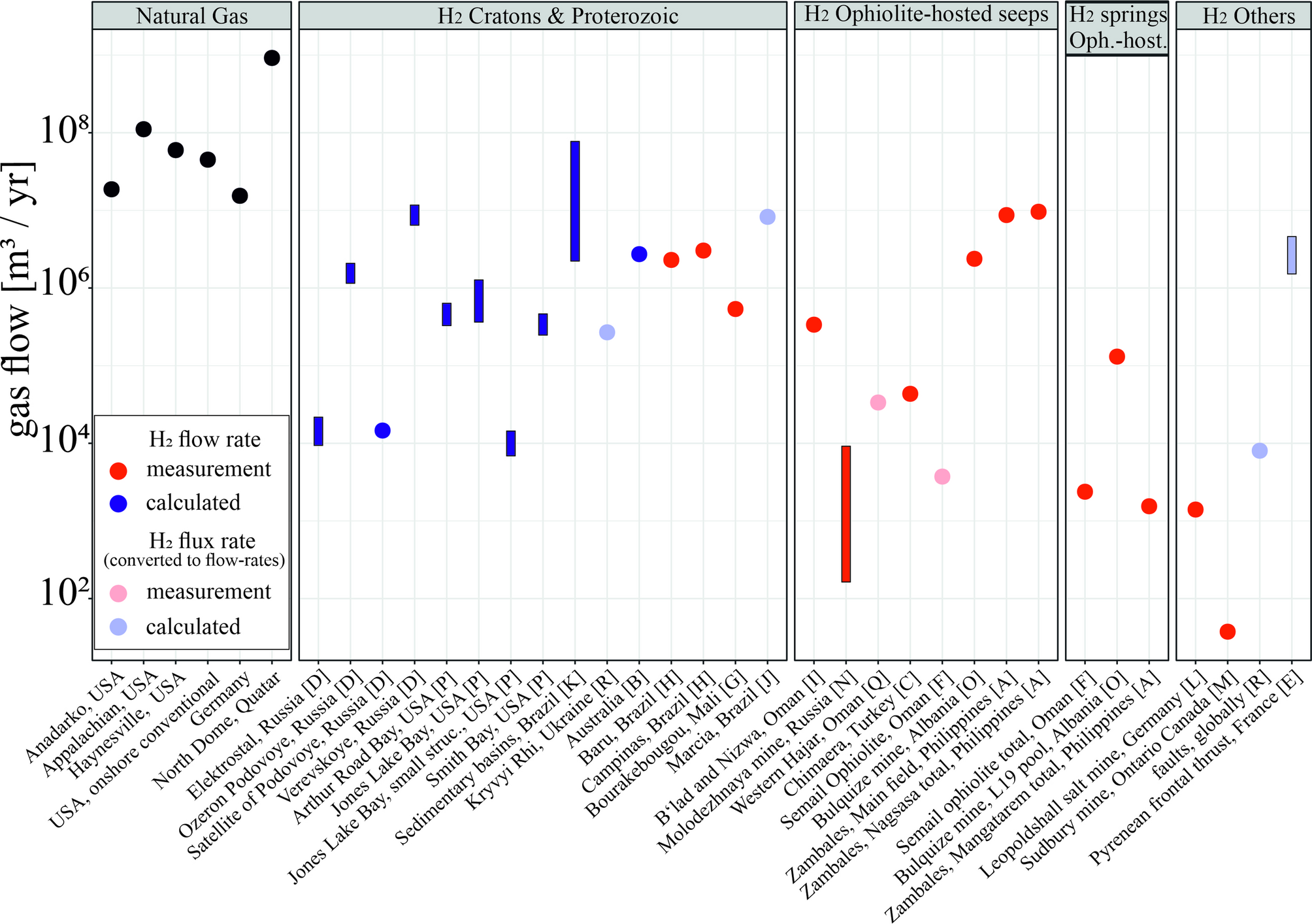
A University of Toronto team went back through more than a decade of its own hydrogen measurements at the Kidd Creek mine in northern Ontario and published an estimate, in PNAS earlier this year, that around 140 metric tons of hydrogen flows unused out of the mine's vents every year [1][9]. The number matters less for its size than for what it says about the state of the resource case for geologic hydrogen: the field's most concrete public figures now come from gas leaking out of existing mine workings, not from any reservoir a company has drilled and reported [8].
The arithmetic is worth stating plainly. Barbara Sherwood Lollar and her colleague Oliver Warr had a long-term record from 35 boreholes at Kidd Creek, and over more than a decade each hole released an average of eight kilograms of hydrogen a year [6]. Extrapolating to the more than 14,000 boreholes at the mine produces the 140-tonne total [7]. Multiply 14,000 holes by eight kilograms and you get 112 tonnes, so the published figure implies closer to 17,500 producing holes [14]. Sherwood Lollar describes the tally as not world-changing but says that if all of it were captured it might power a substantial portion of the mine's own operations, which would serve as a local demonstration that the gas can be put to work [10].
The reason anyone is doing this arithmetic is that manufactured hydrogen carries an energy penalty: producing it typically generates large greenhouse-gas emissions and takes more energy than the gas itself contains [3]. Hydrogen already sitting underground, formed when water molecules are split by reactions with iron-rich rock or, as at Kidd Creek, by radioactive decay, would change that calculation [4]. The US Geological Survey has estimated that trillions of tons of H2 are generated within Earth's crust, and that recovering a small fraction could meet global demand for centuries [5]. That is an estimate of generation, not an inventory of tappable accumulations. No one has yet reported a commercially viable reservoir, and public data remains scarce while companies compete for acreage and investment [8]. Dozens of startups are searching, including Australia's HyTerra and the Gates-backed Koloma, both working the US Midwest toward ancient oceanic rocks associated with hydrogen production [15].
The other anchor point is also a mine. In 2024, a team led by Laurent Truche of the University of Grenoble Alpes reported at least 200 metric tons of hydrogen flowing annually out of the Bulqize chromium mine in Albania [11], making Kidd Creek's tally about seven-tenths of that [16]. Truche says Kidd Creek adds to growing evidence that natural hydrogen generation and migration are genuine geological processes, and that the remaining challenge is not proving natural hydrogen exists but proving it can be produced economically and reliably at commercial scale [12][13].
That is why the stimulation route is drawing money. More than a dozen projects funded by ARPA-E aim to speed the hydrogen-producing reaction by injecting water, heat or catalysts, against an agency goal of a 10,000-fold acceleration, the rate researchers estimate would make stimulated production commercially viable [17][18]. In Oman, a team drilled a one-kilometer borehole, injected 50,000 cubic meters of water, and found gas spewing out months later at 90% hydrogen, according to University of Southampton geoscientist Jo Shannon, who presented the result at the European Geosciences Union conference in May and declined to comment further [19][20].
What to watch: whether anyone actually engineers capture at Kidd Creek rather than measuring the vents again; whether the Oman well's flow rate and decline curve appear in a published paper rather than a conference slide [20]; and whether any of the explorers releases reservoir data instead of positioning statements [8].