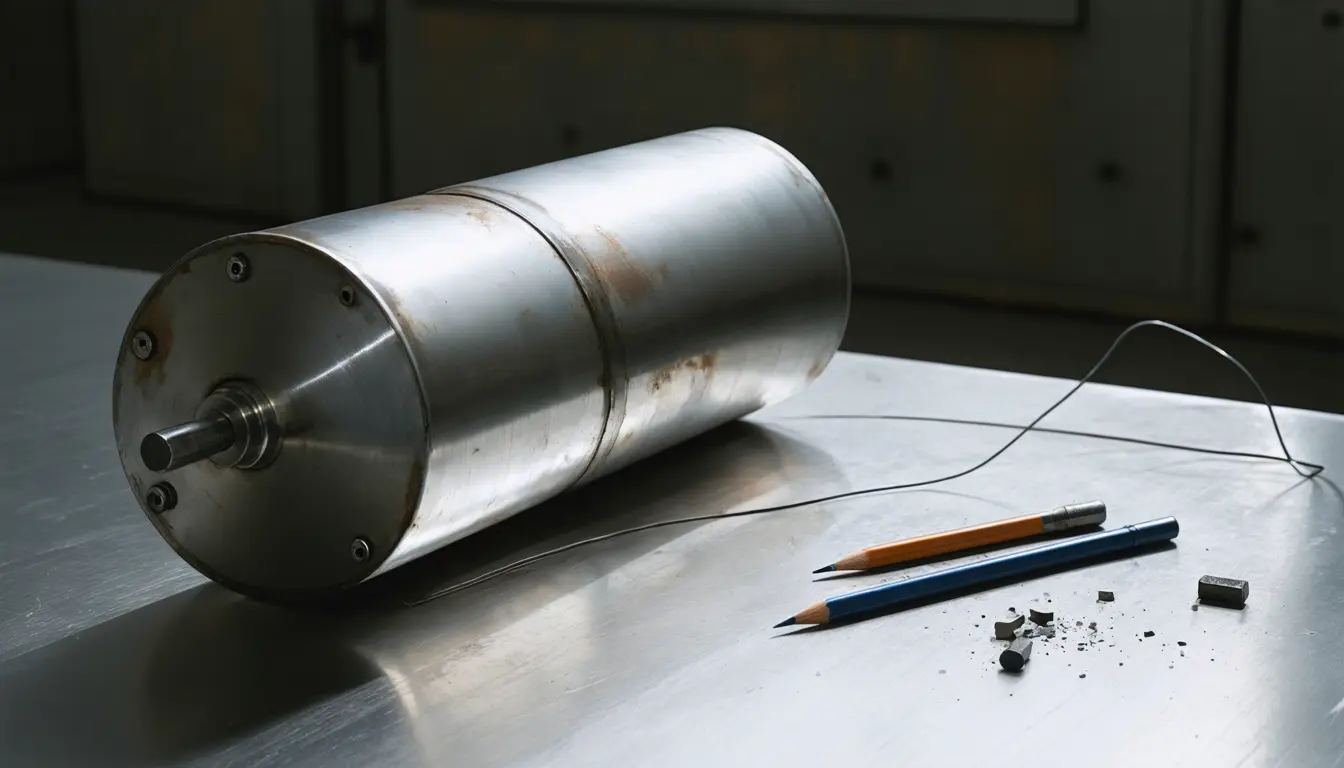
Pitt's fiber-optic sensor locates pencil-lead breaks on a mock spent-fuel canister at Idaho National Laboratory
University of Pittsburgh researchers tested a fiber-optic sensor for signals above 100 kHz on a mock spent-fuel canister at Idaho National Laboratory. The sounds came from pencil-lead breaks, so detection of real cracks is still untested.
The Product Desk
Bar comparison of detectable acoustic signal frequency: the Pitt fiber-optic sensing system detects signals above 100 kHz, against the 20 kHz capability Khurram Naeem cited for most conventional systems.
Detectable acoustic signal frequency, per Khurram Naeem
| Item | Value | Claim |
|---|---|---|
| Pitt fiber-optic system, above | 100 kHz | 8 |
| Most conventional systems | 20 kHz | 8 |
What happened
- The team ran the tests from September 8 to 11 and tried different sensor configurations to gauge how sensitive the system is.
- The demonstration completed the first phase of a project supported by funding from the US Department of Energy.
- Sensible Photonics, a startup co-founded by Pitt professor Paul Ohodnicki, worked on the project with scientists from three national laboratories.
- The team is seeking further funding to evaluate the system's durability and stability and move it toward commercial use at storage facilities.
Why it matters
- What's now possible capability If the approach holds up, fibers could be retrofitted onto casks already in service to pick up the acoustic signals of developing cracks before they compromise the containers.
- What it limits constraint The team has evaluated attachment methods meant to last years in heat and radiation, but the report shows no result yet that they do.
- Who has to decide decision The evidence so far comes from a simulated signal, so storage-site operators should follow the project for now and hold off on buying or scheduling around it.
Take the person who runs dry storage at a coastal plant. The fuel in the steel canisters has left the reactor but still generates heat, so the storage casks around them include ventilation openings [7]. Salty air can enter through those openings and contribute to corrosion of the steel [6]. Over time, corrosion may lead to cracks that threaten the canisters' structural integrity [6]. The Pittsburgh sensor is designed to monitor those canisters [5].
Khurram Naeem, a research assistant professor at Pittsburgh and technical lead for the demonstration, said the system can detect signals above 100 kHz, against the 20 kHz he cited for most conventional systems [8]. That is a factor of five [16]. Interesting Engineering, which reported the work, points out that the higher frequency is a capability of the hardware and does not by itself show that the system finds cracks five times sooner or with better accuracy [9].
The researchers installed optical fibers on the outside of the mock canister and tried several arrangements [10]. They also ran pencil-lead-break tests, a standard technique that produces repeatable acoustic signals simulating the emissions of material damage [10]. "Through a series of pencil-lead-break tests, we showed that the technology could detect the sound and find the source," Naeem said [11].
According to Interesting Engineering, the tests left open whether the system can reliably pick out real corrosion or cracking on canisters in service [13]. Its long-term performance under nuclear storage conditions also remains to be demonstrated [13].
We'd put any monitoring claim on a two-by-two. One axis is the signal: a simulated break, or real corrosion and cracking. The other is time: days on a mock canister, or years on an operating one. Phase one sits in the simulated, short corner, with a four-day test window [17] and pencil-lead breaks as the signal [10]. In our view, a result that should move an inspection budget has to sit in the opposite corner.
What to watch
- Whether the team secures the further funding it is seeking for durability and stability testing.
- A test on actual corrosion or cracks in an operating canister, which the Idaho work did not cover.
- Results from sensors left in place for years under high-temperature and high-radiation conditions.
Clarity's read
What the record supports and how the coverage leans. The claims behind it follow.
Reality
- Evidence40
- Adoption
- Not scored
- Hype gap+15
- Incentives
- Not scored
- Confidence55
Claim ledger
Ranked by verification strength, evidence, and original report placement.
- [1]
University of Pittsburgh researchers demonstrated a fiber-optic sensing system capable of detecting acoustic signals above 100 kHz, roughly five times the frequency cited for conventional systems.
- [2]
The system, developed with Pittsburgh startup Sensible Photonics, was field tested at Idaho National Laboratory in September using a mock nuclear fuel canister to test whether the sensors could detect vibrations and locate their source.
- [3]
The researchers conducted the tests from September 8 to 11, using different sensor configurations to assess the system's sensitivity.
- [4]
The demonstration marked the completion of the project's first phase, supported by funding from the US Department of Energy.
- [5]
The technology is designed to monitor steel canisters that hold spent nuclear fuel and could eventually be retrofitted onto existing storage casks, allowing operators to detect acoustic signals associated with developing cracks before they compromise the containers.
- [6]
At coastal nuclear facilities, salty air can enter through the cask ventilation openings and contribute to corrosion of the steel canisters; over time, corrosion may lead to cracks that threaten structural integrity.
- [7]
Spent fuel continues to generate heat after removal from a reactor, so storage casks include ventilation openings that help dissipate heat.
- [8]
According to Khurram Naeem, a research assistant professor at Pittsburgh and technical lead for the demonstration, the system can detect signals above 100 kHz, compared with the 20 kHz capability he cited for most conventional counterpart systems.
- [9]
The higher detection frequency is a technical capability, not evidence that the system detects cracks five times earlier or more accurately.
- [10]
During the INL demonstration, researchers installed optical fibers outside a mock nuclear fuel canister and tested several arrangements; they also ran pencil-lead-break tests, a standard technique for generating repeatable acoustic signals that simulate the emissions associated with material damage.
- [11]
"Through a series of pencil-lead-break tests, we showed that the technology could detect the sound and find the source," Naeem said.
- [12]
The team also evaluated methods for attaching sensors to storage casks, with the aim of developing installations capable of remaining in place for years under high-temperature and high-radiation conditions.
- [13]
The tests did not establish that the system could reliably identify actual corrosion or cracks in operating nuclear fuel storage canisters, and its long-term performance under nuclear storage conditions remains to be demonstrated.
- [14]
The project involves researchers from Pittsburgh's Swanson School of Engineering and Sensible Photonics, a startup co-founded by Pitt professor Paul Ohodnicki, who collaborated with scientists from Idaho National Laboratory, Oak Ridge National Laboratory and Pacific Northwest National Laboratory.
- [15]
The team is seeking further funding to evaluate the system's durability and stability and advance it toward potential commercial use at nuclear storage facilities.
- [16]
100 kHz against the 20 kHz cited for conventional systems is a factor of five, matching the source's 'roughly five times'.
- [17]
The September 8 to 11 test window covers four days.
Get this ledger inside ChatGPT. Ask about any of our stories and the answer brings its figure, each claim’s verdict and the sources. Free, no account.
Sources
1 independent publisher whose own reporting we read for this story.
- interestingengineering.comNew nuclear waste sensor detects 100 kHz vibrations, could help spot canister cracks
1 article · October 15, 2026
Topics and entities
Follow any of these and your For You feed starts watching them — no settings page required.
Entities
- Idaho National LaboratoryFollow
- University of PittsburghFollow
- Khurram NaeemFollow
- Sensible PhotonicsFollow
- US Department of EnergyFollow