Science1 publisher2 min readPublished
Female gray tree frogs choose mates less reliably as competing calls multiply in a lab test
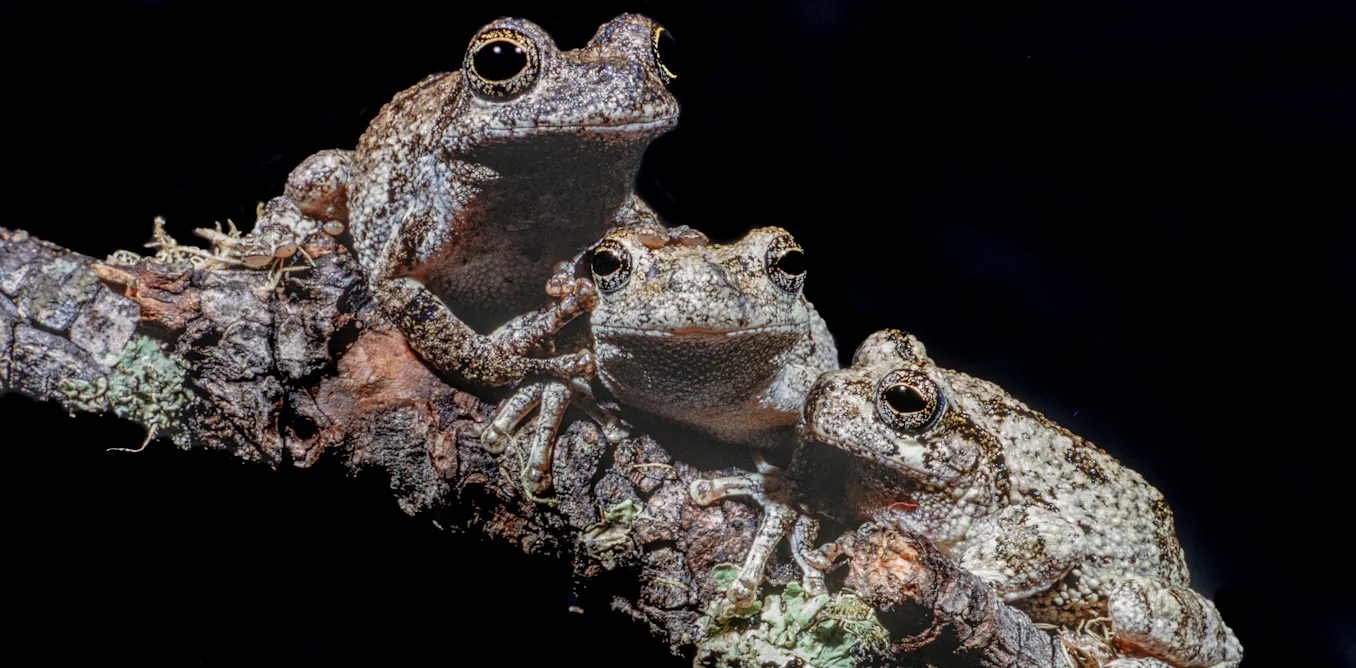
Female gray tree frogs got slower and worse at picking an attractive mating call as rival calls multiplied, a 60-frog lab study in iScience found. The authors trace the decline to how females weigh options, though its effect on which males mate in a wild chorus has not been tested.
The Scientist · Science desk
What happened
- The females were caught from breeding choruses in East Tennessee and tested in a lab, where each chose a call by hopping toward its speaker.
- Each frog heard one long, attractive target call alongside one, three or seven shorter, less attractive distractor calls.
- As distractors were added, females were also more likely to make no choice at all within the 10-minute test window.
- Wild gray tree frog choruses can include dozens or even hundreds of calling males, far more than the eight calls the lab offered at most.
Compiled by The ScientistSomething wrong?How this is made
Why it matters
- constraint Weak female preferences in a chorus can no longer be read as a hearing problem by default; field designs will need to separate what a female can hear from how many options she can weigh.
- cost If overload carries over to ponds, the cost falls on offspring, because overloaded females could mate with males they would otherwise reject, whose traits are linked to poorer offspring fitness.
- decision If the authors' untested idea holds, chorus size becomes a strategic choice for males, with less attractive males gaining in big choruses and attractive males in small groups or alone.
The playback schedule is what makes this experiment worth reading. In a pond, calls overlap, and overlapping signals make it harder to pick one out of the noise, a problem known as energetic masking [7]. Biologists have long seen female preferences weaken in choruses and have usually blamed masking [8]. The team took it out of play by running every recording in sequence, so no two calls ever overlapped [6]. Each call reached the female clean, and her choices still degraded as calls were added [5].
I think the design settles its narrow question. With overlap gone, the authors place the limit in the female's own cognition [17]. "The challenge comes from too many males to choose from, not being unable to hear the males clearly," one of them wrote in The Conversation [9].
Across the three set-ups a female faced two, four or eight speakers [1]. A frog hopping at random would reach the target half the time in the smallest set-up and one time in eight in the largest [2]. A female whose preference held firm would pick the target every time, whatever the number of speakers. So the useful measure is how far the frogs slid toward the chance floor. The Conversation account reports the direction of each effect. It does not report the proportions or decision times [5].
The lab test cannot show who mates in a real pond. Besides capping the options, the arena removed vegetation and predator risk [12]. In a natural chorus, sensory and cognitive limits probably act together, and the authors say their next step is to measure how much overload matters there [14]. They want to know whether decisions really take longer in the wild and whether females end up with less preferable males [14]. Until then, the claim that chorus density changes which males mate rests on a lab preference test [14]. So does the authors' suggestion that males could exploit the limit [11].
Other animals show the same pattern. Bees choosing among flowers, ants comparing nest sites and mosquitoes picking egg-laying sites all decide worse as options multiply, according to the authors [15].
What to watch
- Field data from natural gray tree frog choruses on whether females take longer to choose and end up with less preferred males.
- The iScience paper's success rates at each set-up, set against the 1-in-8 chance level at eight calls.
- Any comparison of mating success for short-calling males in large versus small choruses, the direct test of the exploitation idea.