Science1 publisher3 min readPublished
Frozen DNA samples put the black teatfish's lifespan beyond a century
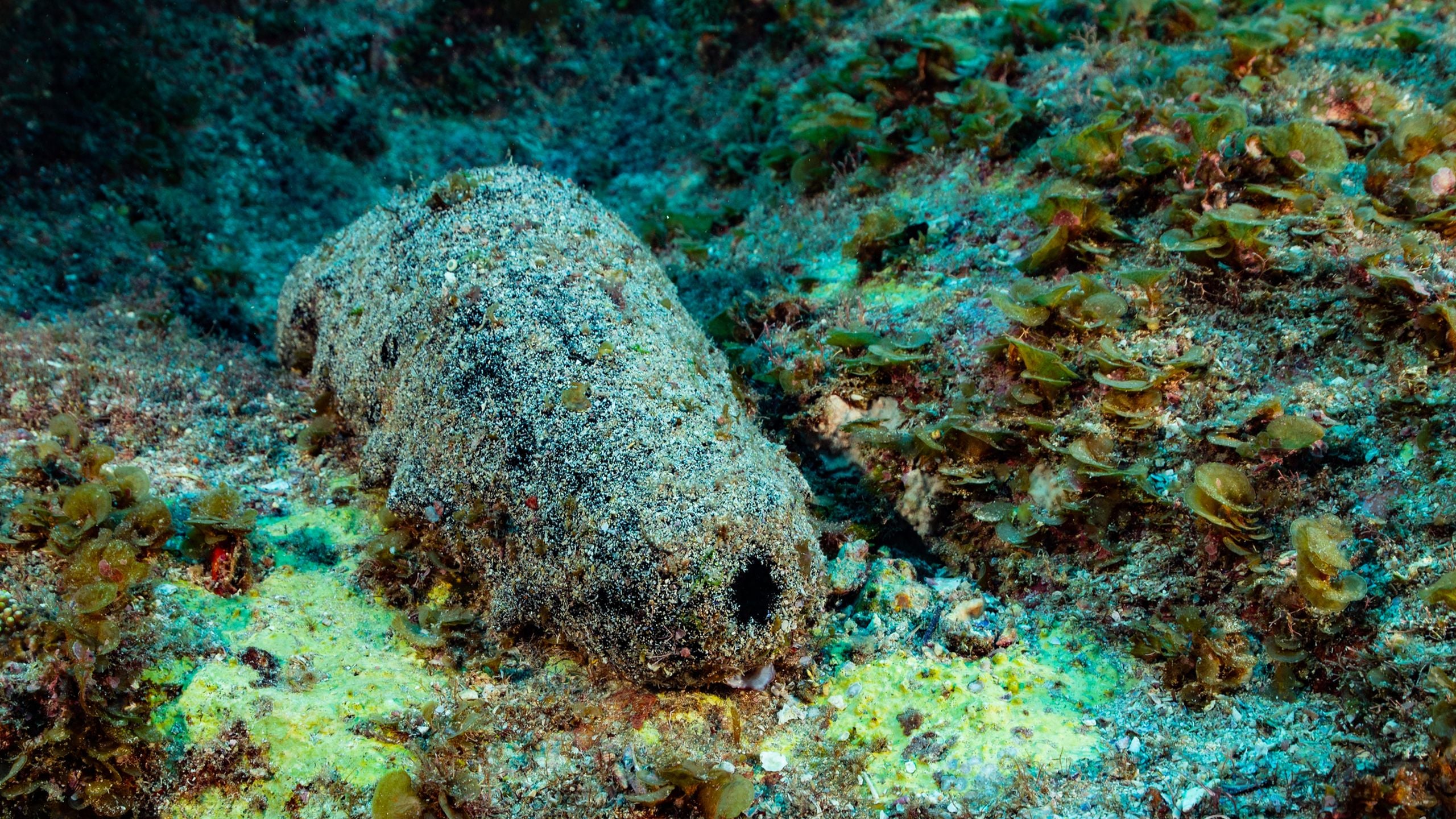
Australian Institute of Marine Science biologists re-identified 31 black teatfish by DNA after 24 years and estimate the species can live more than 120 years. Adults barely grow, so a teatfish's size reveals little about the age of an endangered animal still prized as a delicacy.
The Scientist · Science desk
Drafted by a language model from the sources cited here and checked against its claim ledger before publication. How we use AISend a correction
What happened
- At Bird Islet in September 2024, 31 of the 52 animals analyzed matched 2000 samples, so at least 60 percent of that reef's teatfish were 24 or older.
- The matched animals were near full size in 2000, yet by 2024 they averaged 21 percent lighter and 14 percent shorter, for reasons the researchers could not pin down.
- Of the 76 teatfish genetically profiled in 2000, 31 turned up again, an adult survival rate of at least 41 percent over 24 years.
Compiled by The ScientistSomething wrong?How this is made
Why it matters
- capability DNA from stored tissue works as a permanent tag, letting researchers follow individual animals across decades even when, like sea cucumbers, they shed every physical marker.
- constraint Because adults stall or shrink once full-grown, length cannot separate a 24-year-old teatfish from a younger adult, so age data for this species has to come from repeated genetic sampling.
- exposure On a reef where at least 60 percent of adults are 24 or older, most animals a harvest removes would be decades old, and replacing them depends on how fast juveniles arrive.
- decision Anyone setting harvest rules from the 120-year figure is choosing to trust a constant-mortality extrapolation over the 24 years of survival actually observed.
The study gets two percentages from the same 31 animals, and they answer different questions [11][14]. Divide by the 52 teatfish analyzed at Bird Islet in 2024 and the result describes the reef: at least 60 percent of its adults were already there in 2000 [11]. Divide by the 76 animals genetically profiled in 2000 and the result describes a cohort: at least 41 percent survived 24 years [14]. The lifespan estimate is built on the second figure [15].
Spread evenly over 24 years, 41 percent survival means about 96 percent of adults live through any given year, so roughly 4 percent are lost annually [1]. If that rate holds, about one adult in a hundred would still be alive after 123 years [2]. That is my own check on scale, not the authors' method. ScienceAlert's report states their assumption that adult mortality stays roughly constant [15]. It does not give the full calculation behind the 120-year figure, or compare it with any fishery's catch limits.
The study cannot show whether mortality stays flat in very old animals. The teatfish matched in 2024 were already 26 to 42 centimetres long in 2000, near the species' maximum size [12]. Their 24 years on record are a minimum, added to an unknown starting age. The century comes from extrapolating the 24-year observed record [10]. In my view the 24-year survival is the firmer result, and it is remarkable on its own. "This species is the first sea cucumber species known to surpass a longevity of a century," the authors wrote in iScience [4]. They also wrote: "Although individuals of some sea urchin species can live to over 100 years, deriving at a similar conclusion for the black teatfish was surprising" [3].
Once a teatfish is adult, its size says little about its age [12][13]. Most of the 31 matched animals had shrunk, averaging 21 percent lighter and 14 percent shorter than in 2000 [13]. Sea cucumbers can lose and regain body mass. The researchers suggest changing environmental conditions may have played a role, though the cause is unclear [13].
The design is a good one, and patient. Physical tags fall off sea cucumbers within weeks or months [6]. So when Uthicke and John Benzie tried to census the Great Barrier Reef population after falling numbers closed the fisheries in 1999 [5], they used each animal's DNA as its tag [7]. Return visits after six months and a year re-identified individuals and showed the population was not bouncing back from overfishing [8]. Those early results hinted at lifespans of several decades, but the window was too short for confidence, and the samples went into cold storage [9]. In September 2024 the team went back to Bird Islet and sampled 53 animals [10].
For a fished species, a 4 percent annual loss [1] means the adults on a reef built up over decades. The resighting design follows adults, so it measures how long they persist. How quickly juveniles replace animals taken by a fishery is a separate question. I'd expect a harvested reef to rebuild slowly, provided new animals arrive about as slowly as old ones die. The lack of a rebound after the 1999 closures fits that expectation without proving it [5][8].
What to watch
- Repeat DNA surveys at the other Great Barrier Reef sites sampled in 2000, which would show whether Bird Islet's survival rate is typical.
- Evidence that teatfish mortality rises with age, which would pull the 120-year estimate down while leaving the 24-year survival result intact.
- Any reassessment of black teatfish harvest rules that cites these survival estimates.