Invest2 publishersIndependently confirmed3 min readPublished
XPeng's $900m robot spin-out comes with a seven-year clock and a $1bn put
A third of the money is XPeng's own. The rest can demand roughly $1.03 billion back if Dogotix misses its IPO deadline, while the car business loses 1.34 billion yuan a quarter.
The Investor · Invest desk
What happened
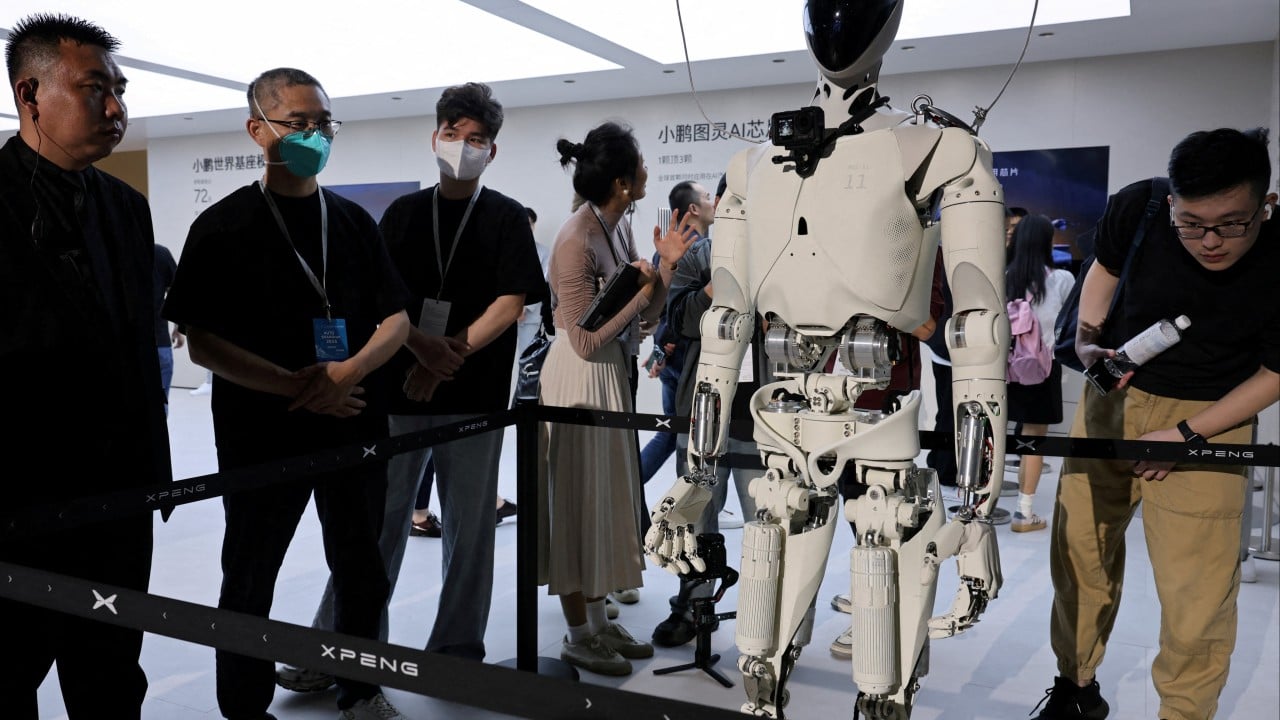
- XPeng's robotics business raised more than $900 million at a $6.3 billion valuation in a round led by IDG Capital.
- The robotics assets, IP and staff move into a new standalone subsidiary named Dogotix.
- XPeng keeps about 82 per cent of Dogotix, falling to 68.41 per cent if warrants and an incentive plan are fully used.
- The robot plan starts above 1,000 units a month and targets 1 million a year by 2030.
Compiled by The InvestorSomething wrong?How this is made
Why it matters
- cost The IPO clause behaves like borrowing: miss year seven and XPeng's consolidated balance sheet faces a repurchase of roughly $1.03 billion against $600 million received.
- exposure Because a third of the headline number is XPeng's own subsidiary and its two top executives, the $6.3 billion mark rests on far less arm's-length capital than $900 million suggests.
- constraint Keeping Dogotix consolidated means the robotics burn keeps hitting the same income statement that is already showing a widening loss, limiting how much separation the spin-out actually buys.
- precedent A humanoid unit funded on an IPO ratchet sets the template other Chinese physical-AI arms will be asked to accept, with the parent underwriting the downside.
The buyback clause is the most informative number in this deal, and it is not the part being quoted. Seven years of 8 per cent compound interest turns each dollar of investment into about $1.71 [18], comfortably above the alternative 120 per cent of cost written into the same clause [12]. The floor never binds. If Dogotix has not completed a qualified IPO by year seven, the outside investors who put up $600 million [4] can ask for roughly $1.03 billion [19]. Dogotix stays consolidated on XPeng's books [11], so the parent carries that contingency.
Then look at who bought. Of the $900 million, $200 million came from an XPeng subsidiary and $100 million from companies controlled by chief executive He Xiaopeng and co-president Brian Gu [4]. A third of the round is XPeng and its own executives marking the asset at $6.3 billion [20]. The arm's-length price discovery here is the $600 million from IDG Capital, Tencent, Alibaba and Gaorong Ventures [1][3].
What the money has to buy is volume. XPeng wants more than 1,000 robots a month at first and 1 million a year by 2030 [16], which is about 83 times the initial annualised rate [21] and roughly 2.4 times the pace of its car business, annualising the 103,295 vehicles delivered in the second quarter [14][22]. XPeng's argument for getting there is that its existing car supply chains and factories beat Tesla's position, and that Tesla has yet to sell an Optimus [9].
Demand is the part nobody has priced. The first IRON units go into XPeng's own showrooms and factories so the company can iterate without outside customers [15], with commercial deliveries in China and abroad scheduled for 2027 [8]. The order book starts empty by design.
The parent's arithmetic sits underneath all of it. A second-quarter net loss of 1.34 billion yuan against 19.7 billion yuan of revenue is 6.8 per cent of sales [6][23], and a 179 per cent widening implies a year-ago loss of about 480 million yuan [24]. According to XPeng, research and development costs rose 32.1 per cent in the quarter [7]. Because Dogotix remains consolidated, its spending keeps landing in the same income statement, only now partly funded by other people. That is the trade on offer: give up robotics equity down to about 68 per cent in the fully diluted case [11] so someone else pays for the ramp, and accept a repurchase obligation if the listing does not arrive.
None of the closing conditions have been met, and the deal could still fall through [5]. The equity market's read was a 2.38 per cent decline to $11.90 in pre-market trading [13].
What to watch
- Whether the unmet closing conditions are satisfied, or the round is renegotiated or abandoned.
- Whether IRON units leave XPeng's own showrooms and factories for paying third-party customers in 2027.
- Whether Dogotix files for a listing well inside the seven-year window, which would signal the buyback clause is priced as real.
Clarity's read
What the record supports and how the coverage leans. The claims behind it follow.
Reality
- Evidence62
- Adoption18
- Hype gap+42
- Incentives74
- Confidence66
Claim ledger
Ranked by verification strength, evidence, and original report placement.
- [1]
XPeng's robotics business raised more than $900 million at a $6.3 billion valuation in a round led by IDG Capital.
ReportedSupportedSource: cryptopolitan.com, citing XPeng2 sources— create a free account to open themView cited source - [2]
XPeng is spinning its robotics assets, IP and staff into a standalone subsidiary called Dogotix.
- [3]
Tencent and Alibaba backed the round as strategic investors and Gaorong Ventures participated.
- [4]
Of the $900 million, about $600 million came from external investors, $200 million from an XPeng subsidiary, and $100 million from companies controlled by CEO He Xiaopeng and co-president Brian Gu.
- [5]
None of the closing conditions have been met yet, so the deal could still fall through.
- [6]
XPeng reported a second-quarter 2026 net loss of 1.34 billion yuan ($199.4 million), 179 per cent wider than the same period a year earlier, on revenue up 8 per cent to 19.7 billion yuan.
- [7]
The widened quarterly loss came amid a 32.1 per cent jump in research and development costs.
ReportedSupportedSource: SCMP, citing XPeng2 sources— create a free account to open themView cited source - [8]
XPeng plans to mass-produce IRON by the end of 2026, with commercial deliveries in China and overseas markets starting in 2027.
- [9]
XPeng believes it has a manufacturing advantage over Tesla's Optimus because it can use the supply chains and factories built for its cars; Tesla has yet to sell any Optimus robots.
ReportedSupportedSource: XPeng's claim, reported by cryptopolitan.com2 sources— create a free account to open themView cited source - [10]
XPeng called the round the largest single private funding round ever for a Chinese robotics maker.
ReportedSupportedSource: XPeng statement2 sources— create a free account to open themView cited source - [11]
XPeng will retain about 82 per cent of Dogotix, a stake that could fall to 68.41 per cent once warrants and an equity incentive plan are fully used; Dogotix stays consolidated on XPeng's books.
- [12]
The deal includes a seven-year timeline in which Dogotix must complete a qualified IPO or investors can force a buyback returning their original investment plus 8 per cent annual compound interest, or 120 per cent of what they paid, whichever is higher.
- [13]
XPEV traded down 2.38 per cent at $11.90 in pre-market activity.
- [14]
XPeng delivered 103,295 vehicles in the second quarter, up 64.8 per cent from the first quarter.
- [15]
Early IRON units will work in XPeng's own showrooms and factories so the company can test and improve them without outside customers first.
- [16]
XPeng wants to make over 1,000 robots per month at first, with a long-term goal of 1 million robots per year by 2030.
- [17]
IRON has 76 degrees of freedom across its body, 21 in each hand, and runs on three of XPeng's Turing AI chips providing a combined 2,250 TOPS.
- [18]
Eight per cent compounded annually over seven years returns about 1.71 times the original investment, well above the 120 per cent alternative in the same clause.
- [19]
Applied to the $600 million of external money, the year-seven buyback would total roughly $1.03 billion.
- [20]
The $200 million from an XPeng subsidiary plus $100 million from executive-controlled companies is $300 million, one third of the $900 million round.
- [21]
The 2030 target of 1 million robots a year is about 83 times the initial run rate of 1,000 a month annualised.
- [22]
One million robots a year is roughly 2.4 times XPeng's second-quarter vehicle deliveries annualised.
- [23]
The 1.34 billion yuan quarterly net loss equals about 6.8 per cent of the quarter's 19.7 billion yuan of revenue.
- [24]
A 179 per cent widening to 1.34 billion yuan implies a year-earlier loss of about 480 million yuan.
Sources
2 independent publishers whose own reporting we read for this story.
- cryptopolitan.comXPeng's robot unit raises $900M at $6.3B valuation, led by IDG
1 article · August 24, 2026
- scmp.comEV maker Xpeng set to challenge Tesla in embodied AI after robotics unit raises US$900m
1 article · August 24, 2026
Topics and entities
Follow any of these and your For You feed starts watching them — no settings page required.
Topics
- Humanoid RoboticsFollow
- Venture Funding TermsFollow
- Embodied AIFollow
- Corporate Spin-outs and Deal StructureFollow
- China EV FinancialsFollow