Product1 distinct publisher3 min readPublished
The CameraJet's camera earns its keep in a control loop that fires within 100 milliseconds of spotting a gap, while Dyson keeps none of the images, which leaves the app's coaching to carry the rest of the price.
The Product Desk · Product desk

Compiled by The Product DeskSomething wrong?How this is made
The moment that decides this product arrives partway through a brush, when the head reaches the back of the lower molars and the MyDyson app puts a live image of that spot on your phone [6]. The sensor producing it is 0.1 megapixels, mounted right under the brush head [3]. It has two jobs, and only one of them does work the buyer can feel.
Job one is a control loop. Gap Optical Targeting reads 28 live images a second, and Dyson says the device jets within 100 milliseconds of the camera seeing a gap [4]. Run the frame rate: 28 images a second is one frame every 35.7 milliseconds, so the whole detect-and-fire budget is under three frames [10]. That is a narrow, well-posed problem, which is why a low-resolution camera is the right part to specify: find the gap and fire a small burst before the head has moved on, in doses small enough that nothing pools in the mouth [8].
Job two is advice. The app offers tips, guides and feedback on which areas you already brush well and which you are neglecting [6]. Dyson also says no images are recorded or stored on the product or in the cloud, and live viewing works only while you are live viewing or auto-jetting [7]. That is a defensible privacy position, and it removes the thing that would make the scan actionable over months: an image from week one to hold up against week six. Whatever the coaching says has to be taken on trust rather than checked.
Teams shipping features like this tell themselves that showing people the hidden thing changes what they do. What survives in a bathroom is usually the work a device performs whether or not anyone is watching the screen. Jetting a gap the user never located is that kind of work. Live video of your own molars is a first-week novelty unless it accumulates into a record, and here it cannot. That read is mine, not Dyson's.
Scale is worth keeping in proportion, too. The targeting model was trained on 470,000 dental images collected during development, wrapped in 16 million lines of code [5]. At the camera's own 28 frames a second, that corpus is about 4.7 hours of footage [11]. Ample for gap detection, and nowhere near a diagnostic instrument, which Dyson does not claim it to be.
The cleaning argument rests on Dyson's own bench work: a cone-shaped jet at lower pressure than the needle jets used by other water flossers [13], evaluated against a proxy plaque the company built over a five-year collaboration with the National University of Singapore's Faculty of Dentistry [12].
For anyone about to put a camera into a physical product, two questions sort the spend. Does the sensor drive an actuator within the same second, or does it produce a report a person has to act on? And can the user confirm the benefit inside a week without taking the vendor's word for it? A sensor that acts, with a result the user can feel, is where a premium holds. A report the user cannot verify is where the price gets argued over in the reviews. Dyson has funded both at $500 [1]. The honest way to value that at home is to pay for the part that acts and count the coaching as upside until there is a baseline the user can see.
Ranked by verification strength, evidence, and original report placement.
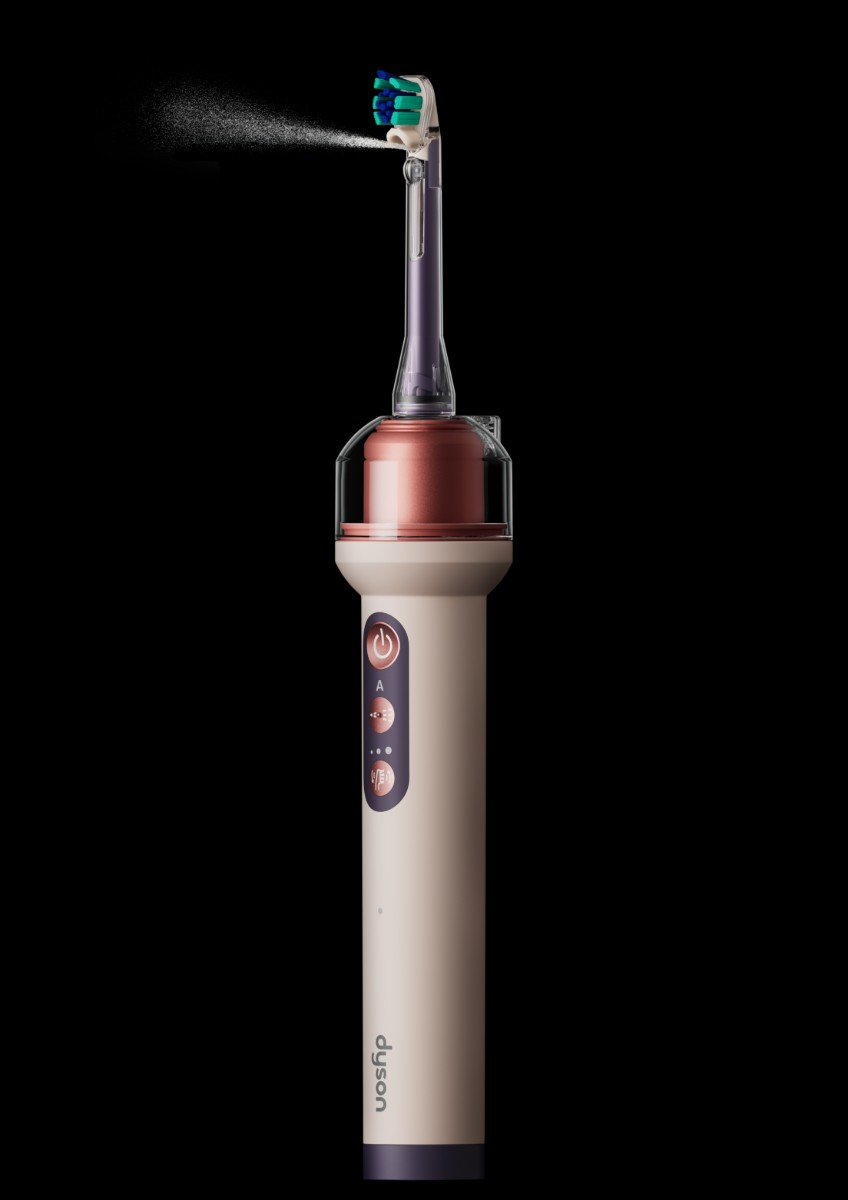
Dyson announced the CameraJet, a $500 three-in-one toothbrush with a camera, water tank and motors onboard that combines brushing, flossing and rinsing in one device.
Dyson says the result is a cone-shaped spray, rather than the simple needle-shaped jet used by many other water flossers, giving wider coverage while being propelled at lower pressure to be gentler on gums and enamel.
Dyson says the device uses an 'anti-gravity tank with a diaphragm pump and pressure chamber that adapt during use to deliver controlled jets in any orientation'.
Founder James Dyson said in a statement that by combining a camera, machine learning, precision fluid dynamics, advanced brushing technologies, connectivity and Wi-Fi, the CameraJet 'introduces an entirely new way to keep your mouth healthy'.
The device carries what Dyson calls a '100k pixel macro lens camera', which is 0.1 megapixels, mounted right under the head of the brush.
The companion MyDyson app gives a view of the mouth, especially the back of the teeth, and offers tips, guides and personalized feedback on brushing, including where the user is already good and which areas they are falling behind on, plus settings for brushing intensity and jetting modes.
Distinct publishers with included, body-backed reporting in this cluster.
2 articles · September 1, 2026
Follow any of these and your For You feed starts watching them — no settings page required.
product
Dyson hands the flossing decision to a camera inside the toothbrush1 distinct publisher
product
Meta ran pods-plus-agents for a year and shelved it. Its own scoreboard says why1 distinct publisher
product
OpenAI made age prediction the default gate, so its false-negative rate is now the product1 distinct publisher
product
Pixel's Bluetooth diagnostics changes the triage order, not the fix list1 distinct publisher
Evidence-backed comparisons of source perspectives and observed adoption signals. Read the methodology
Which Builder, Operator, and Investor concerns the observed source mix emphasized—not a truth score.
Evidence, demonstrated adoption, hype gap, incentives, and confidence are assessed independently, each on its own current evidence. How these are measured.
One demo, one writer, Dyson's numbers
Strip out what Engadget observed for itself — the app view, the fluid behaviour, the shape of the head — and every load-carrying figure is Dyson quoting Dyson: 28 frames a second, 100 milliseconds, 470,000 images, 16 million lines, nothing stored anywhere. The duplicate posting doubles the footprint without adding an observer.
Announced, not yet in anyone's bathroom
What exists is a launch and a demo unit. No shipping date, no sales, no reviewer with the thing on a shelf for a month, no dentist trying it in a clinic — the only evidence of the product meeting a user is the writer's own session at Dyson's event.
The loop is real; the framing is inflated
Credit where it is due: the camera is not decoration, it steers the jet, and that is a genuine sense-and-act loop in a handheld. The overstatement sits around it — 'an entirely new way to keep your mouth healthy' from the founder, code-line counts offered as proof of intelligence, years of fluid dynamics presented as an outcome when no plaque test appears anywhere in the reporting.
The only witness sells the refills
Dyson controls the demo, the specifications and the privacy assurance, and the design routes future spending back to it: clear SLS-free rinse only, Dyson's own non-foaming toothpaste and low-foam mouthrinse so the lens stays clear, RFID heads that track wear and prompt replacement. A $500 entry price with a consumables tail is a reason to read every unverified number twice.
Clear account, single teller
We are confident about what was said and by whom: the reporting is specific, internally consistent, and careful to mark which lines are Dyson's. We are much less confident about whether the specifications hold, and one publisher — printed twice — leaves no way to find out from here.