ProductNot yet confirmed elsewhere1 publisher2 min readPublished
At Hornsea 2, drone-delivered maintenance kits reached Ørsted's turbines before technicians did
Ørsted and Skyports flew 55-65 kg maintenance kits to Hornsea 2 turbines beyond the pilot's sight in a four-week trial. Offshore operators now have a tested envelope for light kits, though the case for fewer boat trips still rests on the two companies' own claims.
The Product Desk
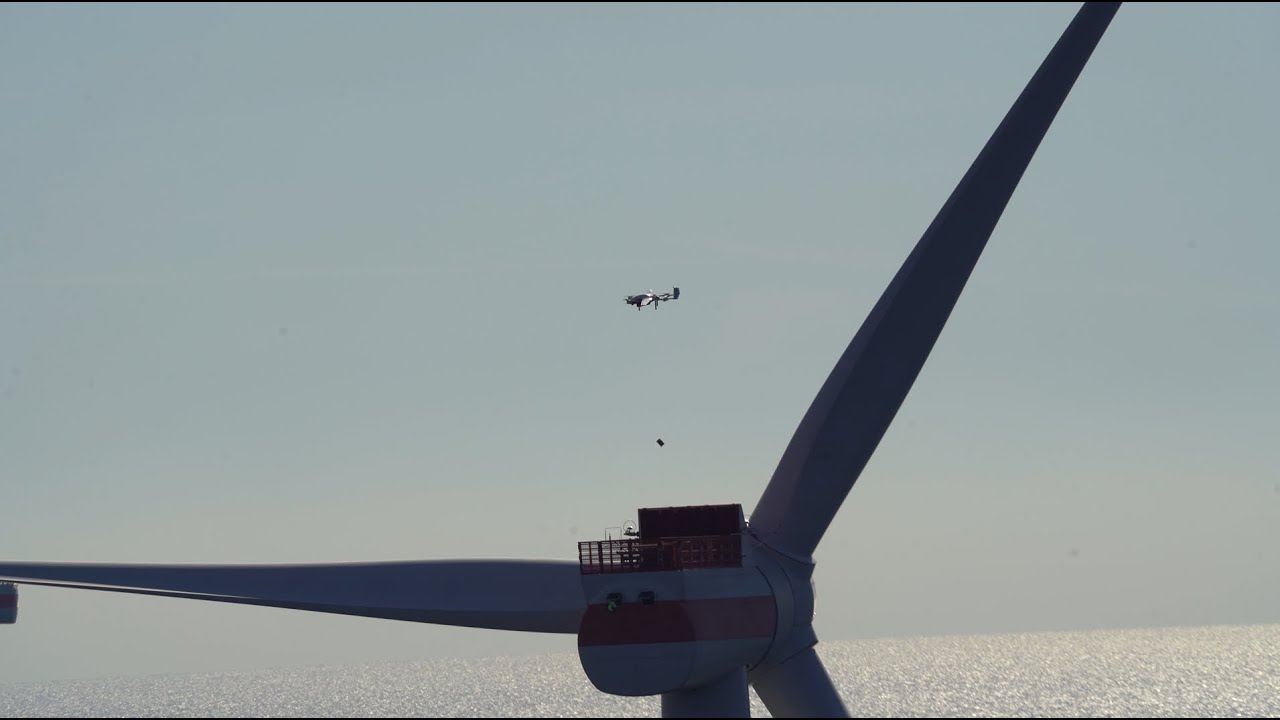
What happened
- Skyports built a load-collection method with an automatic hook so the drone could pick up and drop off kits without a person handling them.
- Interesting Engineering reported that deliveries were demonstrated across roughly 4 km of the wind farm.
- After each job, the drones went back to the turbines to collect the used kits.
- Ørsted had flown heavy-lift drones offshore before, but Interesting Engineering said this was the first trial with automated pickup and return under real conditions.
Why it matters
- constraint Because the drone flies from the service operations vessel, the ship stays in an operator's logistics plan, and the savings on offer are in hoists and short boat movements.
- capability With a drone kept on site daily, a part a technician lacks mid-job can be flown out on request, so reactive repairs need not wait for the next vessel run.
- precedent Ørsted frames the trial as confirmation of folding drone-enabled maintenance into routine operations, so the next step it signals is drone flights in its regular maintenance schedule.
Some of the Hornsea 2 flights were never on a schedule. "As we had a daily presence, we were able to cater for a variety of ad-hoc flight requests and get equipment sent out to support the teams. We were able to cover both planned and reactive works," said Richard McCrilley, project lead at Ørsted [13].
The stated purpose was narrower: finding out whether drones could viably take over the routine maintenance trips now made by sea vessel [2]. Here's what users actually do, going by McCrilley: with a drone on site every day, they asked it for jobs nobody had planned [13].
The pitch runs wider than the evidence. Skyports chief executive Alex Brown said "traditional turbine logistics, either through vessels or helicopters, involve time, coordination, varying levels of risk and cost" [11]. He also said, "At Hornsea 2, we've shown the potential for cargo drones as a viable alternative that minimizes these factors" [17]. McCrilley said that by delivering parts and tools more efficiently and safely, "we can improve turbine uptime and reduce emissions and operating costs" [12]. The published account does not include a flight count, a cost per delivery or a measured change in uptime [16].
The ship stays in the plan. The drones carried kits from the service operations vessel to the turbines and brought the used ones back to it [15][9]. The step they take over is the one Interesting Engineering calls time-consuming and potentially dangerous: shipping a kit to the turbine and hoisting it up [10]. Brown said the drones give operators "a practical way to reduce lifting and vessel movements" [18].
The sorting we'd apply to a month of maintenance logistics uses two axes. One is whether the load fits what Hornsea 2 tested, kits of 55 to 65 kg over roughly the 4 km the trial covered [8][5]. The other is whether the job was planned or reactive [13]. Reactive jobs inside that envelope are the strongest case. Interesting Engineering wrote that drones open the possibility of emergency part delivery "with little to no delay" [19]. Planned jobs inside it mainly save the hoist [10]. In our view, anything heavier or farther sits outside the evidence and stays on the boat.
We think operators should test the reactive, in-envelope quadrant first. The tradeoff is that reactive coverage came from having the drone there every day [13]. Four weeks of that took a team spanning safety, aviation and drone operations alongside technicians, plus close coordination with the UK Civil Aviation Authority [6][7].
What to watch
- Ørsted publishing flight counts, weather availability or cost per delivery from Hornsea 2, which would let operators test the vessel-trip savings against numbers.
- Drone deliveries appearing in Ørsted's regular maintenance schedules at other wind farms, the routine use McCrilley described.
- Any change in how the UK Civil Aviation Authority handles offshore beyond-line-of-sight cargo flights, which sets how much coordination each deployment needs.
Clarity's read
What the record supports and how the coverage leans. The claims behind it follow.
Reality
- Evidence40
- Adoption15
- Hype gap+35
- Incentives75
- Confidence45
Claim ledger
Ranked by verification strength, evidence, and original report placement.
- [1]
Ørsted completed a trial of a large cargo delivery drone at its Hornsea 2 offshore wind farm in the North Sea.
- [2]
According to Ørsted, the trial tested whether drones could be a viable way to replace routine sea vessel trips for maintenance operations and costs.
- [3]
The trial was run with Skyports Drone Services using one of its large cargo drones.
- [4]
Skyports developed a novel load-collection method with automatic hook operation for the trial, allowing the drone to pick up and drop off payloads by itself.
ReportedSupportedSource: Skyports press release, as reported by Interesting EngineeringView cited source - [5]
The drones were operated beyond visual line of sight, and delivery was demonstrated across roughly 4 km (2.5 miles) of the wind farm.
- [6]
The trial ran for around four weeks and required a team of safety, aviation, drone operators and other technicians.
- [7]
The trial required close coordination with the United Kingdom's Civil Aviation Authority.
- [8]
Each kit weighed between 55 kg (121 lb) and 65 kg (143 lb) and contained tools, spare parts and other materials for specific tasks.
- [9]
Kits were delivered to turbines before technicians arrived; after the work was completed, drones collected the used kits and returned them to the Service Operations Vessel.
- [10]
Maintenance kits of this kind have traditionally been shipped to site and then hoisted up to the wind turbine, which Interesting Engineering describes as time-consuming and potentially dangerous.
- [11]
"traditional turbine logistics, either through vessels or helicopters, involve time, coordination, varying levels of risk and cost"
ReportedSupportedSource: Alex Brown, CEO of Skyports Drone Services, in a press releaseView cited source - [12]
"This trial confirms our approach to integrating drone-enabled maintenance into our routine operations. By delivering parts and tools more efficiently and safely, we can improve turbine uptime and reduce emissions and operating costs."
- [13]
"As we had a daily presence, we were able to cater for a variety of ad-hoc flight requests and get equipment sent out to support the teams. We were able to cover both planned and reactive works."
- [14]
Ørsted has experimented with heavy-lift drones at its offshore wind farms before; this trial was the first to feature more automated cargo pickup and return and to prove its utility under real conditions.
- [15]
The drones delivered packages from the Service Operations Vessel to the work site at the turbine.
- [16]
The published account of the trial gives kit weights, delivery distance and trial length, but no flight count, cost per delivery or measured change in turbine uptime.
- [17]
"At Hornsea 2, we've shown the potential for cargo drones as a viable alternative that minimizes these factors"
ReportedInsufficientSource: Alex Brown, CEO of Skyports Drone Services, in a press release2 sources— create a free account to open themView cited source - [18]
"These drones give wind farm operators like Ørsted a practical way to reduce lifting and vessel movements, get technicians working faster and maximize the time turbines spend generating"
ReportedInsufficientSource: Alex Brown, CEO of Skyports Drone Services2 sources— create a free account to open themView cited source - [19]
Interesting Engineering wrote that drones open the door for the possibility of emergency part delivery on site "with little to no delay".
Sources
1 independent publisher whose own reporting we read for this story.
- interestingengineering.comAutonomous heavy cargo drones airlift 143-pound loads to North Sea wind turbines
1 article · October 10, 2026
Topics and entities
Follow any of these and your For You feed starts watching them — no settings page required.