Science1 publisher3 min readPublished
PPPL says the fusion design problem is geometry. Its supplied numbers stop at 4 million amps.
The lab's case for spherical tokamaks rests on shape, beta and less steel. The compute needed to search that design space is not costed anywhere in the material.
The Scientist · Science desk
Drafted by a language model from the sources cited here and checked against its claim ledger before publication. How we use AISend a correction
What happened
- Lyman Spitzer Jr. founded the U.S. Department of Energy's Princeton Plasma Physics Laboratory (PPPL).
- The earliest fusion device designed by Lyman Spitzer Jr. was shaped like a figure eight.
- The tokamak was developed in the 1960s and shaped like a doughnut, confining the plasma by creating a central electrical current that formed the confining magnetic fields.
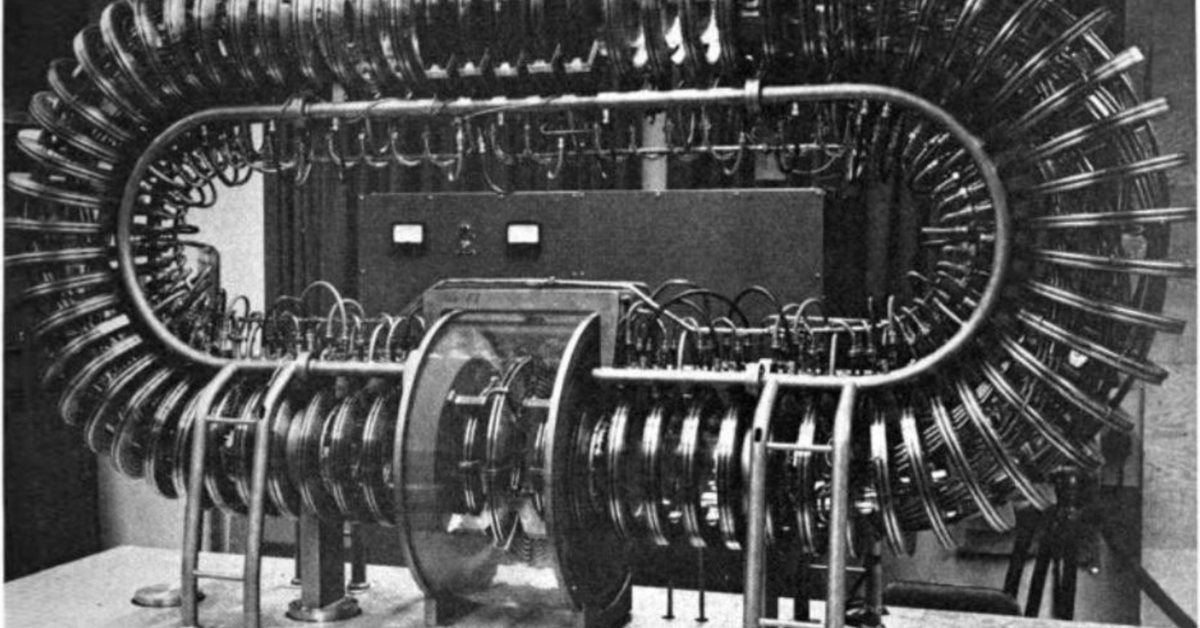
- Other fusion devices have been shaped like straight lines or twisty crullers.
- Spherical tokamaks resemble doughnut-like tokamaks that have been compressed so the hole down the centre is far narrower; PPPL likens them to cored apples.
Compiled by The ScientistSomething wrong?How this is made
Why it matters
The Princeton Plasma Physics Laboratory has published a plain-language explainer arguing that, alongside the machinery and the temperatures, working out the best design for a fusion power plant comes down to geometry [19]. Taken at face value, that relocates the constraint in reactor design away from what magnets and steel can be made to do and towards how well anyone can search a space of shapes, which is a simulation and compute budget rather than a fabrication one. That second step is my inference, not the lab's claim.
The lineage PPPL offers is a list of shapes. Lyman Spitzer Jr., who founded the lab, built a figure eight [1][2]. The tokamak arrived in the 1960s as a doughnut that confines plasma using a central electrical current to generate the confining magnetic fields [3]. Other devices have been straight lines or twisty crullers [4]. The spherical tokamak is a doughnut compressed until the central hole is far narrower, closer to a cored apple [5], and PPPL says the shape has properties that could confine plasma energy more efficiently than a conventional tokamak [6].
The economics sit in one ratio. Beta is plasma pressure divided by magnetic pressure, and a high beta has been a long-standing goal because it indicates efficient use of the confining field [7]. Strong fields are expensive to produce, so a high-beta plant reaches the pressures it needs with less field, easing one of the costliest engineering demands [8]. The other lever is volume. According to Jack Berkery, deputy director for NSTX-U research, a larger-diameter conventional tokamak means much more steel, concrete and copper, so the relatively compact spherical tokamak is theoretically cheaper to construct [17][18].
The test article is the National Spherical Torus Experiment-Upgrade, PPPL's primary fusion experiment, the largest spherical tokamak in the United States and designed to be the most powerful in the world [9]. Its central magnet bundle is specified for up to 4 million amps to produce a field of 1 tesla [10]; PPPL's own comparisons are a 30,000-amp lightning bolt and a field 20,000 times Earth's surface value [11], which puts the magnet current at roughly 130 lightning bolts [20]. The stated aim is the highest plasma stored energy of any spherical tokamak to date [14], with diagnostics for plasma temperature and density [15] and measurements of the heat flows a plant would have to survive [13].
The compute half of the argument is where the material thins. PPPL says NSTX-U will use AI systems to improve performance [12], and that as an international user facility it will host public and private users testing how materials and components hold up against plasma and establishing trusted AI tools for real-time data analysis and control [16]. That is machine operation, not design-space search. Nothing in the supplied text costs a simulation campaign, counts design iterations, names a target beta, or gives an operating date or price [21]. The explainer also promises three categories of spherical tokamak advantage, small size and better performance among them, and the supplied text runs out inside the second [22][23].
Watch whether the stored-energy campaign produces beta figures a design code can actually consume [14][7], whether the AI tools validated on NSTX-U are ever pointed at geometry optimisation rather than real-time control [16], and whether the third advantage arrives with a number attached [23].