Product1 distinct publisher3 min readPublished
The controller Claude discovered clears seven fault types in seconds and ships as ordinary deterministic code, which turns the interesting part of AI in the lab into an on-call rota question rather than a physics one.
The Product Desk · Product desk

Compiled by The Product DeskSomething wrong?How this is made
Sergio Cantu, QuEra's VP of Quantum Systems, put the bottleneck in staffing terms rather than physics terms: what made scaling hard, he said, was "the people driving at 2 am to fix a laser lock" [14]. That is the sentence to read the result through. Teams tell themselves the AI story in quantum computing is a cleverer algorithm running on the qubits; the thing actually being done here is filling a shift.
A human specialist needed roughly five to 10 minutes for comparable recovery work [6], which is 300 to 600 seconds against a sub-six-second clearance, somewhere between 50 and 100 times faster [3]. The multiple is less interesting than the labour it displaces: hand-authoring the previous routine cost 8 to 12 person-weeks [2] of the people you least want reading traces at 3am. And the agent's version was built by probing rather than by anticipating. It introduced disturbances, changed a setting, measured the result, then chose again, across hundreds of failure conditions including overnight [9].
What makes this deployable on a Monday is what came out the other end. Engineers reviewed the process and defined what counted as success, while operating limits, interlocks and emergency stops bounded what the agent could reach [10]. The change-control conversation is therefore a code review of a controller, not a policy argument about model behaviour inside a control loop, and nothing phones an API when the lock drops.
On the numbers that matter for lights-out running, the 99.3% trial success rate [1] is less telling than the false-positive record: the controller never claimed a recovery that had not actually happened [3]. QuEra's researchers read the five misses as a condition of the test rig rather than a fault in the recovery logic [4], which is plausible and also exactly the sort of claim an independent rig would settle. All of it reaches us through one Interesting Engineering write-up in which Cantu is the only person quoted [17], so treat the trial record as a vendor figure until somebody outside QuEra runs it.
Two conditions decide whether the pattern transfers to your hardware. One is a testbed the agent is allowed to break, kept off the machine customers are booked on; the Model Hardware Standard exists to hold an agent's actions inside predefined safety limits precisely because that separation is what makes the probing tolerable [8]. The other is a success criterion an instrument can score instead of a senior engineer's judgment call: when the tuned settings were later checked with an independent instrument the AI could not influence, they matched those of an experienced specialist and corrected a flaw the manual tuning had missed [12]. Where both conditions hold, the payoff shows up as commissioning time, as it did when the approach was moved to a second laser wavelength and the settings were worked out from scratch in a single unattended overnight run rather than weeks of hands-on work [13]. Where either is missing, what you have is a demo, and somebody still keeps their phone on the nightstand.
Ranked by verification strength, evidence, and original report placement.
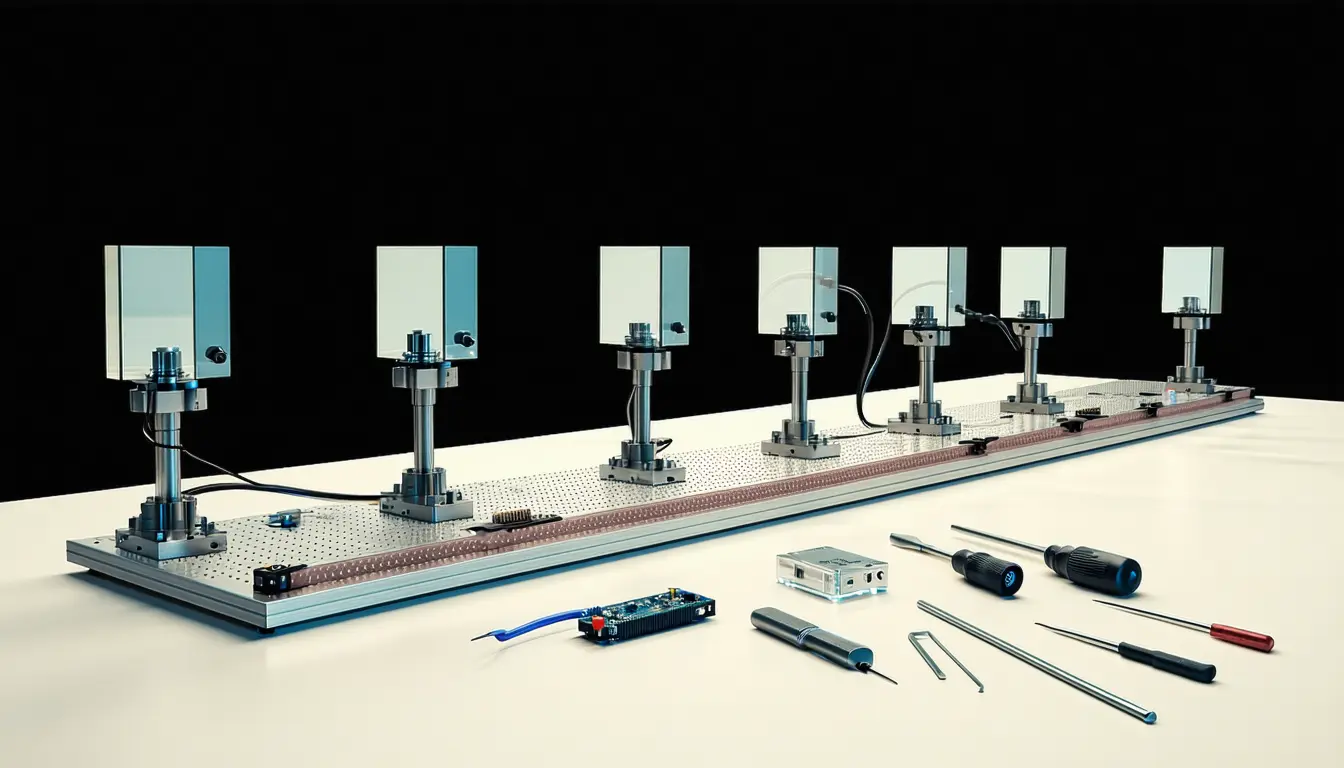
In a test involving a neutral-atom quantum-computing system operated by Massachusetts-based QuEra Computing, Anthropic's Claude restored a laser's lock in 695 of 700 trials, usually in less than six seconds.
The resulting controller was tested against seven types of faults.
The controller never reported success when the laser had not actually recovered.
The five unsuccessful trials shared a condition of the test rig rather than indicating a failure of the recovery logic.
The researchers gave Claude access to a dedicated laser testbed through the Model Hardware Standard (MHS), developed by Anthropic and HHMI Janelia Research Campus, which is designed to let AI agents interact with scientific equipment while keeping operations within predefined safety limits.
In the interestingengineering.com report of the result, Sergio Cantu of QuEra Computing is the only person quoted.
Distinct publishers with included, body-backed reporting in this cluster.
1 article · August 29, 2026
Follow any of these and your For You feed starts watching them — no settings page required.
product
Anthropic's hardware standard moves agent safety onto the wiring1 distinct publisher
leadership
Anthropic's hardware standard shrinks instrument integration to a configuration task1 distinct publisher
product
AWS, Hugging Face and robot suppliers start wiring Anthropic's machine-control standard1 distinct publisher
product
Anthropic's agent-hardware standard hands the do-not-touch list to the lab1 distinct publisher
Evidence-backed comparisons of source perspectives and observed adoption signals. Read the methodology
Which Builder, Operator, and Investor concerns the observed source mix emphasized—not a truth score.
Evidence, demonstrated adoption, hype gap, incentives, and confidence are assessed independently, each on its own current evidence. How these are measured.
Precise numbers, single interested source
695 of 700, six seconds, a factor of five in noise, one overnight run at a new wavelength — the figures are specific enough to be falsifiable and not one of them has been checked outside QuEra. Interesting Engineering cites no paper, protocol or dataset, and the two people speaking both draw QuEra paychecks. The strongest piece of verification in the whole account is internal: an instrument the agent could not influence agreed with a human specialist's settings, which is exactly the right test and still the vendor's own telling of it.
One subsystem, one rig, one vendor
This has been used exactly once, on a dedicated laser testbed, on one subsystem of one company's machine. The genuine signal is that the output is ordinary deterministic control software rather than a demo notebook — that is a thing an operations team can actually run. But nothing here puts it on a customer machine, in a second lab, or on hardware other than lasers, and the Model Hardware Standard it depends on is still called a research preview.
Body more careful than the frame
Interesting Engineering does the unglamorous thing and says what this is not: no self-repairing quantum computer, one subsystem, humans still drew the safety boundary, software cannot fix a broken part. The stretch sits above that prose — a 99.3% figure and a 'fixes laser drift in seconds' framing invite a reader to treat one testbed campaign as a fleet capability, and the weeks-to-overnight commissioning comparison is offered with no detail on how the weeks were counted. Overstatement in packaging, not in the reporting itself.
Both interested parties want this result
QuEra needs its machines to look operable without a physicist on site, because that is what selling hardware to remote customers requires. Anthropic needs the Model Hardware Standard to look like the default way agents touch instruments. One experiment serves both, and the only people quoted about it are QuEra's VP of Quantum Systems and its president — the latter explicitly praising the research preview and Anthropic's models while noting it is now cheaper to keep QuEra's computers running. No voice in the piece has any reason to press on the figures.
Mechanically detailed, journalistically thin
The technical account is specific enough to argue with: what disturbances were injected, what the agent could reach, why five trials failed, and the unusually clear statement that the shipped controller has no model in its loop. That specificity is worth something. What is absent is a second telling of any kind — one outlet, one company, no external record — so we can describe the claim confidently while holding the result loosely.