ProductNot yet confirmed elsewhere1 publisher2 min readPublished
AWS, Hugging Face and robot suppliers start wiring Anthropic's machine-control standard
Anthropic's Model Hardware Standard swaps each instrument's own API for one command set. The early integrator list, not the microscope demo, is what turns an agent driving lab hardware into something a buyer can specify.
The Product Desk
What happened
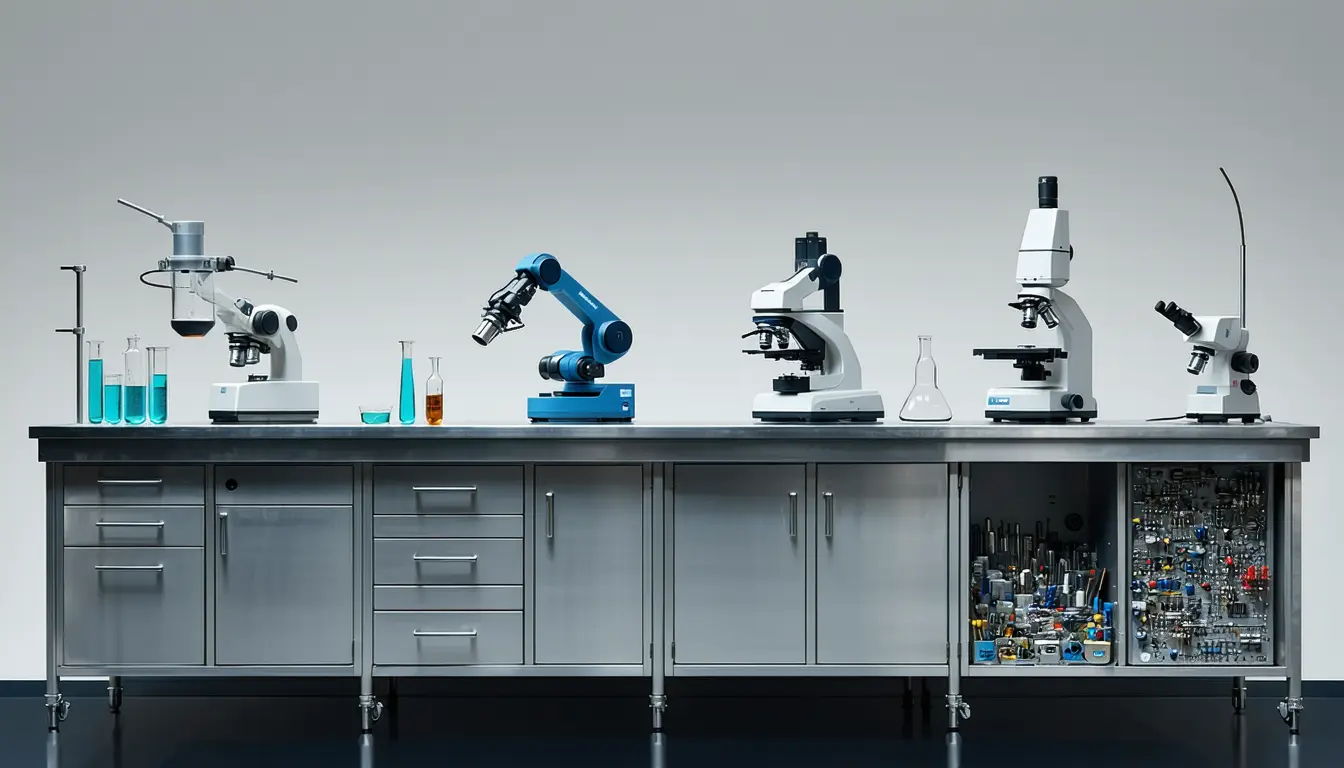
- Anthropic previewed the Model Hardware Standard, built with the medical research institute HHMI, which replaces each machine's own API with one interface and a standardized set of configuration commands.
- Access is currently restricted to a limited number of partners, whom Anthropic says it will work with on safety features before wider release, with an open-source license planned after that.
- Two users are named so far: HHMI has an agent that manages microscopes, and QuEra Computing is using MHS with Claude to coordinate the lasers it uses to program its quantum computers.
- Amazon Web Services, Hugging Face and several industrial robot suppliers are working to integrate MHS, which Anthropic says will also cover manufacturing equipment rather than lab instruments alone.
- Labs can publish a file describing each instrument's properties, such as a robotic arm's weight or a sensor's wavelengths, and can define guardrails such as a ceiling on laser beam strength.
Why it matters
- decision The next instrument purchase order gets a new spec question, and the answer decides whether integration is the vendor's cost or a hired developer's.
- constraint While access stays partner-gated, the guardrail design is exercised only by labs Anthropic picked, so buyers cannot review it before they are asked to depend on it.
- exposure Limits like a laser power ceiling exist only when someone fills the field in, and the bleached sample belongs to the lab rather than to the standard.
- precedent An open-source hardware control standard with cloud and robot vendors attached makes agent-operated equipment something a purchasing committee evaluates instead of something a lab builds itself.
Somebody in the building has already written the code MHS proposes to delete. Counting the proteins in a sample means several instruments handling it in a fixed order [7], and that order currently lives in glue code written against each machine's own API, one taking Python where the next takes Java [6]. The person who wrote that glue is the person who gets paged when a firmware update breaks it.
The unified command set [5] gets the attention, and the machine-readable description file is the part that changes the work. An instrument that publishes its own arm weight, or the wavelengths its sensor can read, gives an agent something to plan against rather than probe for [11]. That file is also a procurement artifact. Whoever ships it is doing integration work the buyer currently pays a developer to do.
Then there is the cost line. Anthropic says the Claude-generated laser-positioning script from its internal test runs cheaper than an inference-based device configuration workflow [16]. The useful reading is about billing shape rather than savings. The model is an authoring expense paid once per workflow; the script is a maintained artifact that runs with no model in the loop. Bench automation priced that way sits in a software or capital line rather than on a per-action inference meter.
The evidence base is thin, and worth naming as thin. Anthropic has put forward two working deployments and three groups of integrators, with no count of instrument models that actually speak MHS [15], and the account comes from a single publisher's report [14].
Which leaves a lab manager a grid with two axes. First, does the instrument vendor ship MHS itself, or do you wrap it. Second, does the workflow freeze into a script, or does it need a model on every run. Vendor-native plus frozen script is a line item, and you can ask for a delivery date. Self-wrapped plus model-in-loop is a staffed project with an inference bill attached, whatever the standard on the box is called. Most labs will spend the next year in the two mixed boxes, and those are the ones to cost honestly before somebody's roadmap slide does it for them.
So the question for the next instrument quote is which fields of that description file the vendor has filled in, and what happens to the ones left blank [11].
What to watch
- The open-source release, and whether the guardrail definitions ship with the license or trail behind it.
- A named instrument or robot vendor listing MHS support on a spec sheet with a version and a date.
- Any second source, or Anthropic's own docs, stating how many instrument models MHS actually covers.
Clarity's read
What the record supports and how the coverage leans. The claims behind it follow.
Reality
- Evidence30
- Adoption22
- Hype gap+30
- Incentives68
- Confidence38
Claim ledger
Ranked by verification strength, evidence, and original report placement.
- [1]
Anthropic PBC previewed the Model Hardware Standard (MHS), a standard that makes it easier for AI agents to control machines such as microscopes.
- [2]
MHS was developed in collaboration between Anthropic and the medical research institute HHMI.
- [3]
Amazon Web Services Inc., Hugging Face Inc. and several industrial robot suppliers are currently working to integrate MHS with their products.
- [4]
Anthropic has so far made MHS accessible only to a limited number of partners, and says it will work with those early adopters to develop safety features before making MHS broadly available.
- [5]
MHS replaces disparate device-specific APIs with a single unified interface that provides a standardized set of configuration commands.
- [6]
Writing code for scientific instruments is difficult because each machine has a different API, the APIs often are not compatible, and one machine may only support Python while another uses Java.
- [7]
Measuring the number of proteins in a biological sample requires multiple machines to process the object in a specific order, and implementing such workflows requires researchers to write custom code.
- [9]
Startup QuEra Computing Inc. is using MHS and Claude to coordinate the lasers with which it programs its quantum computers.
- [10]
Anthropic says MHS enables agents to automatically fix certain experiment errors and to write instrument control scripts.
- [11]
According to Anthropic, MHS lets researchers create a file describing key properties of each instrument, such as the weight of a robotic arm or the wavelengths a sensor can detect, helping agents pick the best way to use each machine and avoid configuration mistakes.
- [12]
Researchers can define safety guardrails, for example a limit on the strength of laser beams used in microscopy, because excessive illumination can damage samples and compromise experiment results.
- [13]
Anthropic plans to make MHS available under an open-source license.
- [14]
Both supplied source texts are the same SiliconANGLE report, so the account rests on one publisher.
- [15]
The reporting names two operating MHS deployments (HHMI's microscope agent and QuEra's laser coordination) and three integrator groups (AWS, Hugging Face, industrial robot suppliers), and gives no count of instrument models that support MHS.
- [16]
In one internal test Anthropic had Claude generate a script that automatically adjusts the position of lasers, and says such scripts cost less to run than an inference-based device configuration workflow.
- [17]
Anthropic says the standard will enable agents to control manufacturing equipment as well as scientific instruments.
Sources
1 independent publisher whose own reporting we read for this story.
- siliconangle.comAnthropic previews MHS standard for AI agents that operate machines
2 articles · August 27, 2026
Topics and entities
Follow any of these and your For You feed starts watching them — no settings page required.