Loading today’s stories
Product2 distinct publishers3 min readUpdated
A long press in ChatGPT is now the fastest visual assistant on an EU iPhone
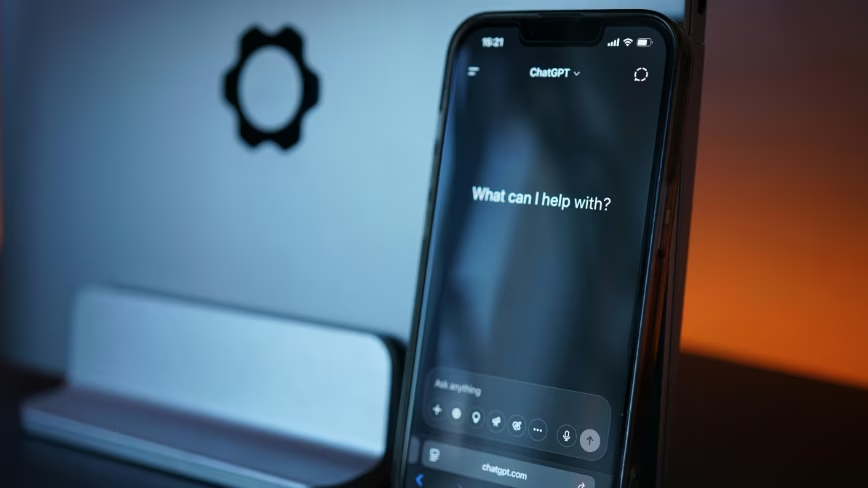
OpenAI shipped a four-photo shortcut on 21 August. It landed in the hole Apple left when it withheld its WWDC26 camera assistant from EU iPhones with no date attached.
The Product Desk · Product desk
What happened
- OpenAI added a shortcut in ChatGPT on iPhone: long pressing the plus button beside the prompt box surfaces the user's four most recent photos, ready to attach.
- The previous path to attach a photo was to open the plus menu, choose Photos, then find the image in a library that may hold tens of thousands of pictures.
- TNW characterised the change as taking two taps out of the most common thing people do with ChatGPT on a phone.
- By the described paths, the gesture removes one tap: the old route was three interactions (plus button, Photos, select image) and the new one is two (long press plus, select from four).
- The shortcut shipped in OpenAI's 21 August weekly drop, alongside better handling of the current time and faster loading for long conversations on the web.
Compiled by The Product DeskSomething wrong?How this is made
Why it matters
The asymmetry here is in what each side had to build. OpenAI's contribution is a long-press handler and a tray of four thumbnails [1]. Apple's equivalent is a Siri mode inside the Camera app plus an expanded Visual Intelligence, demonstrated at WWDC26, which would let you point a phone at something and ask about it without attaching anything at all [6]. One of those is a gesture. The other is system-level camera access, and in the EU it has no ship date [7].
The gesture itself is smaller than its billing. TNW says the change takes two taps out of the most common phone use of ChatGPT [3], but by that same account the old route was plus, then Photos, then find the image, and the new one is long press, then pick from four [1][2]. That is one tap saved, plus whatever the library scroll cost you [14]. What actually changed is not the count. It is that the tray arrives pre-populated with the photo you took thirty seconds ago, which is the only photo most people are asking about.
Apple's split is the part operators should read closely. The withheld features stay live on Mac and Vision Pro while iPhone and iPad in the EU get nothing and no timeline [7]. That pattern says the blocker is not whether the software works [15]. Apple's stated objection is that the Commission's reading of the interoperability rules would force it to hand rival assistants the same deep system access Siri enjoys, and regulators turned down both its Trusted System Agent proposal and an 18-month phased rollout [9]. Craig Federighi put the company's position plainly in June: "We're deeply disappointed that our EU users won't have Siri AI on iPhone or iPad when we share our new software releases later this year" [8].
The two publishers do not describe the same EU baseline, and the difference matters. TNW frames the result as a continent of iPhones without a native visual assistant, with the long press as the closest thing an owner there has to a camera that answers questions [11]. 9to5Mac notes that Visual Intelligence has been in iOS for nearly two years, still confined to relatively recent iPhones and still not offered in every region [13]. So some EU users have a version of this already, on newer hardware; what they are not getting is the upgrade Apple demoed. Either reading leaves the same delta on OpenAI's side of the ledger.
TNW puts the affected population at roughly 450 million people across the EU [10], and OpenAI is not treating that as a charity case: it is taking ads into 31 European countries [12]. Default routes get worn once. If Apple prevails in Brussels and ships the Camera Siri mode next year, it arrives into muscle memory that a competitor spent the interval building for free.
Loading topic controls
Loading related stories