Science1 publisher2 min readPublished
Starfish left live coral behind in almost 75% of feeding events at One Tree Reef
A University of Sydney survey of coral feeding scars on the Great Barrier Reef found crown-of-thorns starfish moving on before a colony died, with regrowth concentrated in the slow-growing corals Montipora and Porites.
The Scientist · Science desk
What happened
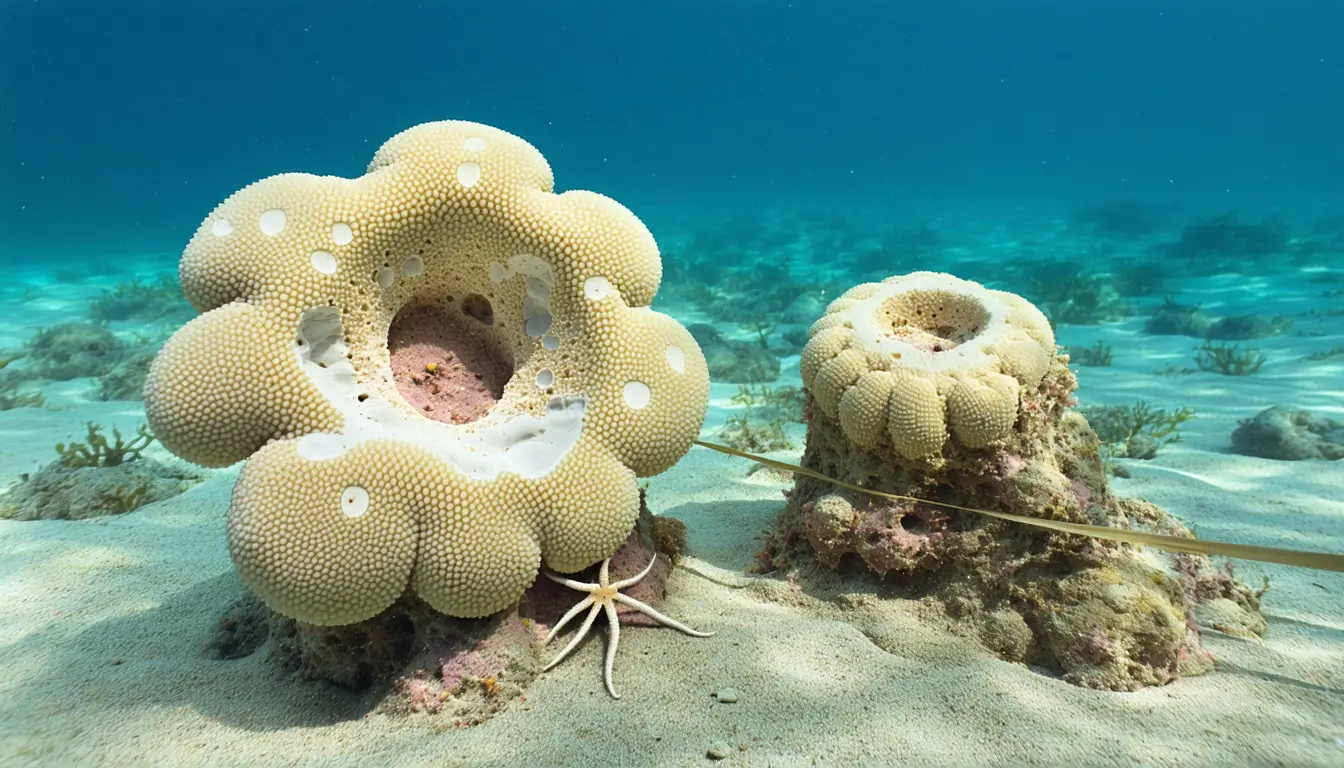
- A University of Sydney team led by Shawna Foo surveyed coral feeding scars at the One Tree Island Research Station and found living coral tissue still present after almost 75% of the starfish feeding events examined.
- Remnants of the fast-growing Acroporidae corals did not regenerate over the scars, while regrowth occurred mostly among the much slower-growing Montipora and Porites corals.
- All of the surveyed sites lie in protected areas, where healthy fish populations control crown-of-thorns numbers and prevent the destructive outbreaks recorded elsewhere on the Great Barrier Reef.
- The Great Barrier Reef has recorded four major crown-of-thorns outbreaks since the 1960s, at intervals of roughly 15 years.
- Declining numbers of crown-of-thorns predators, among them tritons and several coral reef fishes, raise outbreak vulnerability on the reef and in marine environments worldwide.
Compiled by The ScientistSomething wrong?How this is made
Why it matters
- decision Foo puts a different endpoint on a cull: once an outbreak is suppressed, leaving starfish on the reef becomes the target, and programs measured by how many animals they remove would have to be rescored.
- constraint Because the work sat almost entirely inside reefs with intact fish populations, managers on outbreak reefs cannot carry the survival figure across to their own sites.
- exposure Reefs that lose tritons and predatory fishes also lose the low-density condition under which this feeding pattern was observed, so fishing pressure comes first.
- capability Following individual feeding scars gives reef managers a unit of measurement for routine predation on the same colonies where outbreak damage would show up.
The starfish at One Tree Reef were not clearing colonies. "At One Tree Reef, COTS appear to consume a relatively consistent amount of coral during each meal and move on, rather than demolishing the entire coral colony," Foo said [6]. "This meant live coral tissue remnants were frequently left behind" [7].
The interpretation rests on which corals came back. "By feeding on fast-growing corals such as Acropora, low-density COTS populations create space for slower-growing coral species to persist, helping to increase coral diversity," Foo said [10]. The paper's reading is that at low densities the starfish stop dominant coral species from monopolizing reef space [11].
Take the complement of the survival figure and slightly more than one feeding event in four ended with no live tissue at that spot [20]. What the survey tracked was the fate of individual feeding scars and the tissue around them [3]. It did not track reef diversity through time, so the biodiversity result is an inference from which taxa regrew, not a measured change in community composition [11].
The phys.org account describes the research as largely conducted in areas with healthy fish populations that are not susceptible to outbreaks, and says it can inform culling practices for future outbreaks [22]. With no comparison reef where predators have been fished out, the survey cannot show that fish predation is what produced the moderate feeding pattern, only that the pattern appears where starfish are rare [4].
Foo's statement of the management implication is narrower than swapping predator protection in for culling. "The implications of our work can help us decide when and why culling should occur and the ecological endpoint of a cull. Once an outbreak is suppressed, the goal should not necessarily be to eliminate COTS entirely. Culling needs to be complemented by strong marine management to protect COTS predators and keep COTS populations in check," she said [16]. She also drew the line between the two states of the population: "It's important to distinguish between COTS populations performing their natural role as coral predators and outbreaks causing sustained reef decline" [15].
Co-author Maria Byrne placed the result in older theory. "The results are consistent with the intermediate disturbance hypothesis, an important framework in ecology and conservation," Byrne said [17]. That hypothesis holds that occasional, moderate disturbance can help maintain biodiversity in an ecosystem [18]. Foo emphasised that the findings do not diminish the significance of devastating outbreaks, which coral populations struggle to recover from [14]. The work appears in Ecology and Evolution under the title "The fate of coral feeding scars following predation by individual Crown-of-thorns seastars" [2].
What to watch
- The Ecology and Evolution paper itself, for the number of feeding scars and colonies behind the almost-75% figure.
- A matched survey on an outbreak reef with depleted predators, which would test whether scar fate differs where starfish are dense.
- Whether Great Barrier Reef cull programs adopt an ecological endpoint short of eliminating crown-of-thorns, as Foo proposes.