Invest2 publishers2 min readPublished
Bitcoin's rate-driven breakout follows a quarter in which ETFs took in $6.34 billion
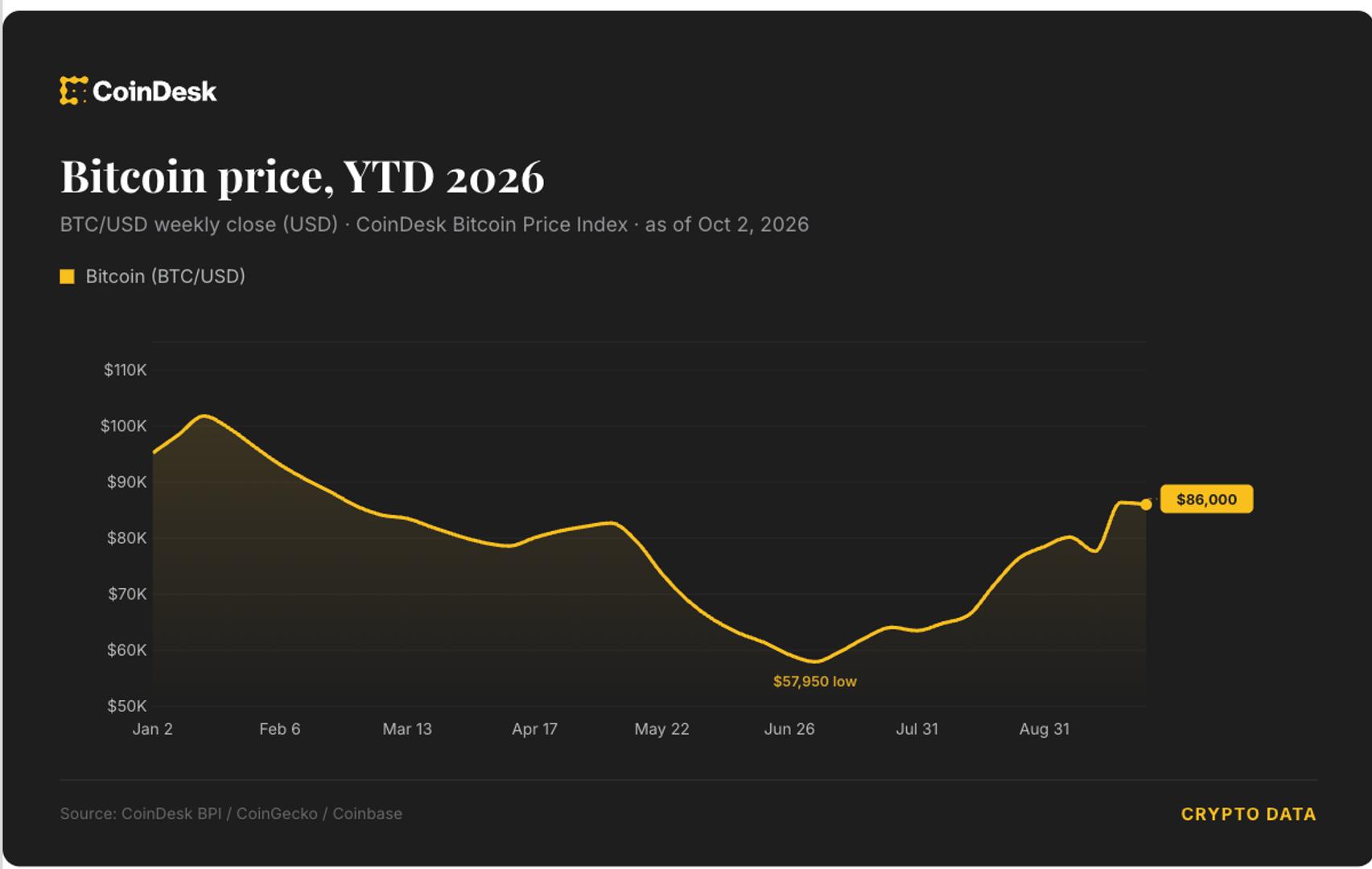
Bitcoin rose to $86,757 after August core PCE came in at 3.0% against 3.3% expected and October hold odds jumped to 74% from 35.8%. The year's sub-$1 billion ETF total understates the buying, because a strong third quarter first had to cover first-half redemptions.
The Investor · Invest desk
What happened
- Spot Bitcoin ETFs lost $490 million in the first quarter and $4.97 billion in the second before taking in $6.34 billion in the third, according to SoSoValue.
- Bitcoin had spent the week stuck between $82,000 and $85,000 while the 10-year Treasury yield reached 5.34%, according to CoinDesk.
- September payrolls rose 29,000 against forecasts of about 90,000, and unemployment edged up to 4.2%, the Bureau of Labor Statistics said.
- September CPI is due on October 14 and the Fed still projects another hike this year, so a hot print would put December back in play.
Compiled by The InvestorSomething wrong?How this is made
Why it matters
- contradiction Kalchev puts futures open interest about 12% below its September 22 peak while Sun says it rose with price, so whether forced selling can unwind this rally depends on whose count is right.
- exposure The year's net ETF intake is about 0.8% of the funds' $109.3 billion in assets, so one more second-quarter-sized exit would put 2026 back into net outflows.
- precedent If Sun is right that bank wealth platforms are writing Bitcoin into client allocation plans, ETF flows would follow model portfolios more closely than Fed odds.
A 0.3-point miss on core PCE moved the odds of an October hold by 38.2 points in a week [6][2]. Nexo analyst Iliya Kalchev told Decrypt the market had been evenly split as recently as September 29 [4]. The price moved much less, gaining 2% on the week [1]. Tim Sun of HashKey said high Treasury yields had been capping Bitcoin, and that short covering added to the buying once it broke its range [5].
The under-$1 billion figure for 2026 is a net, or rather the residue of a first half that lost $5.46 billion [5]. Add the $6.34 billion third quarter and the year comes to about $880 million [1]. Kalchev counts roughly $3 billion across 10 of the last 11 sessions [9], about 3.4 times the year's net [3]. September's $2.65 billion trailed only August's $3.52 billion among months since October 2025, according to SoSoValue [8]. That intake came against a 25-basis-point hike and a 10-year yield above 5%. Sun said it showed the money was "not merely chasing liquidity, but are rather allocation-driven inflows" [10].
If the third-quarter buyers are trading rates, a hot inflation print would send them out at the pace of the second quarter [7][16]. If Sun is right, the buying holds through a hawkish print, as it held through September's hike [10]. The third path opened on Friday. The jobs data showed July and August revised down by a combined 60,000, and average monthly gains over the past year at 45,000 [18]. Decrypt wrote that a print that soft raises the question of whether the labor market is turning [18]. Kalchev, speaking before the release, said "Cooling inflation without labor weakness is generally supportive of risk assets, Bitcoin included" [14]. Friday's report delivered the labor weakness his condition left out [13].
I think rates explain the timing of this week's move and say little about the money under it, because the quarter's buying came through a rate hike [10]. The counter-case is that these funds shed $4.97 billion in a single quarter this year [7], with the price still about 31% below last year's record [17]. The best case the Fed is offering is a pause. New York Fed President John Williams said there was "no need for urgency" after September's hike while keeping one more increase in his baseline [15]. Net ETF outflows in the sessions after the October 14 CPI print would prove this view wrong [16].
What to watch
- The Fed's October 28 decision: a surprise hike would test whether third-quarter ETF buyers hold through tighter policy a second time.
- Whether the 10-year yield, at its highest since 2002, eases after Friday's weak payrolls, given Sun's account that yields were capping the price.