Asus ROG built the easy half of a headset-free gaming setup
Asus ROG's first gaming soundbar handles the half of the job that is easy to demo. Capturing a voice in a room your own subwoofer is filling is the other half, and it is where every rival will be graded too.
The Product Desk
What happened
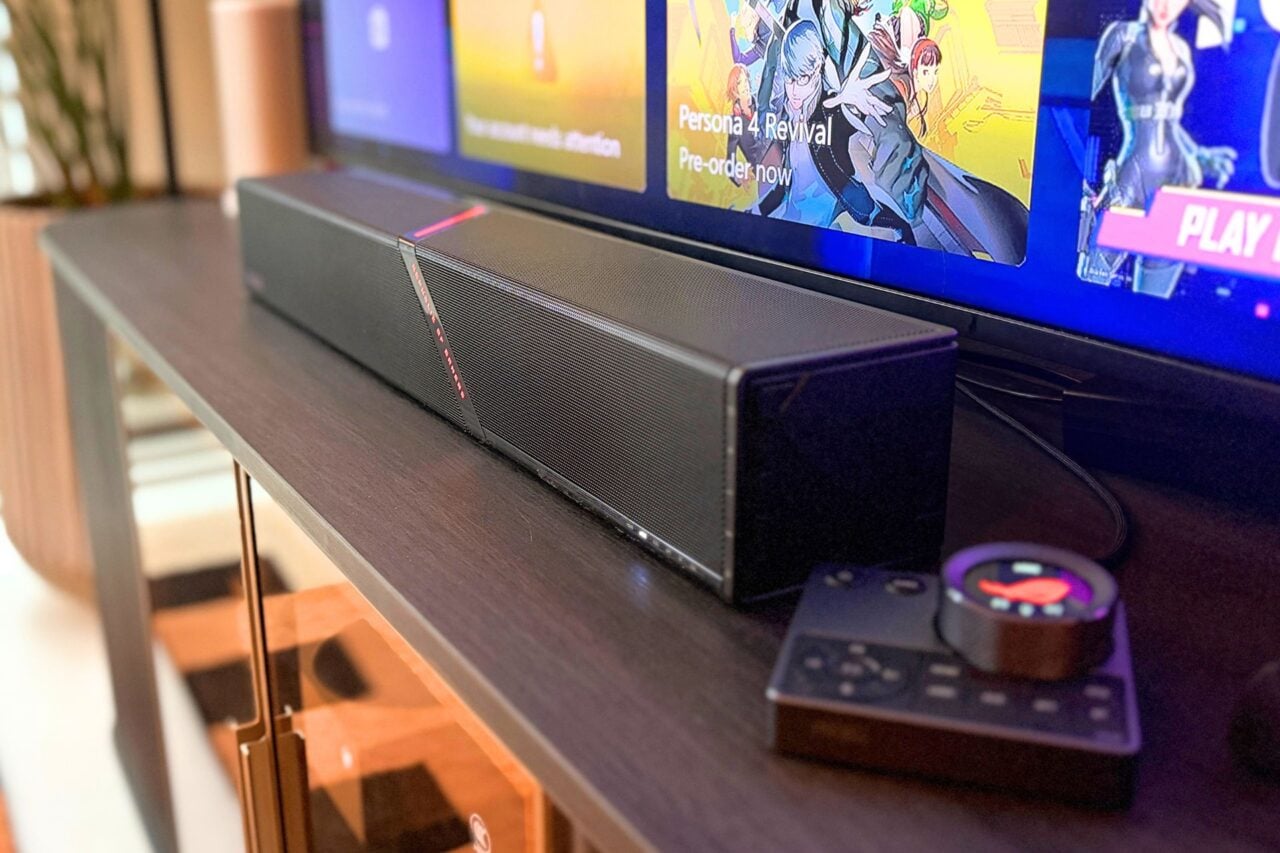
- Asus ROG's Gjallar is the company's first gaming soundbar, sold as an all-in-one for both sides of gaming audio: hearing the game and projecting your voice to the friends you play with.
- The bundle arrives in three pieces, with a soundbar, a side-firing subwoofer, and a USB-C-tethered hub that carries the microphones as well as the sound and input controls.
- Gizmodo's review concludes the Gjallar is cool on paper but the sound is only okay and the microphone hub is subpar at best, with barely working mics heading the list of cons.
- For television the reviewer found it a little muddy and less clear than the Bose Lifestyle Ultra Soundbar, with dialogue audible but flat even with the movie EQ switched on.
Why it matters
- cost The $600 covers the half of the job that was straightforward to build, so a buyer who wanted the headset gone still has to fund a headset or a standalone mic, paying for voice hardware twice.
- constraint Because the microphones sit in the hub rather than the bar, weak voice pickup is not something a buyer can tune, reposition or upgrade around; the remedy is a different box on the desk.
- precedent This review sets the scoreboard for the category, one on which the microphone verdict outweighs the driver verdict, and that is the grading the next entrant walks into.
- decision Anyone shopping for a headset-free setup now has to price the voice side as its own decision rather than trusting a bundle to cover it, which turns one purchase into two.
Voice capture and voice playback are two different problems, sized differently. A soundbar can assume roughly where the listener is sitting and push at them. A hub on a desk has to lift one person's voice out of a room that the soundbar is busy filling, which is why Asus ROG ships a feature it calls Acoustic Echo Cancellation, described in Gizmodo's review as AI that cancels out noise while you chat [2]. Subtracting the product's own output is the tractable part of that. Subtracting the room, plus the distance between a couch and the hub, is the part that decides whether the squad can hear you.
The spec sheet leans the same way. The Gjallar's driver layout is 2.1.2, which is quoted as 5.1.2 once Dolby Atmos is counted in [7]: three channels of arithmetic on the same hardware, 5.1 minus 2.1 [13]. There is nothing dishonest in that, and the up-firing drivers do work, since the reviewer could place footsteps and gunfire on all sides in Fortnite [8] while finding the sound big rather than nuanced in Cyberpunk 2077 [9]. The playback half has numbers to print. The capture half has no figure on the carton, and it is the half the entire pitch rests on.
What a product team tells itself the buyer wants is better game audio. What this buyer wanted, per the review's own opening, was to play co-op with friends without putting anything on his head [11]. Those are different purchases. On the review's reading, the product delivers one of the two jobs it advertises [12]. A headset-free setup where the mic fails still leaves you wearing a headset, just with a soundbar attached to the desk as well. The person who has to defend that line item on Friday ends up defending it in the exact gear the purchase was meant to retire.
Whoever ships the next one of these inherits the same asymmetry. Drivers, cabinets and up-firing angles are a sourcing and tuning exercise with a known answer. Picking up a voice from across a room that your own subwoofer is driving is a signal-processing exercise, and it is the one that cannot be shown off in a quiet demo space.
So grade an all-in-one on two axes instead of one. Playback quality is the axis every demo is built around. Capture reliability, measured with the product's own output running, is the axis nobody demos. A headset replacement scores high on both. Score high on playback but low on capture, and the result is a soundbar paired with a dead accessory, sold at the price of both. The reverse case, low playback but high capture, gives you a microphone with speakers bolted on, which is a headset with extra steps. The test costs nothing: the thing at the volume you would actually play at, someone on the other end of the call, and their answer about whether they can hear you. The channel count is printed for you. The capture number you have to generate in your own room.
What to watch
- Whether Asus ROG revisits the hub's Acoustic Echo Cancellation in firmware, and whether any outlet retests voice pickup after it does.
- Further reviews that put a second person on a live call rather than judging the Gjallar by its drivers, since Gizmodo's verdict is the only one here.
- Whether the next companies into gaming soundbars bundle a near-field or boom mic instead of relying on far-field pickup from a hub.
Clarity's read
What the record supports and how the coverage leans. The claims behind it follow.
Reality
- Evidence58
- Adoption
- Insufficient
- Hype gap+32
- Incentives48
- Confidence54
Claim ledger
Ranked by verification strength, evidence, and original report placement.
- [1]
Gizmodo's verdict is that the Gjallar is cool on paper but the sound is just okay and the hub with microphones is subpar at best, with 'The microphones barely work' listed first among the cons.
- [2]
The microphones integrated into the Gjallar's hub have what Asus ROG calls 'Acoustic Echo Cancellation' (AEC), the idea being that the hub is used as a microphone for chatting with friends while AI cancels out noise.
- [3]
The review's pros are big sound, compact design and lots of low end; the cons are barely working microphones, price, brick-like design, and sound that is big but not always nuanced.
- [4]
The Asus ROG Gjallar is Asus ROG's first-ever product in the gaming soundbar category, and it positions itself as an all-in-one package for both sides of gaming audio: hearing sound from your game and projecting your voice to friends.
- [5]
The Gjallar consists of three main components: the soundbar, a side-firing subwoofer, and a USB-C-tethered hub with microphones for communication, controlling sound and switching inputs.
- [6]
The Asus ROG Gjallar is a $600 soundbar, and Gizmodo's review lists 'Expensive' among its cons.
- [7]
The Gjallar has a 2.1.2 channel layout, or 5.1.2 when factoring in Dolby Atmos, with up-firing speakers giving it height and space.
- [8]
Playing Fortnite, the reviewer was able to hear environmental noises on all sides, including footsteps and gunfire.
- [9]
In Cyberpunk 2077 the Gjallar was solid but a little less satisfying, with less spatial detail on environmental sounds such as rainfall or passing cars; the reviewer would describe the sound as 'big' but not always the most nuanced.
- [10]
Compared with the Bose Lifestyle Ultra Soundbar, the reviewer found the Gjallar a little less clear, and for TV it was a little muddy at times, with dialogue audible but flat even with the movie EQ on.
- [11]
The reviewer opens by saying he would like to game headset-free and play cooperatively with friends online without ever donning an additional piece of hardware.
- [12]
Of the two jobs the Gjallar advertises, the review endorses one: game audio is rated okay while the microphone hub is rated subpar at best, so one of two advertised functions passes.
- [13]
The 5.1.2 figure quoted for the Gjallar describes the same hardware as its 2.1.2 layout with Dolby Atmos counted in, a difference of three channels.
Get this ledger inside ChatGPT. Ask about any of our stories and the answer brings its figure, each claim’s verdict and the sources. Free, no account.
Sources
1 independent publisher whose own reporting we read for this story.
- gizmodo.comAsus ROG Gjallar Gaming Soundbar Review: Sorry, Did You Say Something?
1 article · August 27, 2026
Topics and entities
Follow any of these and your For You feed starts watching them — no settings page required.