Google's Gemini 4 Argon turns one table photo into 4,500 robot training episodes
Google says Gemini 4 Argon turned one photo into more than 4,500 training episodes that raised a real robot's success rate from 56 to 75 percent. The Decoder reports the demos still need detailed human prompting, and access is through paid developer programs.
The Engineer · Build desk
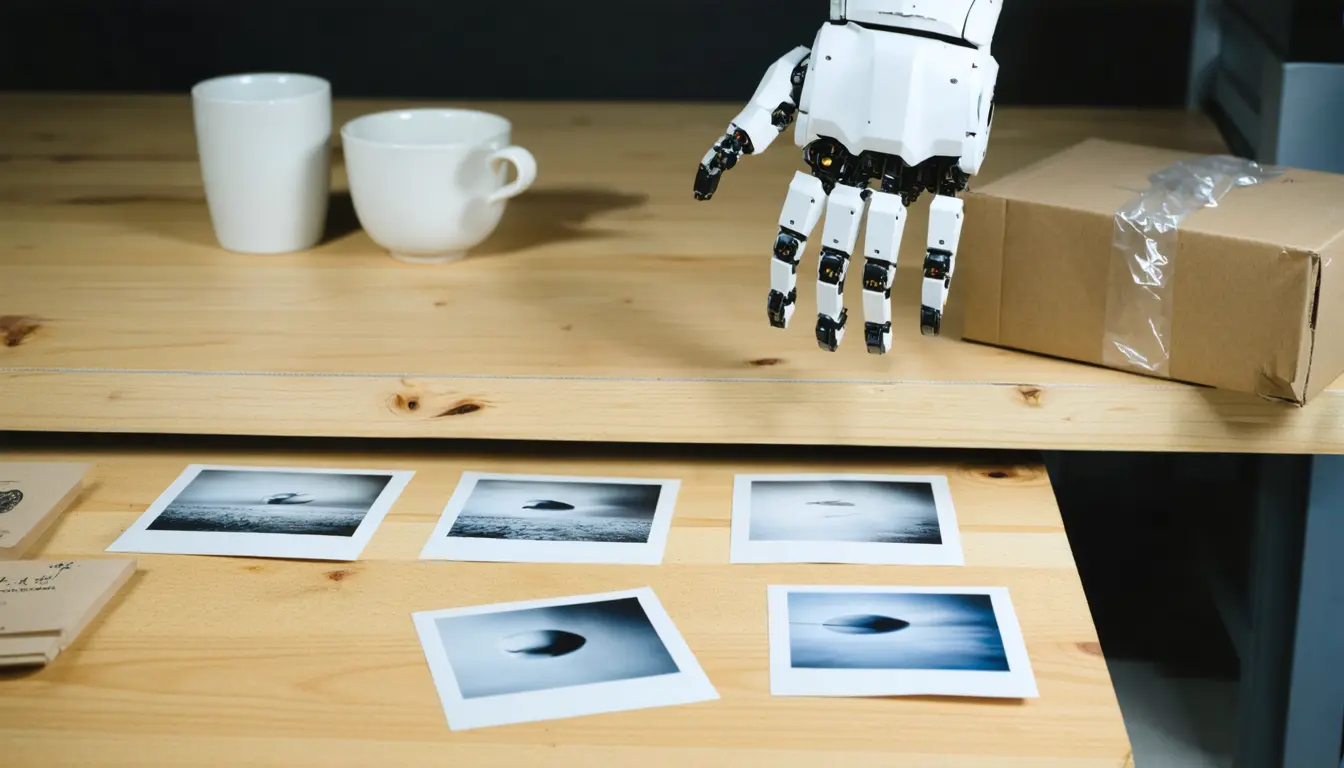
Before and after: the real robot's success rate climbed from 56 percent to 75 percent when tested, in Google's demo as reported by The Decoder.
| Measure | Value | As of | Claim |
|---|---|---|---|
| Real-robot success rate, before | 56% | 5 | |
| Real-robot success rate, after | 75% | 5 |
What happened
- Before Spot touches the real pedal of a step-on trash bin, it practices balancing on three legs inside a simulated copy of the bin.
- From a recording of a teleoperated robot, Argon builds a simulation meant to look the same and replicate the same force readings at the fingertips.
- Google says it has built 68 browser sandboxes of published robotics experiments, each from a single prompt per paper.
Why it matters
- What it limits constraint Detailed prompting means engineering time goes into writing the prompt for each new task. In our view that cost lands on the adopter, and no estimate of it was published.
- Who has to decide decision A team that wants to test the gain on its own robot has to buy into one of Google's paid developer access programs first.
- Who's exposed exposure A team that budgets on the 19-point gain is budgeting on one table scene whose real-robot trial count was not reported.
The gain is 19 percentage points in success rate [13], and execution time fell from 35 to 24 seconds, about 31 percent [5][14]. Both come from one scene: a table with party props, rebuilt from a single photo [4]. For the numbers to transfer, your scene would have to look like that table to the simulator. Your control model would also need training episodes of similar quality.
Volume per task is modest. Google's 77 tasks and more than 4,500 episodes [4] work out to at least 58 episodes per task if they were spread evenly [15].
The Lego demo shows where the human sits. The prompt told Argon to review its own logs and camera images, find the cause of a failure, and retry after applying a verified fix [8]. The retry loop is specified in the prompt. The runs then went from just under a minute to 23 seconds to about 17 seconds, and the 23-second run clipped the edge of the box [8].
Google pitches one model for control, world generation and data grading [1]. The demos pull in more parts. In the Scrabble demo, Gemini Omni, a separate video world model, generates the clips, while Argon acts as the director: it writes timestamped instructions and checks individual frames [7]. It took 33 steps to put five tiles in order [7]. In the Spot demo, two extra AI agents verify the foot and gripper before the can drops [12].
The Decoder reports an ERQA score of 87 percent for Argon, on 400 questions with no helper tools [10]. The available text of the report ends before any comparison scores. In our view, a question-answering score tells you about robot control only if the two track each other. They are different measurements.
Google also says it has built 68 browser sandboxes of published robotics experiments, one prompt per paper, including robot soccer and a humanoid on a skateboard [9].
What to watch
- Trial counts behind the 56 and 75 percent figures, and results on other robots or scenes.
- Whether Argon access widens beyond Google's paid developer programs.
- Comparison scores for the 87 percent ERQA result, and whether third parties reproduce it.
Clarity's read
What the record supports and how the coverage leans. The claims behind it follow.
Reality
- Evidence40
- Adoption
- Insufficient
- Hype gap+35
- Incentives
- Insufficient
- Confidence50
Claim ledger
Ranked by verification strength, evidence, and original report placement.
- [1]
Gemini 4 Argon is Google's attempt at a single AI model that controls robots, generates interactive 3D training environments, and evaluates training data.
- [2]
The demos still require detailed human prompting and guidance.
- [3]
Argon is available through Google's paid developer access programs.
- [4]
From a single photo of a table with party props, the model built a virtual replica, including a soft plush cap, came up with 77 tasks, and generated more than 4,500 training episodes for a control model.
- [5]
When tested on the real robot, the success rate climbed from 56 to 75 percent and execution time dropped from 35 to 24 seconds.
- [6]
In the Spot demo, Gemini 4 Argon builds a virtual copy of a step-on trash bin, and the Boston Dynamics Spot robot practices balancing on three legs inside that simulation before attempting the task on real hardware.
- [7]
Gemini Omni is a video world model that generates clips of how a scene changes. Argon acts as director, writing timestamped instructions, then checks individual frames and adjusts the next command. After 33 steps, five scattered letter tiles were arranged to spell ARGON.
- [8]
In the Lego demo, the prompt told Argon to review its own logs and camera images, find the cause of failures, and retry after applying a verified fix. The first run took just under a minute, the second 23 seconds with the brick clipping the edge of the box, and the third about 17 seconds, landing dead center.
- [9]
Given a single prompt per paper, Argon recreates published robotics experiments as interactive simulations that run in the browser; Google says 68 such sandboxes have been built so far, including robot soccer and a humanoid robot on a skateboard.
- [10]
The ERQA benchmark used 400 questions with no helper tools, so models had to solve everything through reasoning alone, and Argon scores 87 percent.
- [11]
From a recording of a teleoperated robot, Argon builds a simulation designed to look the same and replicate the same force readings at the fingertips.
- [12]
In the Spot demo, before the robot drops the can, two extra AI agents verify that the foot and gripper are positioned correctly.
- [13]
The real-robot success rate gain is 19 percentage points.
- [14]
Execution time fell by about 31 percent.
- [15]
At least 58 training episodes per task on average, if episodes were spread evenly across tasks.
Get this ledger inside ChatGPT. Ask about any of our stories and the answer brings its figure, each claim’s verdict and the sources. Free, no account.
Sources
1 independent publisher whose own reporting we read for this story.
- the-decoder.comGoogle wants Gemini 4 Argon to be the only AI model robots need
1 article · October 15, 2026
Topics and entities
Follow any of these and your For You feed starts watching them — no settings page required.
Topics
- AI BenchmarksFollow
- Robotics Foundation ModelsFollow
- Simulation-based robot trainingFollow