Sea-ice algae from 6,000 years ago lower Arctic winter ice projections by 1 million square kilometers
Researchers at Cambridge and CIMAT used 6,000-year-old algae records to project Arctic winter sea ice about 1 million km2 below earlier estimates. They say the weighting narrows the uncertainty range by as much as 85%.
The Scientist · Science desk
Three figures: the uncertainty range in projections cut by as much as 85%; 27 climate models weighted against ancient sea ice; future Arctic winter sea ice shrinking by around 1 million square kilometers (386,000 square miles) more than thought.
| Figure | Value | Note | Claim |
|---|---|---|---|
| Cut in projection uncertainty range, as much as | 85% | 11 | |
| Climate models weighted | 27 models | 8 | |
| Extra future winter sea ice loss, around | 1 million km² | 386,000 square miles | 1 |
What happened
- They compared the sediment-based ice estimates with simulations of the same period from 27 climate models and weighted each model by how well it matched, using Bayesian weighting.
- Taken together, the models overpredicted how much winter sea ice there should be.
- The Arctic recorded its lowest maximum sea ice extent in March 2025, and that record was tied again this year.
Why it matters
- What it limits constraint The result rests on sea ice responding to orbital warming the way it will to human-driven warming, an assumption the authors argue from physics and the report does not describe testing.
- Who's exposed exposure If the precipitation hints hold, Greenland ice sheet stability and flood risk in southern Europe are the places where the winter-ice revision would show up.
- Who has to decide decision Anyone relying on an unweighted multi-model average for Arctic winter ice now has a weighted alternative that removes the historical positive bias.
- What it sets up precedent Weights learned from palaeoclimate data and carried over to other variables, as the authors did with precipitation, can be tried on other model disagreements.
Climate models disagree with each other most in winter [2], so the team needed an independent check on them. It found one in ocean sediment.
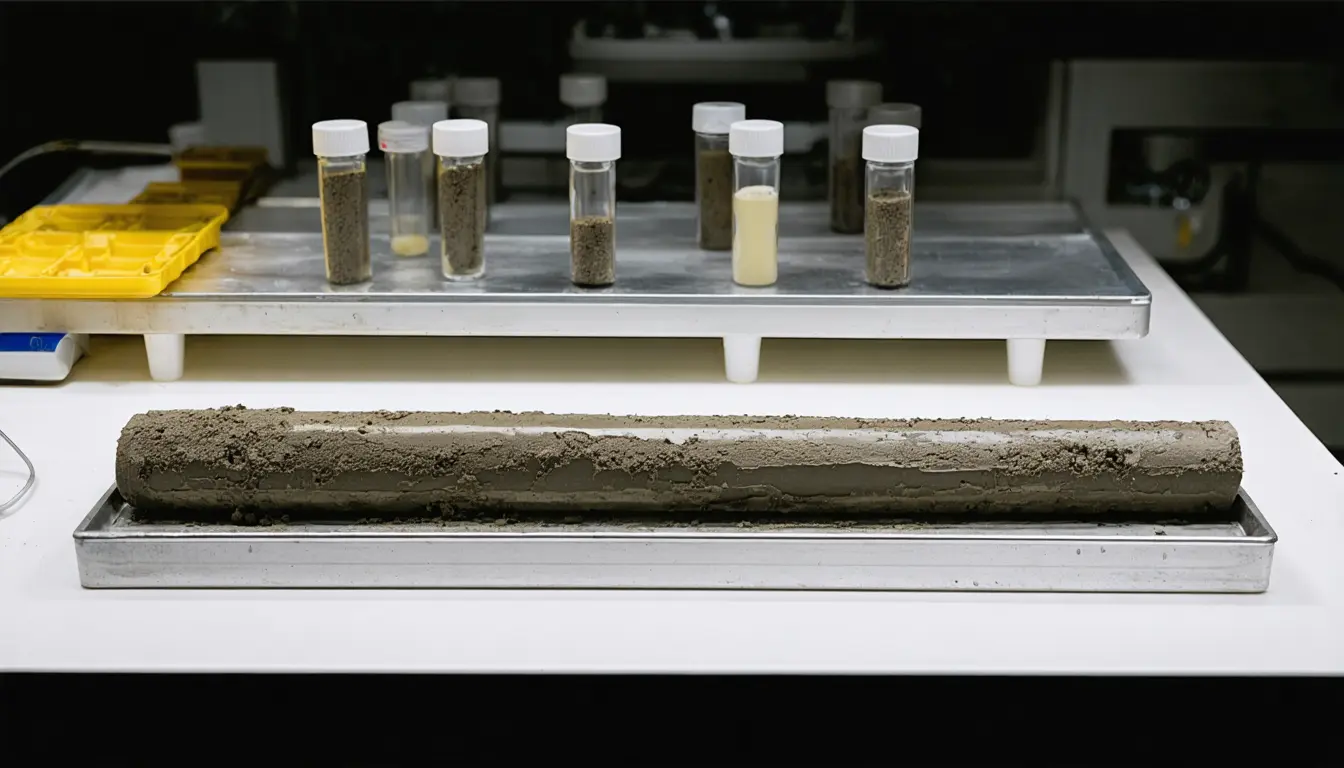
Algae that live in sea ice make the biomarker IP25 [5]. Read alongside markers from open-water organisms, the levels in a core give an estimate of how much ice covered the water [7]. The cores date to the mid-Holocene, when shifts in Earth's orbit made the Arctic warmer and cut ice cover [6]. Each of the 27 models had simulated that period, and the weighting rewards the ones that match the sediment record [8].
The test of whether the weights do anything useful came on the recent past. "When we apply the model weights to historical simulations, we completely eliminate the positive bias," said lead author Crystal Fu, of Cambridge's Scott Polar Research Institute [10].
The result depends on the assumption that weights fitted to mid-Holocene warming apply to modern warming. Mid-Holocene warmth came from orbital shifts [6], and the Arctic warmed then for different reasons than it does now [13]. The authors argue the weights still apply because the same physical processes govern sea ice across different climates [8]. "It doesn't matter if the warming is natural variation or caused by human activity: if it warms, sea ice is going to melt," Fu said [12]. We think that is a fair statement about how ice responds to heat. Whether a model's winter errors 6,000 years ago match its errors in a future climate is a separate question, and the weighting depends on the answer.
The 1 million square kilometer figure measures ice area, and the report does not translate it into weather. Phys.org's report says winter ice loss has been linked to colder winters and heavier snowfall in the U.K., northern Europe and North America [3]. The authors say the results could have implications for winter conditions in the U.K. and across Europe [14]. North America appears only in that background link [3]. The study's own downstream result concerns precipitation: the researchers say they found hints that snowfall over southeast Greenland and rainfall in the Mediterranean are underestimated [15].
The report also does not give the baseline extent, the emissions scenario, the time horizon of the 1 million square kilometers, or the range the 85% is measured against [1][11].
What to watch
- The paper itself (Nature Geoscience, DOI 10.1038/s41561-026-02123-w) for the scenario, time horizon and baseline behind the 1 million square kilometer figure.
- Whether other groups applying the weights to precipitation confirm the southeast Greenland snowfall and Mediterranean rainfall signals.
- Next March's Arctic winter maximum, to see whether the record low set in 2025 and tied this year is broken.
Clarity's read
What the record supports and how the coverage leans. The claims behind it follow.
Reality
- Evidence60
- Adoption
- Not scored
- Hype gap+15
- Incentives
- Not scored
- Confidence58
Claim ledger
Ranked by verification strength, evidence, and original report placement.
- [1]
Future Arctic winter sea ice is likely to shrink by around 1 million square kilometers (386,000 square miles) more than previously thought, after researchers used clues from a warm period 6,000 years ago to improve the reliability of climate models.
- [2]
Loss of winter Arctic sea ice has received far less attention than summer retreat, even though climate models disagree with each other most during the winter months.
- [3]
Winter ice cover regulates the release of heat and moisture to the atmosphere, and its loss has been linked to colder winters and heavier snowfall in the U.K., the rest of northern Europe and North America.
- [4]
In March 2025 the Arctic recorded its lowest maximum sea ice extent since modern measurements began, and that record was tied again this year.
- [5]
Researchers from the University of Cambridge and the Centro de Investigacion en Matematicas in Mexico (CIMAT) compiled the largest-ever database of a key biomarker, IP25, produced by algae living in sea ice.
- [6]
The samples came from ocean sediment cores dating from the mid-Holocene, when subtle shifts in the Earth's orbit contributed to warmer conditions and reduced sea ice cover in the Arctic.
- [7]
The researchers measured IP25 alongside complementary biomarkers from organisms that live in open water to estimate the extent of sea ice cover thousands of years ago.
- [8]
The ancient measurements were compared with simulations from 27 climate models of the same period, and Bayesian weighting gave models different weights by how well they reproduced the ancient sea ice. Because the same physical processes govern sea ice across different climates, the weights could be applied to simulations of the recent past and future.
- [9]
Taken together, the models overpredicted how much winter sea ice there should be.
- [10]
"When we apply the model weights to historical simulations, we completely eliminate the positive bias," said lead author Crystal Fu, from Cambridge's Scott Polar Research Institute.
- [11]
The approach helped reduce the range of uncertainty in the projections by as much as 85%.
- [12]
"It doesn't matter if the warming is natural variation or caused by human activity: if it warms, sea ice is going to melt," Fu said.
- [13]
The Arctic warmed for different reasons in the mid-Holocene than it does today.
- [14]
The results, reported in Nature Geoscience, could have implications for future winter conditions in the U.K. and across Europe.
- [15]
The researchers say they found hints that knock-on effects could be larger than expected: applying the revised model weights to precipitation projections suggests snowfall over southeast Greenland and rainfall in the Mediterranean may also be underestimated, with possible implications for Greenland ice sheet stability and flood risk in southern Europe.
Get this ledger inside ChatGPT. Ask about any of our stories and the answer brings its figure, each claim’s verdict and the sources. Free, no account.
Sources
1 independent publisher whose own reporting we read for this story.
- Winter sea ice loss may be underestimated, according to ancient clues from a warmer Arctic | University of Cambridge
cam.ac.uk
1 article · October 15, 2026
- phys.orgWinter sea ice loss may be underestimated, ancient clues from a warmer Arctic suggest
1 article · October 16, 2026
Topics and entities
Follow any of these and your For You feed starts watching them — no settings page required.
Entities
- Centro de Investigación en Matemáticas (CIMAT)Follow
- Nature GeoscienceFollow
- IP25Follow
- University of CambridgeFollow
- Crystal FuFollow