Alphabet plans to spend significantly more than this year's $200 billion on capex next year
Alphabet president Ruth Porat said Monday that capex will "increase significantly" next year from roughly $200 billion this year. Second-quarter free cash flow was already negative $5.9 billion, a first for Alphabet as a public company.
The Investor · Invest desk
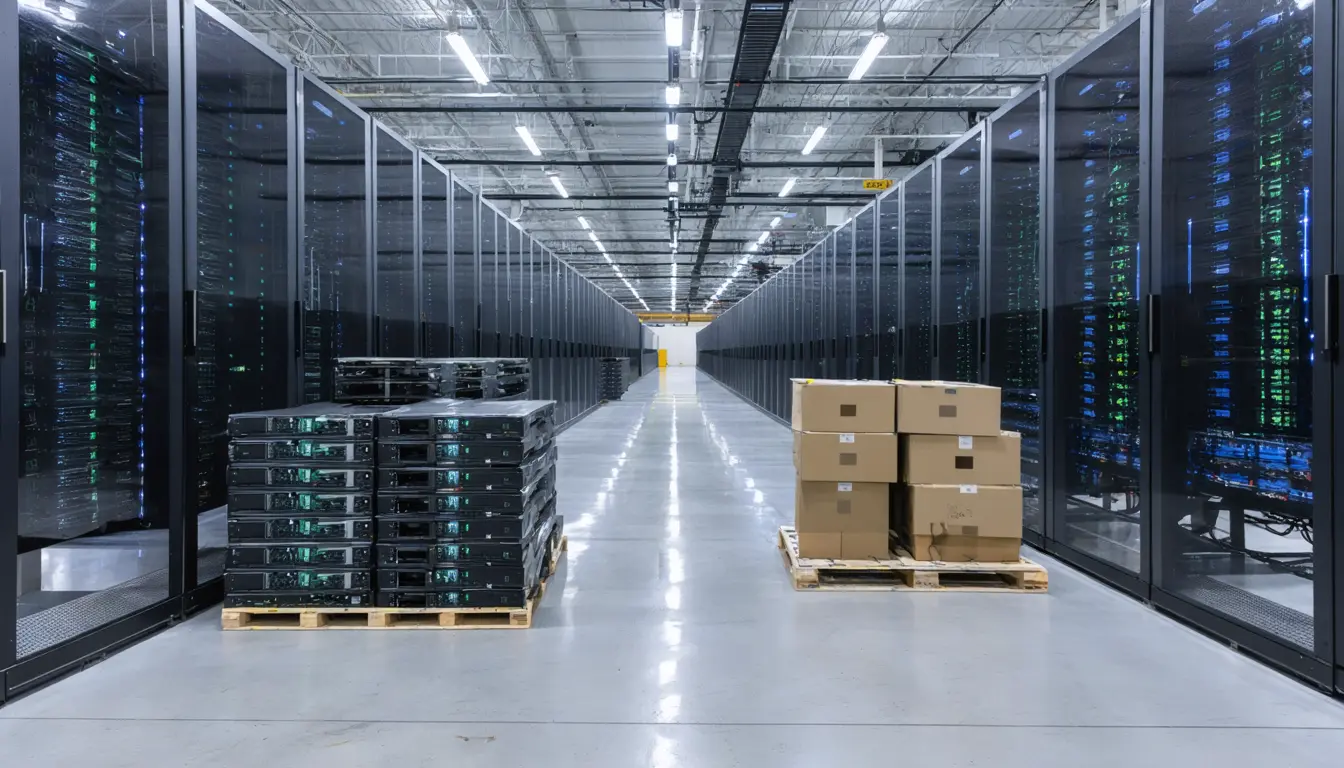
Key figures: Alphabet's second-quarter free cash flow was negative $5.9 billion. Second-quarter capex was $44.9 billion. Google Cloud's second-quarter operating profit was $8.8 billion, more than tripled. The 2026 capex outlook is up to $205 billion, lifted in July.
| Figure | Value | Note | Claim |
|---|---|---|---|
| Alphabet Q2 free cash flow | −$5.9 billion | 7 | |
| Alphabet Q2 capex | $44.9 billion | 6 | |
| Google Cloud Q2 operating profit | $8.8 billion | more than tripled | 8 |
| Alphabet 2026 capex outlook, up to | $205 billion | lifted in July | 5 |
What happened
- Alphabet raised the ceiling of its 2026 capex outlook to $205 billion in July. Its shares dropped more than 6% the following day.
- Second-quarter capex was $44.9 billion, with the vast majority going to technical infrastructure for AI, CFO Anat Ashkenazi said on the earnings call.
- Google Cloud's revenue rose 82% to $24.8 billion in the quarter, and its operating profit more than tripled to $8.8 billion.
- Jefferies strategist Chris Wood has argued the AI boom will most likely end in capital destruction as cheaper open-source Chinese models take share; Porat disagreed.
Why it matters
- constraint Any 2027 figure will be judged against the July sell-off, so a larger raise needs Cloud profit growth beside it.
- cost Cloud's $8.8 billion of operating profit equals about 20% of one quarter's capex, so the segment selling the capacity does not fund the build alone (operating profit and cash spent are different measures).
- contradiction Porat's evidence is a shortage of compute, while Wood's thesis concerns what that compute earns once cheaper models arrive. Both can hold at once, so her rebuttal leaves his claim open.
- exposure With about 71% of Americans opposed to a data center nearby, Porat said, energy supply and local jobs become part of what each new site costs to approve.
Porat gave a direction and no size. Alphabet did not put a number on "increase significantly" [2], so the only anchor is this year's outlook of as much as $205 billion [5], or rather the top of it. Divided over four quarters, that ceiling averages $51.25 billion [11], about 14% above the $44.9 billion spent in the second quarter [12]. (It is an average; the quarters need not be equal.)
We think the direction holds. Alphabet says it is "capacity constrained" [3], and the segment selling that capacity earned $8.8 billion of operating profit on $24.8 billion of revenue [8], a margin of 35.5% [13]. A shortage sold at that margin is a reason to build more. The counter-case is that the margin belongs to today's prices.
Porat's test for a return has two parts, she said: "One, what is the value that we add to partners so that you can actually deliver attractive revenue growth, and the other is how efficiently do we deliver that compute capacity." [17] She put the same logic more sharply to Fortune: "It's illogical to say that we're in a capacity-constrained position because there's such strong demand for the insight and the ability to improve business and government, and yet you can't drive a return on it." [16] A shortage shows buyers want compute at today's prices. It does not show what they will pay once cheaper models are available.
Her case against waiting is about timing. "You must invest for long-term growth," she said. "By the time you need it, it's too late." [10] On that logic Alphabet is not holding back spending to collect more evidence of returns first.
We would be wrong on direction in two observable ways. One is a capex outlook that stops rising while Porat still calls the company capacity constrained. That would mean something other than demand sets the limit. The other is Cloud revenue growth falling well below 82% [8] while spending climbs.
What to watch
- Alphabet's next earnings call: whether the 2026 capex outlook moves above $205 billion and whether any 2027 range appears.
- Google Cloud revenue growth against the 82% of the second quarter, and whether its operating margin holds near 35.5%.
- Whether Alphabet executives keep describing compute as capacity constrained once new capacity comes online.
Clarity's read
What the record supports and how the coverage leans. The claims behind it follow.
Reality
- Evidence60
- Adoption70
- Hype gap+15
- Incentives70
- Confidence55
Claim ledger
Ranked by verification strength, evidence, and original report placement.
- [1]
Alphabet is spending roughly $200 billion this year to build out its AI capacity.
- [2]
Alphabet President Ruth Porat said Monday at Fortune's Most Powerful Women Summit that Alphabet expects capital expenditures to "increase significantly" next year.
- [3]
Porat said Alphabet remains "capacity constrained" as demand for compute grows.
- [4]
Asked whether the industry is at the peak of AI spending, Porat replied, "We do see this as an opportunity that extends for quite some time."
- [5]
In July, Alphabet lifted its 2026 capex outlook to as much as $205 billion, and the stock dropped more than 6% the following day.
- [6]
Capital expenditures hit $44.9 billion in the second quarter, with the vast majority spent in technical infrastructure to support AI investments, CFO Anat Ashkenazi said on the Q2 earnings call.
- [7]
Free cash flow was negative $5.9 billion in the second quarter, the first time Alphabet's quarterly cash flow had dipped below zero in its more than 20 years as a public company.
- [8]
Google Cloud's revenue climbed 82% to $24.8 billion in the second quarter, while its operating profit more than tripled to $8.8 billion.
- [9]
Porat acknowledged growing resistance to data centers, saying about 71% of Americans don't want one built in their community, in line with a recent Gallup poll, but argued opinion shifts when companies add energy capacity, protect affordability, and create local jobs.
- [10]
Porat said: "You must invest for long-term growth. By the time you need it, it's too late."
- [11]
A $205 billion full-year capex ceiling averages $51.25 billion per quarter.
- [12]
The $51.25 billion average quarter is about 14% above the $44.9 billion of second-quarter capex.
- [13]
Google Cloud's second-quarter operating margin was about 35.5%.
- [14]
Google Cloud's $8.8 billion operating profit equals about 20% of Alphabet's $44.9 billion second-quarter capex.
- [15]
Jefferies global head of equity strategy Chris Wood argued the AI boom will most likely end in massive capital destruction in the U.S. as cheaper open-source Chinese models take market share; Porat disagreed.
- [16]
Porat told Fortune: "It's illogical to say that we're in a capacity-constrained position because there's such strong demand for the insight and the ability to improve business and government, and yet you can't drive a return on it."
- [17]
To earn an attractive return, Porat said, companies need to focus on two things: "One, what is the value that we add to partners so that you can actually deliver attractive revenue growth, and the other is how efficiently do we deliver that compute capacity."
Sources
1 independent publisher whose own reporting we read for this story.
Topics and entities
Follow any of these and your For You feed starts watching them — no settings page required.
Topics
- AI Infrastructure SpendingFollow
- Big Tech earnings seasonFollow
- Data Center BuildoutFollow