Product2 publishers3 min readPublished Updated
Alibaba dates mass production of its most powerful AI chip to the first quarter of 2027
T-Head has published a basic spec sheet for the Zhenwu V900 and Eddie Wu claimed clusters of up to 500,000 chips, yet the foundry behind the part is still unnamed, and Wu himself named supply shortages as the limit on Alibaba's compute.
The Product Desk · Product desk
What happened
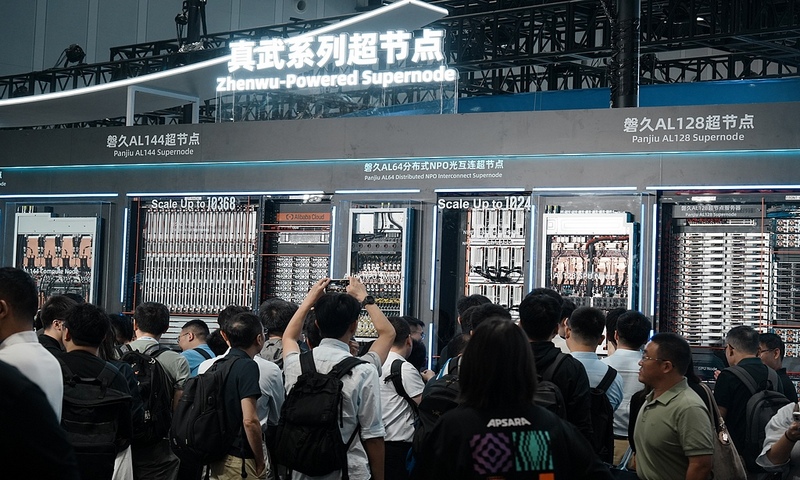
- Alibaba's chief executive Eddie Wu unveiled the Zhenwu V900 at the company's Apsara cloud conference in Hangzhou, a processor from its T-Head design unit built for both high precision training and low precision inference.
- T-Head published a basic spec sheet listing 216GB of memory and 1,200 GB/s of inter-chip interconnect bandwidth, with native support for precisions from FP32 through FP4.
- Wu said a single cluster can hold up to 500,000 of the chips, and that the resulting machine will run frontier model training and inference.
- Mass production and commercial release are set for the first quarter of 2027, with Bloomberg reporting that Alibaba will refresh the lineup every year.
- Bloomberg put Zhenwu family deliveries at 560,000 units to more than 400 external customers, while Alibaba's own post claims more than 650 customers for the same family.
Compiled by The Product DeskSomething wrong?How this is made
Why it matters
- constraint Anyone betting on the 500,000-chip cluster is also betting on a fabrication route no one has named, with Nvidia's top parts and TSMC both closed off and the domestic alternative short of capacity.
- decision Teams planning next year's compute cannot order this part at all, so the live choice is how much Alibaba Cloud capacity to commit to on the strength of a chip due in 2027.
- contradiction Wu's growth promises and his supply warning point in different directions: a yearly chip refresh and larger models, alongside his own statement that shortages cap how fast Alibaba can add compute.
- cost Shareholders carry the build-out while the silicon is still 2027 inventory, with quarterly profit down 75% after almost $10bn of spending.
A team deciding how much Alibaba Cloud capacity to book for 2027 can work with part of the spec sheet. Per-chip memory and interconnect bandwidth show up the first time a training job runs [4]. The cluster ceiling is a different kind of number. Multiply the 500,000 chips Wu cited by the memory on T-Head's sheet and one machine holds roughly 108 petabytes of attached memory [1]. "The most powerful AI chip in China today, delivering three times the performance of its predecessor, the Zhenwu M890," Wu said of the processor at Apsara [2].
The delivery figures describe something smaller. Bloomberg's count works out at fewer than 1,400 chips for the average external customer, and fewer than 900 using Alibaba's own higher customer number [2]. The cluster ceiling is about 89% of every Zhenwu unit Bloomberg says has been delivered so far [5]. Filling one would take nearly everything the family has shipped.
Nobody has said who makes the wafers. United States export controls keep Nvidia's most advanced accelerators out of China and largely block Chinese firms from using TSMC, and Bloomberg reported that it is unclear whether Alibaba works with SMIC, a capacity constrained rival [15]. Wu said global shortages across the AI data centre supply chain are limiting how fast Alibaba can scale its compute, and that mid to long term industry demand far outpaces what the company can supply [13].
What arrives sooner is rented capacity. Alibaba Cloud starts bringing its AI supernodes online at commercial scale this quarter [14]. Qwen 4 is already training, and Wu put Qwen 4.5 and Qwen 5 at five to 10 trillion parameters against the 2.4 trillion in Qwen 3.8 Max [16]. At the top of that range, that is about four times the current flagship [4]. The capacity goal for 2032 is around 53% of the 37.7GW that Cushman and Wakefield counts under construction in the United States alone [11][12][3]. Citigroup estimates that much capacity could drive more than $160bn of external revenue for the cloud division, according to Bloomberg [19]. Set that against the more than $53bn Alibaba has committed over three years and about $10.2bn raised in an August share sale [17].
For a buyer, three dates carry more weight than the spec sheet. First, when the part can be rented or bought. Second, when a fabrication route gets named or second-sourced. Third, when a customer outside Alibaba trains a frontier model on more than a pilot allotment. Only the first has a published date [7]. Until the second one is answered, the 500,000-chip cluster is a capacity promise from a cloud vendor. Price it the way you would any other 2027 supplier commitment, with a fallback and an exit if the part slips. Wu did not say where the new data centres will be built [14].
What to watch
- Any disclosure of which foundry makes the V900, or of a second source, before the 2027 release.
- Whether the first quarter of 2027 holds, given Alibaba's stated plan to refresh the Zhenwu line every year.
- An external customer naming a Zhenwu order in the tens of thousands of units rather than the low thousands.