LeadershipNot yet confirmed elsewhere1 publisher3 min readPublished
Exponential View finds AI revenue outruns the yearly cost of data centers already in service
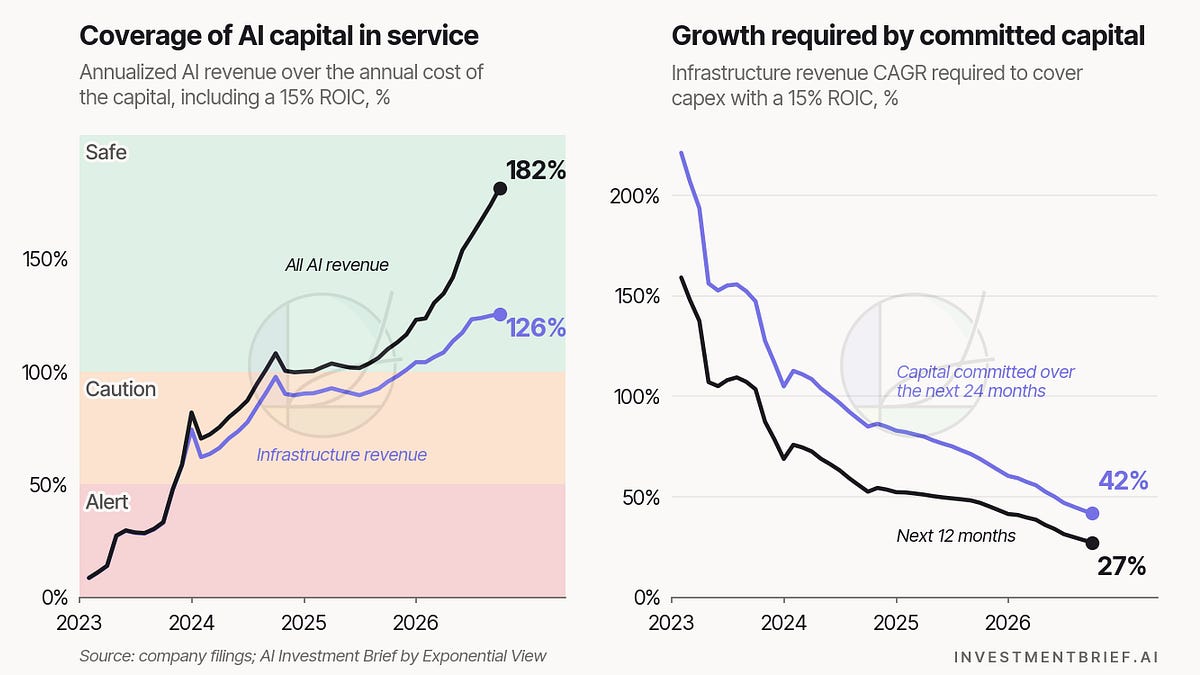
Exponential View puts annualized AI revenue at $276bn, enough to cover 182% of the yearly cost of data-center capital already in service. The tally finds today's build covered and the hurdle rising with every dollar committed from here.
The Board Room · Leadership desk
Bar comparison in $bn a year: AI infrastructure revenue $191bn and annual cost of AI capital in service $151bn. The revenue bar is taller than the cost bar.
Annual figures for AI capital in service In $bn a year
| Item | Value | Claim |
|---|---|---|
| Infrastructure revenue | 191 $bn a year | 3 |
| Annual cost of capital in service | 151 $bn a year | 21 |
What happened
- To pay for the next 12 months of committed capital, infrastructure revenue must grow 27% a year over the equipment's life, and 42% a year if 24 months are counted.
- Capital committed through September 2027 will add $414bn a year to the hurdle once in service, and capital committed through September 2028 will add $612bn.
- Exponential View's cohort of listed AI companies traded at 24.2x trailing earnings at the 1 October close, down from 24.8x a week earlier.
Why it matters
- constraint The 182% describes only the $480bn in service. The $328bn of construction in progress, about 41% of deployed capital, sits outside the test and is covered by no figure in the brief.
- decision Committing a second year of capital lifts the required growth from 27% to 42% a year, 15 points higher. A 24-month build plan therefore depends on a faster sustained climb than a 12-month plan does.
- exposure The ratio is struck on September's annualized rate. Revenue actually earned over twelve months was $161bn, about 58% of that rate, so the cover leans on recent growth holding.
The test Exponential View runs is narrow by construction. It divides annualized AI revenue by the yearly cost of the data centers that hyperscalers and neoclouds already operate, and it leaves out future commitments and construction in progress [6]. That cost is depreciation plus operating expense plus a 15% return on invested capital [6]. The stated components are $66bn, $13bn and $72bn [4], which sum to $151bn [21]. Revenue of $276bn [1] over $151bn is about 1.83 [22], within rounding of the published 182% [2].
The return assumption is the largest single component of the cost base. The $72bn of return is about 48% of the $151bn total [23]. Take it out and the in-service cost is $79bn, and $276bn of revenue covers that about 3.5 times [24]. Whether 15% is the right hurdle is the publisher's judgement, and an investor with a lower required return would see more headroom.
Committed capital changes the picture. Once in service, capital committed through September 2027 adds $414bn a year to the hurdle, and capital committed through September 2028 adds $612bn [8]. On top of today's $151bn, the annual cost would reach $565bn and $763bn [d5, d6]. Those are 3.0 and 4.0 times the $191bn that infrastructure revenue brings in now [d7, d8]. The required growth of 27% or 42% a year [7] looks small beside the 3.7-fold rise in total AI revenue over twelve months [18], a gain of 270% [33]. The comparison is loose. The required rates apply to infrastructure revenue alone and must hold for the equipment's five to six year life [7], and Exponential View says further commitments will keep raising the bar [9].
Funding quality is the second exposure. The brief defines its 26.6% discount as the share of the build-out financed by weaker instruments [11]. It weights cash at 100%, investment-grade debt at 85% and vendor financing at 10% [12]. Timing conventions matter here. SoftBank paid the last $10bn of its $30bn into OpenAI's round on 1 October [13], but Exponential View says that payment does not move the measure, because it counts the full round from its close on 31 March [14]. OpenAI's reported raise of at least $30bn more will enter the reading only when it closes [15]. Nscale's convertible notes raise the discount by 0.04pp, and the brief expects a 0.08pp fall when they convert to shares at the IPO [17].
The model is the publisher's own, and the 15% return and the 5-6 year equipment life are assumptions it sets. Revenue is de-duplicated, so a dollar that passes from user to app to model lab to cloud is counted once [20]. The published text breaks off before the layer-by-layer split, so the growth rate of infrastructure revenue alone is not shown.
What to watch
- The next update of the 12- and 24-month growth hurdles, 27% and 42% in this edition, as new commitments are added to the base.
- OpenAI's reported raise of at least $30bn more, which enters the funding quality reading only when it closes.
- Nvidia's $1bn to complete Nscale's $3.36bn round, due in mid-November.
Clarity's read
What the record supports and how the coverage leans. The claims behind it follow.
Reality
- Evidence50
- Adoption
- Insufficient
- Hype gap+15
- Incentives
- Insufficient
- Confidence55
Claim ledger
Ranked by verification strength, evidence, and original report placement.
- [1]
AI revenue reached an annualized $276bn in September, according to Exponential View's AI Investment Brief.
ReportedSupportedSource: Exponential View, AI Investment Brief (investmentbrief.ai)View cited source - [2]
AI revenue now covers 182% of the annual cost of AI capital in service (depreciation, OpEx, and a 15% ROIC ex-WACC).
- [3]
Infrastructure revenue, $191bn of the $276bn annualized AI revenue, alone covers 126% of the annual cost of AI capital in service.
- [4]
The annual cost of capital in service comprises $66bn of depreciation, $13bn of OpEx and $72bn of return on $480bn of capital in service.
- [5]
Net deployed AI capital is $808bn including construction in progress (CIP).
- [6]
Coverage of AI capital in service is annualized AI revenue divided by the cost of capital in service (depreciation + OpEx + 15% ROIC), covering AI data centers currently in operation by hyperscalers and neoclouds and excluding future commitments and construction in progress.
- [7]
To fully cover the next 12 months' committed capital, infrastructure revenue must grow 27% per year for the equipment's 5-6 year life; for capital committed over the next 24 months, 42% per year.
- [8]
Once in service, all AI capital committed through September 2027 will add $414bn a year to the hurdle, and all capital committed through September 2028 will add $612bn a year.
- [9]
Further commitments will continue to raise this bar, setting a higher required growth rate for a more extended period.
- [10]
Exponential View's AI cohort traded at 24.2x trailing earnings at the 1 October close, which it calls still in the safe band, down marginally from 24.8x on 24 September.
- [11]
The funding quality discount, the share of the build-out financed by weaker instruments, is 26.6%.
- [12]
The funding quality discount is 1 minus quality-weighted funding divided by total funding for AI CapEx, with cash weighted at 100%, investment-grade debt at 85% and vendor financing at 10%.
- [13]
SoftBank paid the last $10bn of its $30bn into OpenAI's round on 1 October.
- [14]
Exponential View says neither the SoftBank payment nor Nvidia's same-day payment moves its measure, because it counts the full round from its close on 31 March.
- [15]
OpenAI is reported to be raising at least $30bn more; it will enter Exponential View's reading when it closes.
- [16]
Nscale raised $2.36bn of convertible notes, the first part of a $3.36bn round; Nvidia is due to fund the other $1bn in mid-November.
- [17]
The Nscale notes raise the funding quality discount by 0.04pp; when they convert to shares at the IPO, the discount falls 0.08pp.
- [18]
AI revenue is 3.7x its level a year ago.
- [19]
The AI economy earned $161bn over the last twelve months.
- [20]
Exponential View de-duplicates AI revenue across the stack: when a user pays an app, the app pays a model lab and the lab pays a cloud, the dollar is counted once.
- [21]
The stated annual cost components sum to $151bn.
- [22]
Annualized revenue divided by the summed annual cost is about 1.83, consistent with the published 182%.
- [23]
The $72bn return is about 48% of the $151bn annual cost base.
- [24]
Excluding the return, annual in-service cost is $79bn and $276bn of revenue covers it about 3.5 times.
- [25]
Adding capital committed through September 2027 to today's $151bn cost gives an annual hurdle of $565bn.
- [26]
Adding capital committed through September 2028 to today's $151bn cost gives an annual hurdle of $763bn.
- [27]
A $565bn hurdle is about 3.0 times today's $191bn of infrastructure revenue.
- [28]
A $763bn hurdle is about 4.0 times today's $191bn of infrastructure revenue.
- [29]
The gap between $808bn deployed including CIP and $480bn in service is $328bn.
- [30]
The $328bn gap is about 41% of the $808bn deployed total.
- [31]
The 24-month growth requirement is 15 percentage points above the 12-month requirement.
- [32]
Trailing twelve-month AI revenue of $161bn is about 58% of the $276bn annualized rate.
- [33]
A 3.7-fold rise in AI revenue over a year is a gain of 270%.
Sources
1 independent publisher whose own reporting we read for this story.
- AI revenues at $276bn annualized
investmentbrief.ai
1 article · October 10, 2026
Topics and entities
Follow any of these and your For You feed starts watching them — no settings page required.