Build1 publisher2 min readPublished
Adcock previews Figure's F.04 hands as a bet on mechanical complexity
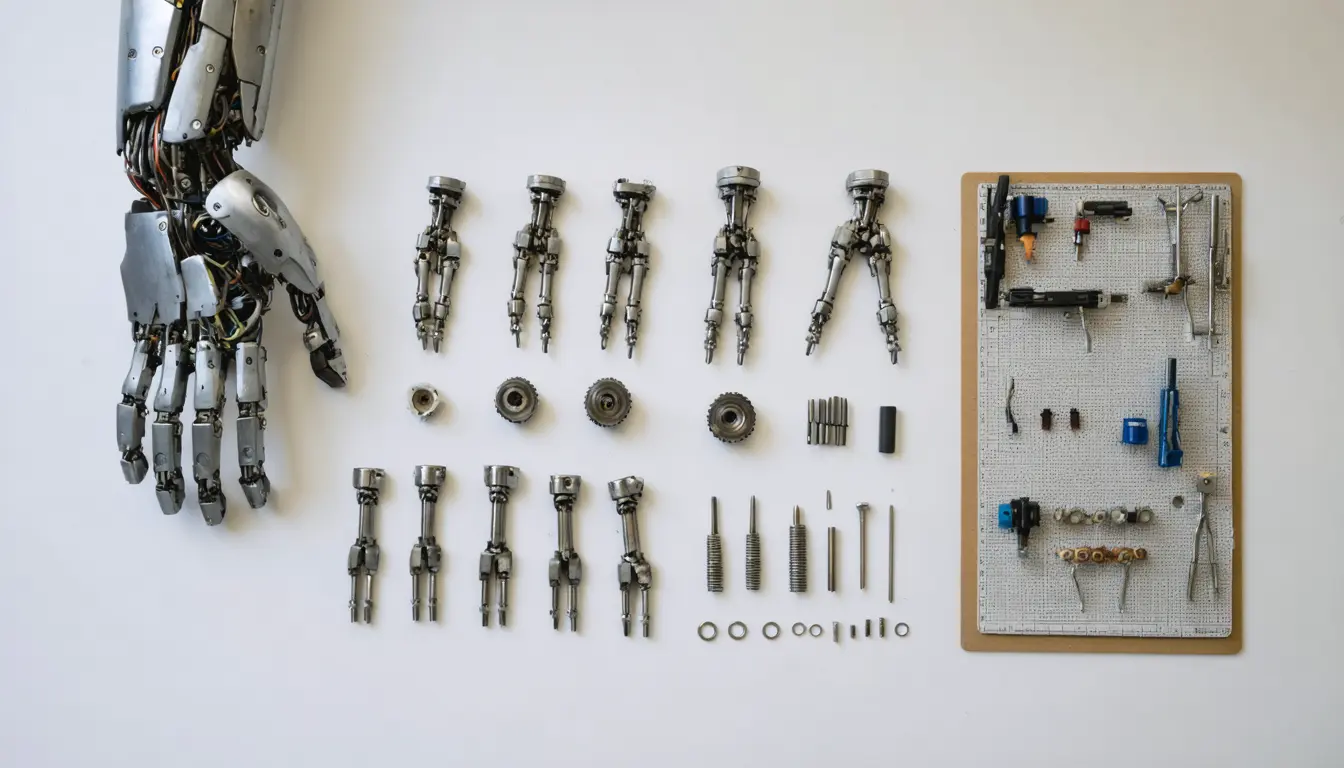
Figure CEO Brett Adcock previewed the F.04 humanoid's hands on October 3, arguing that capable manipulation may require more mechanical complexity. For now the post sets a design direction, and outsiders can test it only after Figure publishes specs and repeatable task results.
The Engineer · Build desk
What happened
- In August, Adcock called Figure's original tendon-based hand an engineering mistake; the company had built and tested it before moving on to other hand architectures.
- Adcock said on May 13 that F.04 had reached full design lock and that parts were starting to ship, Humanoids Daily reported.
- Figure said on September 30 that taking apart its retired F.02 robots would consume staff time and delay the F.04 launch.
- In September 2025, Figure said it had secured Series C commitments of more than $1 billion, valuing the company at $39 billion post-money, in a round led by Parkway Venture Capital.
Compiled by The EngineerSomething wrong?How this is made
Why it matters
- constraint With degrees of freedom, actuator count, tactile-sensor layout and payload all unpublished and no independent benchmark, nobody outside Figure can compare F.04's hands with F.02's or a rival's.
- cost Figure pays for each added mechanism across a production fleet: more assembly time, more parts that wear and need servicing, and a harder control problem.
- decision Anyone valuing Figure on its BMW record is valuing an earlier hand, so F.04 needs task results of its own before that record counts for the new design.
- capability The Series C money lets Figure run the build-test-discard cycle on hands again if this design's complexity does not deliver reliable work.
Adcock's argument takes one side of a real tradeoff [1]. A mechanically elaborate hand gives the robot more ways to grasp and move objects [11]. Every mechanism added for that also has to be assembled, kept durable, serviced and controlled [11]. According to Runtimewire, the post argues for that cost without showing whether the extra capability holds up across long runs, varied objects or ordinary wear [16].
When Figure does publish specs, actuator count is the number to read first [2]. It measures the complexity directly. Each actuator adds to the assembly, servicing and control load [11].
Figure has already put one hand through build, test and discard [3]. Calling your own hardware a mistake in public is how a hardware team should work. The F.04 hands appeared 143 days after the design-lock announcement [1]. Design lock is a defined engineering milestone. It does not establish that production is ready, or that the finished robot has shown the abilities Figure has promised [13].
The field results Figure cites come from F.02. By Figure's November 2025 account, F.02 robots logged more than 1,250 hours at BMW's plant in Spartanburg, where they loaded upward of 90,000 parts and helped build more than 30,000 X3s [6]. Taking both lower bounds at face value, that is about 72 parts loaded per reported hour [2]. Those are Figure's own numbers, not an independent evaluation [6]. Figure also describes F.02 as an early deployment whose lessons informed later designs [9]. For the BMW record to transfer, an F.04 hand with a different mechanical design would have to run comparable work for comparable hours, and the results would have to be published.
I think the direction is right for the goal Figure has set. Its master plan describes a general-purpose humanoid capable of human-like manipulation and, eventually, work alongside people [8]. A humanoid can walk into a home or factory built for people. Useful work there depends on handling objects that vary in shape, position and fragility [14]. A hand designed mainly to be easy to build would have to cover that range with fewer ways to grip [11]. In Runtimewire's framing, the design first has to handle a range of physical tasks over and over, and then has to be manufactured and maintained in production volumes [15].
What to watch
- Figure publishing degrees of freedom, actuator count, tactile-sensor layout and payload for the F.04 hands.
- Repeatable F.04 task results across long runs and varied objects, ideally from an independent evaluator.
- A delivery date for F.04; Figure has not given one, and the F.02 teardown is already delaying the launch.