Invest9 distinct publishers3 min readPublished Updated
Shanghai has valued a small but profitable robot maker above Figure AI, Baidu and JD.com. The multiple, not the machines, is the number to check.
The Investor · Invest desk

Compiled by The InvestorSomething wrong?How this is made
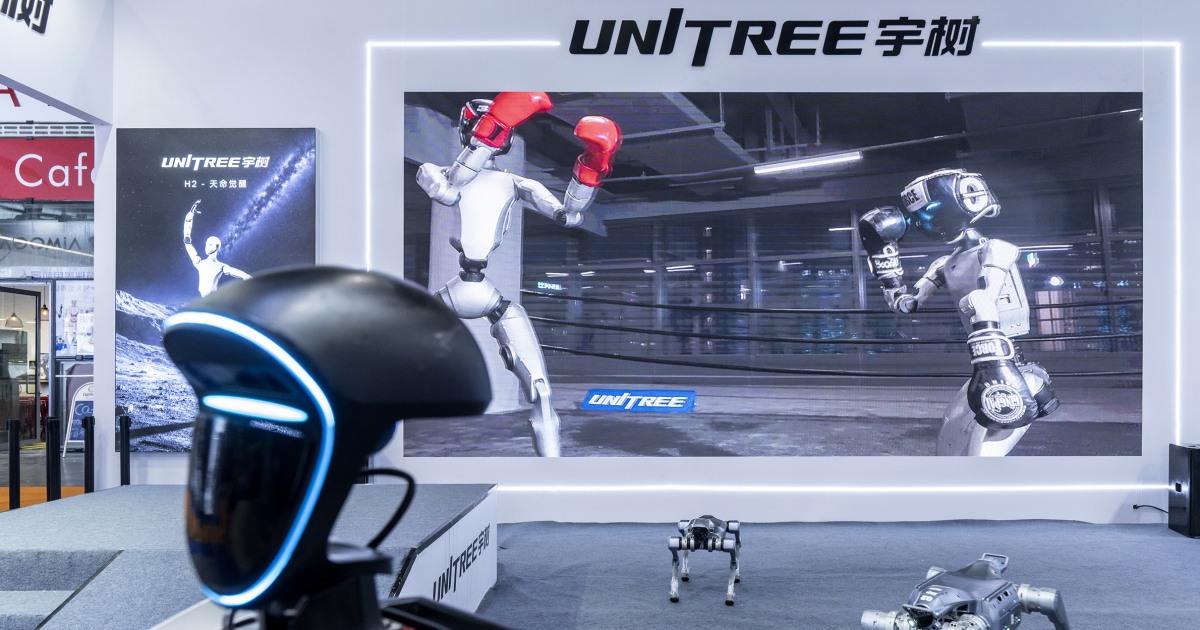
Unitree closed its first day on Shanghai's STAR Market up more than 460%, according to Fortune, after an IPO that raised about $900 million at a $9 billion valuation [1]. At the top of the move the Hangzhou company was worth roughly $66 billion, ahead of Baidu and JD.com and above the $39 billion that Figure AI, the most valuable US robotics company, achieved in a September 2025 funding round [2].
The company behind that number is real and small. Unitree reported 1.7 billion yuan ($252 million) of 2025 revenue, with almost 45% from overseas, and 600 million yuan ($89 million) of profit, per Fortune [3]. Cryptopolitan puts net profit at 591 million yuan and says revenue was more than four times the prior year's [4]. At $66 billion that is about 262 times revenue and roughly 740 times earnings [1][2]. The $66 billion is a peak print, not a close: Cryptopolitan reports the stock was priced at 150.8 yuan, opened at 1,100 yuan for a 629.44% gain, then eased to 883.9 yuan by midday, or about $53 billion [5]. That softer mark is still around 210 times revenue [3].
Unit volumes give a cleaner read. Unitree shipped more than 5,500 humanoid robots in 2025, which Cryptopolitan puts at 32.4% of the global market, plus over 33,000 four-legged robots for close to 60% share [6]. Divide the peak valuation by humanoids shipped and public markets assigned about $12 million of value per unit sold last year [4]. Most of those sales go to research buyers, with only some Chinese tech companies and state-owned enterprises starting to explore operational use [7].
Part of the pop is plumbing. Mainland regulators deliberately hold IPO pricing low to protect retail investors if a listing disappoints, which mechanically inflates day-one gains [8]. Demand was extreme: retail bids reached 7 trillion yuan, oversubscribing that tranche by more than 8,000 times, with offline subscriptions at 2,760 times the shares available [9]. Chip maker CXMT rose 460% on its July 27 Shanghai debut after raising over $8 billion [10], and the first-day record belongs to Wuhan Changjin Photonics at 1,511% [11]. A 460% or 629% first day in Shanghai is closer to a pricing convention than a verdict.
What the multiple has to absorb is policy. The US banned foreign-made robots in late July on national security grounds, exempting models already sold there, and Unitree drew 18% of revenue from the US last year [12] - roughly $45 million on 2025 numbers [5]. The Pentagon has also placed Unitree on its list of Chinese military companies [13]. Morningstar's Kangyuxiao Li wrote on August 18 that losing US access could noticeably affect revenue growth, and that Unitree would also lose customer feedback useful for product improvement [14]. HSBC analysts wrote in mid-July that the shipment surge across robot makers "could be illusionary" and unlikely to be sustained for one to two years without better AI models [15]. Nomura went the other way with a buy rating, crediting rapid product iteration as the basis of a first-mover advantage [16].
Three things to watch. Whether overseas revenue, put at almost 45% by Fortune and more than 40% by Cryptopolitan, holds up once the US ban bites [3][17]. Whether the comparables confirm the mark: UBTech listed in Hong Kong in late 2023 and Agibot is planning its own Hong Kong IPO [18]. And whether the paper wealth stays on paper: founder Wang Xingxing's 121.4 million shares were worth over 107 billion yuan, nearly $16 billion, at the opening price, while DeepSeek added just 140.8 million yuan, about $21 million, in the IPO itself [19]. Unitree also showed a robot called Superman before listing, claiming a two-metre jump and 12.66 m/s top speed; Cryptopolitan notes those figures come from a company video and are not independently confirmed [20].
Ranked by verification strength, evidence, and original report placement.
Shares in Unitree closed their first day of trading up more than 460%; the company raised around $900 million in its IPO on Shanghai's STAR Market at a valuation of $9 billion.
Unitree reported 1.7 billion yuan ($252 million) in revenue in 2025, with almost 45% from overseas sales, and generated 600 million yuan ($89 million) in profit last year.
Cryptopolitan reported Unitree posted 1.7 billion yuan of 2025 revenue, more than four times the previous year, and net profit of 591 million yuan, making it profitable while many humanoid competitors are still losing money.
Unitree's stock was priced at 150.8 yuan per share and opened at 1,100 yuan, a 629.44% increase, valuing it at about 445 billion yuan or $66 billion at its highest point; the price dropped to 883.9 yuan by midday, lowering the valuation to around 357 billion yuan, or about $53 billion.
Mainland Chinese regulators try to keep IPO valuations low to protect retail investors if a newly listed stock fails to live up to the hype, and a large trading-day pop is common for heavily anticipated Chinese IPOs.
Shares in ChangXin Memory Technologies surged by 460% on their first day of trading in Shanghai on July 27, after the company raised over $8 billion in its IPO.
Follow any of these and your For You feed starts watching them — no settings page required.
Evidence-backed comparisons of source perspectives and observed adoption signals. Read the methodology
Which Builder, Operator, and Investor concerns the observed source mix emphasized—not a truth score.
Evidence, demonstrated adoption, hype gap, incentives, and confidence are assessed independently, each on its own current evidence. How these are measured.
Market facts solid, company figures largely unverified
Pricing, raise size and the direction of the debut are corroborated by three publishers, and the policy facts (U.S. robot ban, Pentagon listing, 18% U.S. revenue) plus named analyst views from HSBC, Morningstar and Nomura are directly quoted. Weaker beneath that: revenue, profit, shipment and market-share figures rest on company or single-publisher reporting rather than an audited filing; the two publishers differ on profit and overseas share; the two sources disagree on whether $66 billion was the day's worth or only the intraday peak; and the Superman performance specs are explicitly unconfirmed.
Real shipments, demand still research-led
There is genuine commercial traction: 5,500-plus humanoids shipped in 2025, more than 33,000 quadrupeds cumulatively, reported revenue up more than fourfold and actual profit, which is rare in the sector. But the demand mix is the constraint -- most sales are for research, with Chinese tech firms and SOEs only beginning to explore operational use, and HSBC argues the shipment surge itself may be illusionary without better AI models. Meanwhile the U.S. ban closes an 18%-of-revenue channel to new units. That is early-market adoption, not production deployment.
Valuation runs far ahead of demonstrated fundamentals
Positive gap. Roughly 262 times revenue, about 740 times earnings and some $12 million of market value per humanoid shipped is priced against a research-led customer base, unverified flagship product specs, and a newly closed U.S. channel. Mechanics amplify the optics: mainland regulators suppress IPO pricing, retail bids ran to 7 trillion yuan at 8,000x-plus oversubscription, and comparable pops (CXMT +460%, Wuhan Changjin Photonics +1,511%) show the debut multiple is partly a market-structure artefact. The discount to the gap is that the underlying business is real and profitable, which many humanoid peers are not.
Issuer, sell-side and retail-flow incentives all visible
The cluster documents its own conflicts of interest unusually well. The performance claims for Superman come from the company's own video days before pricing; Nomura published a buy rating on debut day; the founder's stake was worth nearly $16 billion at the open and existing investor DeepSeek topped up during the IPO; regulators deliberately price mainland IPOs low, which manufactures the pop that becomes the headline; and Cryptopolitan's financial figures are sourced to its own prior reporting. Offsetting disclosure exists via HSBC and Morningstar caution and Cryptopolitan's explicit non-verification note.
Moderate
Three independent publishers, dated analyst notes and consistent core numbers support moderate confidence in the market and policy picture. Confidence is held below high because the operating figures are company-sourced, the shipment share percentages are unattributed and single-sourced, the closing valuation is contested between sources, and adoption quality rests on one sentence about research-led demand.
build
Unitree's 8,000x book is now the comparable every humanoid banker will quote2 distinct publishers
product
Unitree's $9bn Shanghai listing prices the humanoid story, not the robot-dog business1 distinct publisher
invest
Unitree's $905M Shanghai listing prices humanoids at 35x sales while profit halves1 distinct publisher
product
Unitree gave back $30bn and still sits near five times its pre-float valuation1 distinct publisher
Distinct publishers with included, body-backed reporting in this cluster.
apnews.com
1 article · August 20, 2026
crowdfundinsider.com
1 article · August 19, 2026
cryptopolitan.com
1 article · August 19, 2026
fortune.com
1 article · August 19, 2026
nbcnews.com
1 article · August 20, 2026
pivotnews.ai
1 article · August 20, 2026
scmp.com
1 article · August 23, 2026
semafor.com
2 articles · August 21, 2026
thedailyupside.com
1 article · August 19, 2026