Invest1 publisher3 min readPublished
Abu Dhabi met Tehran about Hormuz shipping 24 days after cutting all trade with it
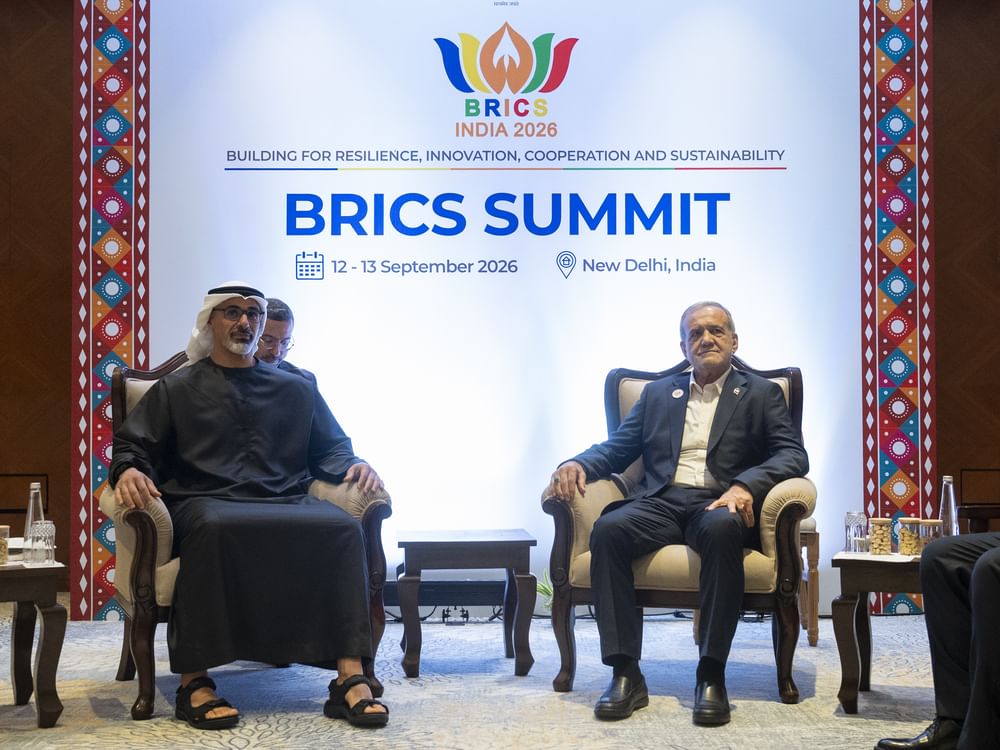
The September 12 sit-down in New Delhi was the first between the two governments since the February 28 conflict began. Cryptobriefing puts Hormuz navigation at the centre of it. The August 19 trade suspension is still in force.
The Investor · Invest desk
What happened
- Iranian President Masoud Pezeshkian and Abu Dhabi Crown Prince Sheikh Khaled bin Mohamed bin Zayed Al Nahyan met on September 12 on the sidelines of the 18th BRICS Summit in New Delhi.
- It was the first face-to-face between leaders of the two countries since the West Asia conflict erupted on February 28, according to cryptobriefing.
- The central topic, cryptobriefing reported, was how to keep ships moving through the Strait of Hormuz.
- Follow-up talks between Iran and Gulf states were reportedly scheduled for mid-September in Oman.
Compiled by The InvestorSomething wrong?How this is made
Why it matters
- constraint The suspension reaches banking relationships and financial flows, not only goods, so Iranian re-entry to the Dubai channel needs Emirati institutions to reopen correspondent lines.
- cost If Iran's transit-fee framework were ever agreed, the charge lands on shippers and their cargo owners, and it puts the Gulf states on the opposite side of the US free-navigation position.
- contradiction The UAE's diplomatic advisor casts the meeting as deterrence combined with diplomacy. The same reporting has the trade measure intact and trust described as a mountain to climb, and the deterrent half is the part still operating.
- precedent Abu Dhabi has shown it will negotiate over the waterway while its economic measure stands.
Twenty-four days separate the August 19 suspension from the September 12 handshake [19], and 196 days separate the start of the conflict from it [20]. The suspension of all trade and financial transactions with Iran was still in force on the day the two men sat down. Cryptobriefing reported that Emirati officials have given no public indication it will be lifted soon [5]. Trust, Emirati officials have said, "is a mountain to climb" [6]. The same report dates the groundwork to the May 2026 BRICS foreign ministers' meeting, where the UAE and Iranian delegations clashed openly [8], roughly four months before New Delhi [21].
Both governments endorsed the BRICS New Delhi Declaration, which called for maximum restraint in protecting civilians, sovereignty, trade, supply chains and energy flows [7]. Roughly a fifth of the world's oil supply passes through the strait on any given day, along with a large share of global LNG exports [11]. By June, UAE Foreign Minister Sheikh Abdullah bin Zayed had publicly stressed the necessity of uninterrupted maritime traffic through it [12]. Iran's transit-fee framework runs counter to established international maritime norms and to the US position favouring free navigation, according to cryptobriefing [13].
The three accounts of the meeting differ on what was discussed. One has the leaders talking about regional de-escalation, stability and ongoing peace initiatives, citing reporting from the summit [23]; another puts Hormuz navigation at the centre [10]. All three were published by cryptobriefing.com [18], one newsroom reading the same sit-down two ways.
The freeze and the strait are separate matters. The August 19 measure covers commercial transactions, banking relationships and financial flows between the two economies [4]. The UAE has historically been a conduit for Iranian commerce, with Dubai connecting Iranian businesses to global markets [9]. The reports did not value the trade the suspension covers [22]. Reopening that channel is a decision for banks. Correspondent relationships have to be restored by institutions.
Where the move showed up in a price was in prediction markets. Cryptobriefing reports an uptick in the probability of a US-Iran deal that includes reconstruction funding, with the YES odds rising modestly [17].
The follow-up round produces a navigation framework and the trade measure is relaxed months later. Or the meeting is what the UAE's diplomatic advisor described, a strategy combining deterrence with diplomacy [16], with the freeze kept because it is the deterrent half. Or Tehran holds to transit fees, the Gulf states decline, and February's positions stand. On this evidence the negotiable item is passage through Hormuz, and the freeze is what Abu Dhabi holds while negotiating it. One piece of news would overturn that: an Emirati statement resuming banking or commercial dealings with Iran before any Hormuz framework exists. That would mean the trade measure was the bargaining chip and the waterway was the cover.
What to watch
- Whether any text out of the mid-September Oman round mentions transit fees, and in whose favour the wording lands.
- Whether insurers cut Persian Gulf war risk premiums, the first place a de-escalation would show up in a bill.
- Whether the UAE and Iran hold a second leader-level contact after New Delhi, or leave it at one photograph.