Washington reopens the Douglas cattle lane and 331,000 tons of beef, for prices it cannot move
The screwworm closure is being unwound while more than 40 cases sit inside Texas and New Mexico. Economists say the relief is not in the price; it is in the discretion Washington now holds.
The Investor · Invest desk
What happened
- USDA is reopening the Douglas, Arizona crossing to Mexican cattle, saying screwworm risk has eased, with New Mexico and Texas crossings meant to follow.
- Cattle imports from Mexico have been barred since May 2025, when the border was closed over the parasite.
- Trump said on Friday he would let in up to 331,000 tons of imported ground beef tariff-free, to be sold below market prices for 90 days.
- More than 40 screwworm cases have been confirmed in southern Texas and southeastern New Mexico since the first Texas case since 1966, reported June 3.
Why it matters
- constraint A phased 3% of cattle supply arriving over months cannot carry the political weight assigned to it, which leaves the price problem where it was and the credit claim unearned.
- decision Importers and grinders now have to decide whether to build sourcing for a below-market programme that stops in three months, with no signal on renewal.
- contradiction The same administration called the closure essential to containment in February and judges the risk acceptable now that the parasite is inside the US, so one of those readings was politics and the...
- exposure The border-state feeders named as beneficiaries sit closest to the confirmed infestations, so they hold the animal-health downside of their own cost relief.
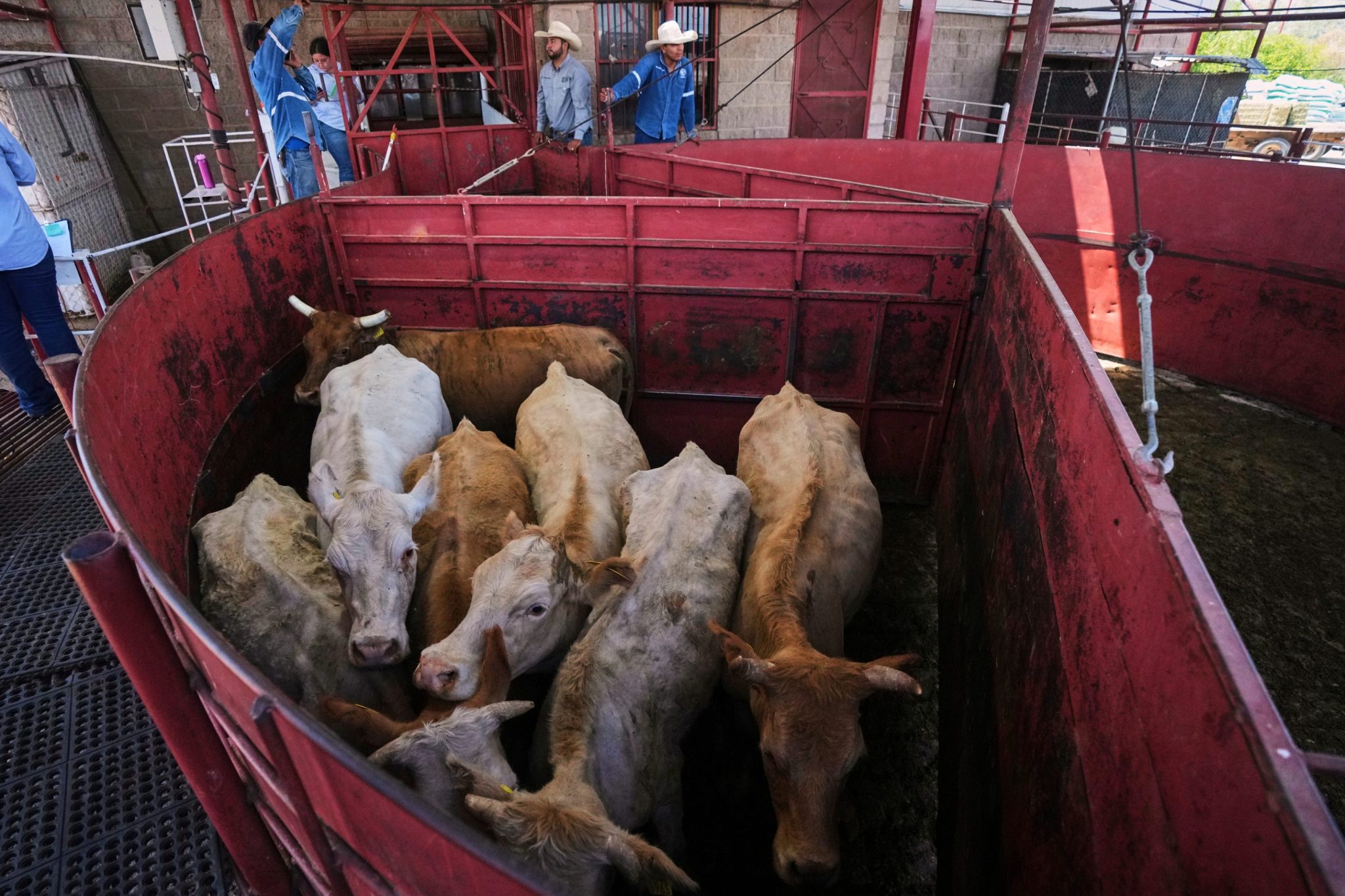
The two interventions run on different clocks, and only one of them has a deadline. The ground beef allowance works out to about 662 million pounds, worth roughly $4.6 billion at July's average retail price, released tariff-free and sold below market across 90 days [6][18]. None of it adds a slaughter animal or a feedlot pen. The Douglas lane does add animals, but Derrell Peel of Oklahoma State puts Mexico's traditional contribution at 1.1 million head, about 3% of US cattle supply, and says the phased schedule means months before that volume comes back [7]. His read on the price effect is blunt: no measurable impact on cattle or beef prices soon [8]. He also names the motive, saying the administration has a lot of incentive to be seen doing something about beef because it is expensive and high profile [9].
The price series is already doing part of the government's work. July's ground beef average landed a penny below May's record, so the peak is behind even though the level is not [2][19]. Across five years the run is close to 57% against about 25% for food overall, some 2.3 times the pace [2][11][20], and uncooked steak set its own record at $13.06 a pound in July [12]. A three-month discount programme does not close a five-year gap of that width.
What is actually being traded here is containment. The White House called the livestock closure essential in February, while conceding it worsened the shortage of cattle for slaughter [1]. The parasite arrived regardless. Agriculture Secretary Brooke Rollins' offsetting safeguards are the animal health programmes in Sonora and Chihuahua plus inspection and certification of each animal at the crossing [16], an approach House Agriculture Chair John Boozman calls careful and science-based [17]. The asset behind that judgement is a cattle industry officials value at $113 billion [14].
Glynn Tonsor of Kansas State supplies the number that should discipline the whole argument: the smaller cattle supply pushed prices up less than it might have, because the industry now gets more meat from each animal [13]. If yield per head is absorbing a herd at its smallest in 75 years [10], then 3% of supply at the border is noise in the retail price, and shoppers are paying for demand meeting five years of accumulated cost.
So the change worth pricing is not volume, it is discretion. USDA's queue for the New Mexico and Texas crossings [4] and the expiry date on tariff-free grinding beef [6] are now variables set in Washington rather than in a pasture, and anyone holding a view on cattle has to model an agency calendar alongside the herd.
What to watch
- Whether USDA moves the New Mexico and Texas crossings out of the queue, or whether new confirmed cases north of the border stall the phased plan.
- Whether the tariff-free ground beef allowance is extended, enlarged or quietly allowed to lapse when the 90 days end.
- Whether retail ground beef breaks above May's record while the two supply measures are running.
Clarity's read
What the record supports and how the coverage leans. The claims behind it follow.
Reality
- Evidence68
- Adoption28
- Hype gap+45
- Incentives72
- Confidence60
Claim ledger
Ranked by verification strength, evidence, and original report placement.
- [1]
In February the White House said closing the border to livestock imports from Mexico more than a year earlier was 'essential' to containing the screwworm, but that it had exacerbated a shortage of cattle for slaughter in the US.
- [2]
The average price of a pound of ground beef rose nearly 57% from July 2021 to July 2026, from $4.39 to $6.89, after peaking at $6.90 in May, a 10% increase over the previous year, according to Bureau of Labor Statistics figures.
- [3]
The US plans to reopen a border crossing in Arizona to cattle from Mexico on Monday as part of a broader Trump administration effort to reduce record-high beef prices, though economists doubt it will mean much to grocery shoppers.
- [4]
USDA said concerns about the New World screwworm's spread lessened enough to allow cattle movement from Mexico at the Douglas, Arizona crossing, about 230 miles southeast of Phoenix, and over time it hopes to reopen other crossings in New Mexico and Texas.
- [5]
The Trump administration closed the border to cattle imports in May 2025 as part of its response to the screwworm, a parasite with flesh-eating larvae that can infest and kill cattle and other animals.
- [6]
Trump announced on Friday that he would allow up to 331,000 tons (300,000 metric tons) of imported ground beef into the US, tariff-free, to be sold at below-market prices over the next 90 days.
- [7]
Derrell Peel, professor of agribusiness at Oklahoma State University, said the phased reopening means it will take months for Mexican imports to return to traditional levels; Mexico has traditionally provided 1.1 million head, about 3% of US cattle supply.
- [8]
Peel said: 'I don't expect to see any measurable impact on cattle prices or beef prices soon.'
- [9]
Peel said the administration 'obviously has a lot of incentive to try to be able to say that they're doing something about high beef prices in particular' and that beef has been singled out because it is expensive and high profile.
- [10]
USDA reported the US cattle herd had dropped to 86.2 million head on Jan. 1, the lowest figure in 75 years, after five years of contraction.
- [11]
Food prices overall have risen about 25% over the same five years, according to Bureau of Labor Statistics numbers.
- [12]
The price of a pound of uncooked steak rose 35% over five years, reaching a record $13.06 per pound in July, also 10% higher than a year before.
- [13]
Glynn Tonsor, professor of agricultural economics at Kansas State University, said the potential price effect of the smaller cattle supply was lessened because the US beef industry is more efficient and gets more meat from each animal than in past years.
- [14]
US government and industry officials view the New World screwworm fly as a major threat to the nation's $113 billion cattle industry.
- [15]
The fly returned to southern Mexico in late 2024 and advanced toward the US, with the first case in Texas since 1966 reported June 3; more than 40 cases have since been confirmed in southern Texas and southeastern New Mexico, in cattle, sheep, goats and dogs.
- [16]
In her July announcement of the phased reopening, Agriculture Secretary Brooke Rollins said starting with an Arizona crossing was possible because the northern Mexican states of Sonora and Chihuahua had stronger animal health programmes, and said each animal would be inspected and declared free of the parasite before crossing.
- [17]
House Agriculture Committee Chair John Boozman said USDA is taking a 'careful, science-based' approach with strong animal health protocols, and called it an important step for America's cattle producers, especially feeders in border states.
- [18]
The 331,000-ton tariff-free allowance is about 662 million pounds, worth roughly $4.6 billion at July's average retail ground beef price of $6.89 a pound.
- [19]
July's $6.89 average for ground beef was one cent, or about 0.14%, below May's record $6.90.
- [20]
Ground beef's five-year increase ran at roughly 2.3 times the pace of overall food inflation.
Get this ledger inside ChatGPT. Ask about any of our stories and the answer brings its figure, each claim’s verdict and the sources. Free, no account.
Sources
1 independent publisher whose own reporting we read for this story.
Topics and entities
Follow any of these and your For You feed starts watching them — no settings page required.
Topics
Entities
- U.S. Department of AgricultureFollow
- Trump administrationFollow
- Donald TrumpFollow
- Brooke RollinsFollow
- Derrell PeelFollow
- Glynn TonsorFollow
- David AndersonFollow
- John BoozmanFollow
- New World screwwormFollow
- Douglas, Arizona border crossingFollow
- Tyson Foods Inc.Follow
- JBS USAFollow
- Bureau of Labor StatisticsFollow