Product1 publisherNot yet confirmed elsewhere3 min readPublished
XPENG's robotics unit banked $900M against a December deadline it set itself
The unit has not sold a robot, and the humanoid it must mass-produce this year exists publicly as a seventh-generation prototype. The eighth generation is the one meant to ship.
The Product Desk
What happened
- XPENG says its robotics arm has raised more than $900M in what it calls a first funding round, for a business that has sold no robots.
- The company is committed to putting its IRON humanoid into mass production before the end of this year.
- Car revenue fell 17.6% in the first quarter with widening losses, a quarter after the company was profitable.
Compiled by The Product DeskSomething wrong?How this is made
Why it matters
- constraint Insisting on full capability before the line starts means the hardware freeze and the software integration have to land in the same few remaining months, with a generation of the robot still...
- decision Sending the first units to XPENG's own showrooms, campuses and factories lets the December commitment be met without an outside buyer, which pushes the real demand test out to 2027.
- exposure With no investor list and no valuation disclosed, and a 2022 Series A sitting behind the first-round label, nobody outside the company can price this unit against its repriced peers.
- cost The bill for humanoids now sits with new outside shareholders rather than the carmaker's own accounts, which buys the vehicle business room but hands robotics investors the schedule risk.
Mass production is a phrase with a wide door. The first IRON units are slated for XPENG's own showrooms, campuses and factory floors, with commercial deliveries in China and abroad held back to 2027 [7]. A deadline satisfied by internal placements is satisfied at whatever volume the internal order book allows, and BYD has already promised a humanoid in every showroom [8], so the move has company. It also means December can be cleared without a single external buyer forming an opinion about the product.
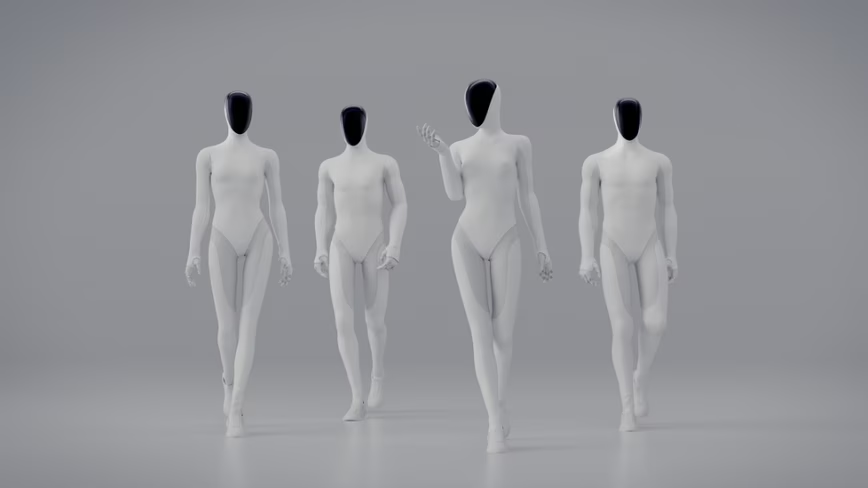
The harder constraint is the hardware. What XPENG has shown publicly is a seventh-generation prototype; the eighth is earmarked as the production model [6]. Management has also said it wants full capability integrated before the line starts [2], which puts a generation of mechanical revision and the software that rides on it inside the months left on the calendar [1]. That is what the money is for, and it is a schedule problem more than a funding one.
The people running it changed on the way in. He Xiaopeng took personal charge of the division, writing in an internal note reported earlier this year that the industry "is becoming increasingly hot and competitive, and we have clearly seen the direction and timing of victory, but it still requires more arduous implementation and extremely high decision-making ability" [11]. The same reshuffle saw the exit of Shi Xiaoxin, the senior director of robotics product planning who had overseen IRON [12].
On the number itself, more than $900M is roughly nine times the $100M Series A that the unit raised in July 2022 as Pengxing Intelligence [18], which is why TNW flags the "first funding round" label as most likely describing a restructured entity rather than a first-ever raise [13]. No investor list and no valuation have been published [13], so there is nothing to hold against LimX Dynamics reaching $2.2bn ahead of an IPO [14]. What the raise is priced at remains a private fact.
Scale is where the ambition detaches from the market it is entering. XPENG wants a million units a year by 2030 [9]. Morgan Stanley has doubled its forecast for Chinese humanoid shipments to 50,000 units [14]. One company's future run rate is twenty times a whole-country forecast [17].
The motive sits in the car accounts. Revenue fell 17.6% in the first quarter with widening net losses, after a profitable quarter [16], and management now presents robotics, robotaxis and flying vehicles as the eventual profit engines [16] of what it calls a physical AI business [15]. Outside money for the robotics arm keeps that spending off the carmaker's own balance sheet through a bad year [19]. He Xiaopeng's claim that software is more than half the value of the machine from the day it ships [10] is the part nobody can check until something ships.
What to watch
- Whether XPENG publishes an investor list or a valuation for the robotics unit, which would show if the raise was priced anywhere near peers such as LimX Dynamics.
- What unit number XPENG counts as mass production in December, and how much of it goes anywhere other than its own showrooms, campuses and factories.
- Whether the eighth-generation IRON is shown publicly before the production line is meant to start.
Clarity's read
What the record supports and how the coverage leans. The claims behind it follow.
Reality
- Evidence34
- Adoption9
- Hype gap+52
- Incentives74
- Confidence44
Claim ledger
Ranked by verification strength, evidence, and original report placement.
- [1]
XPENG has committed to putting its IRON humanoid into mass production before the end of this year, and the source describes the remaining months as a considerable amount of engineering to compress.
- [2]
XPENG has said it wants full capability integrated before the production line starts.
- [3]
XPENG said on Monday that its robotics business has raised more than $900M in what the company described as its first funding round, for a unit that has yet to sell a single robot commercially.
- [4]
IRON was unveiled at XPENG's AI Day in November 2025 and runs on the same Turing chips the company designed for its electric vehicles.
- [5]
IRON has more than 60 joints, a spine with five degrees of freedom, and a layer XPENG calls bionic muscle fascia intended to soften its movement.
- [6]
The robot demonstrated publicly is a seventh-generation prototype, with an eighth generation earmarked as the production model.
- [7]
First IRON units are expected to work as showroom assistants and tour guides, patrol XPENG campuses and take positions on the company's own factory floors, with commercial deliveries in China and abroad following in 2027.
- [8]
BYD has already committed to a humanoid in every showroom, part of a recognisable pattern in the Chinese car industry of deploying robots in dealerships, which generates deployment numbers without requiring a customer to be convinced first.
- [9]
XPENG's longer-term target is a million robot units a year by 2030.
- [10]
CEO He Xiaopeng has said the robots could eventually be priced at levels very similar to car prices within five years, and that software accounts for more than half the value of the machine from the first day it ships.
- [11]
He Xiaopeng has taken personal charge of the robotics division, writing in an internal note reported earlier this year that the robot industry "is becoming increasingly hot and competitive, and we have clearly seen the direction and timing of victory, but it still requires more arduous implementation and extremely high decision-making ability".
- [12]
The reshuffle came alongside the departure of Shi Xiaoxin, the senior director of robotics product planning who had overseen the IRON project.
- [13]
XPENG Robotics, then known as Pengxing Intelligence, completed a $100mn Series A in July 2022, so the description of the new money as a first round most likely reflects a restructured entity rather than a first-ever raise; XPENG has not published the investor list or a valuation.
- [14]
Humanoid companies have been repriced upwards for two years, with LimX Dynamics reaching a $2.2bn valuation before an IPO and Morgan Stanley doubling its forecast for Chinese humanoid shipments to 50,000 units.
- [15]
XPENG now describes itself as a physical AI business spanning humanoids, robotaxis and flying vehicles rather than a carmaker with side projects, and each line consumes capital on a scale vehicle sales are not currently covering.
- [16]
XPENG reported a 17.6% revenue decline in the first quarter alongside widening net losses, having been profitable the quarter before, and management describes robotics, robotaxis and flying vehicles as the eventual drivers of revenue and profit.
- [17]
XPENG's stated 2030 run rate of a million units a year is 20 times the 50,000-unit figure Morgan Stanley now forecasts for Chinese humanoid shipments (the source does not give a year for the forecast).
- [18]
The new raise of more than $900M is roughly nine times the unit's $100M Series A of July 2022.
- [19]
According to TNW, raising outside capital for the robotics unit keeps that spending off the carmaker's own balance sheet while the vehicle business works through a difficult year.
Sources
1 independent publisher whose own reporting we read for this story.
- thenextweb.comXPENG’s robotics arm has raised more than $900M ahead of its humanoid production run
1 article · August 24, 2026
Topics and entities
Follow any of these and your For You feed starts watching them — no settings page required.
Topics
- Manufacturing Scale-UpFollow
- Humanoid RoboticsFollow
- Chinese EV Makers DiversifyingFollow
- Physical AIFollow
- Robotics Funding And ValuationsFollow