World Labs' Atlas conditions video generation on an explicit camera path
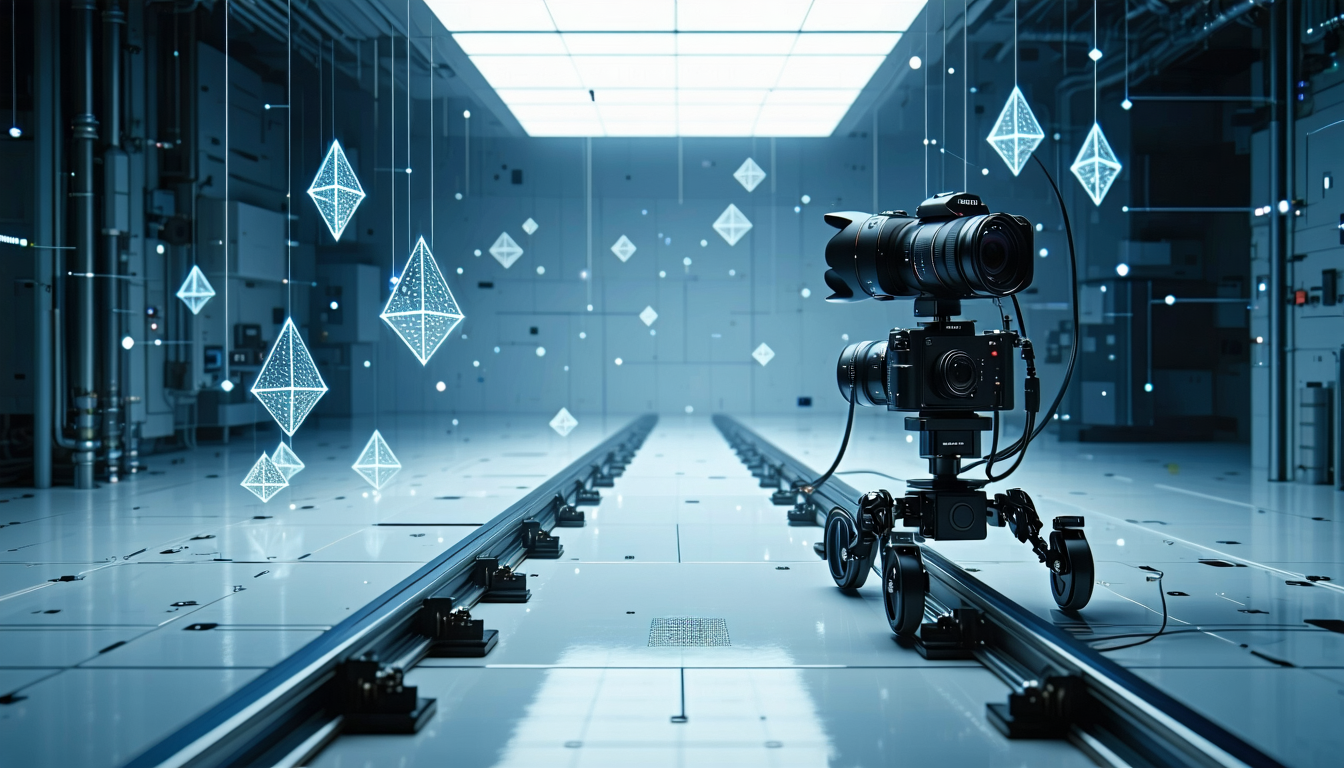
Pose conditioning is what lets one set of weights produce a filmed shot and the RGB-plus-depth stream a robot camera would see. It is also why the geometry Atlas invents ends up inside your training data, unlabelled.
The Engineer · Build desk
What happened
- World Labs, co-founded by Fei-Fei Li, launched Atlas on September 1 as a single model for generating controlled video, reconstructing 3D scenes and producing simulated camera views for robots.
- The model accepts text, images, camera poses and 3D depth maps as inputs, with video represented as a sequence of images rather than as a separate modality.
- World Labs says Atlas generates up to one minute of 1440p video from one to six reference images plus a camera path the user designs by hand.
- Run in reverse, the company says it reconstructs a real location from one or more images, renders unseen angles, and exports explicit geometry as point clouds or 3D Gaussian splats.
- For robotics, World Labs says Atlas can rebuild an environment from phone footage and emit the RGB and depth a robot-mounted camera would observe while moving through it.
Why it matters
- What it limits constraint World Labs limits Atlas's stated contribution to visual and geometric reconstruction, so the contact dynamics for rigid, articulated and deformable objects stay with whatever solver you already run; consolidation stops at the perception end of the loop.
- What it costs cost Because more reference images mean less invented scenery, the safe configuration is the expensive one: capture time per site trades directly against how much guessed geometry a policy might learn from.
- Who has to decide decision Teams now choose between one vendor's weights and a stack of separate video, reconstruction and simulation tools they can each replace independently when one of them regresses.
- What's now possible capability If phone footage is genuinely enough to seed an environment, producing new sim scenes stops being a job for a scanning rig and becomes something a technician can do on a walk-through.
Next story · Invest · Sep 29
AMD pays $8.2 billion in stock to have Fei-Fei Li's lab shape its chip roadmapConfirmed14 publishers
A prompt that says crane up and pan left is a request. Conventional video generators accept camera direction in exactly that form, as words like pan, crane or truck [6], and nothing in the model binds frame 300 to frame 1 in metric space. Atlas instead takes a camera path as native model input, with direct control over the position and angle of the generated views [7], and every input lands in what World Labs calls a shared spatial context, which grounds each image at a position in three-dimensional space [5]. That is the load-bearing choice. Once a frame carries a pose, the same forward pass reads two ways: as a shot, or as what a sensor at that pose would have observed. The staging behaviour follows from the same property, since unrelated reference images can be pinned at chosen positions in a scene and the transitions between them generated [9].
Then count what the model actually observes. Six reference images, up to one minute of output [8]. "Up to" is doing quiet work in that sentence. A minute at 24 frames per second is 1,440 frames, which puts the ratio near one supplied image per 240 generated [18]. World Labs has not published a frame rate, so treat that as an order of magnitude and not a spec. Either way, the large majority of what comes back is invented, and the geometry is invented along with the pixels. The company names its own failure mode: a plausible building placed behind the camera, useful on a fictional set and unacceptable when the subject is a factory, a store or a property listing [12].
The architecture is described as a multimodal autoregressive diffusion transformer pretrained from scratch [3]. So there is no separable reconstruction stage to swap, no camera solver to replace, and no renderer to substitute when a scene comes back wrong. Ben Mildenhall, one of the co-founders, co-created NeRF [17], and the lineage shows in the decision to make pose a model input rather than a post-process fitted to generated frames. That is careful work, and it is the part of this that would survive being wrong about everything else.
What it is not yet is measured. The figures above are World Labs' own, and runtimewire's read is that Atlas's value depends on whether company-run results hold across partner workloads and independent testing [16]. For the video number to transfer, your scenes need to sit inside whatever scale that minute of 1440p was demonstrated at. For the reconstruction number to transfer, your definition of faithful has to match theirs, measured against something you scanned yourself. And for the robotics case to transfer, the invented parts of a reconstruction have to be wrong in ways a policy will not quietly learn to exploit. None of those are unreasonable to hope for. All three are experiments someone has to run before a sim pipeline gets rebuilt around one vendor's weights.
What to watch
- Independent reconstruction error numbers on a site someone else scanned, rather than World Labs' own results.
- Whether World Labs publishes the frame rate, scene-scale limits and access terms behind the one-minute 1440p figure.
- A manipulation policy trained on Atlas-generated views and depth transferring to real hardware without a physics rewrite.
Clarity's read
What the record supports and how the coverage leans. The claims behind it follow.
Reality
- Evidence45
- Adoption15
- Hype gap+35
- Incentives60
- Confidence55
Claim ledger
Ranked by verification strength, evidence, and original report placement.
- [1]
World Labs, the San Francisco AI company co-founded by Fei-Fei Li, launched Atlas on September 1, presenting one model for generating controlled video, reconstructing 3D scenes and producing simulated camera views for robots.
- [2]
World Labs has built an architecture meant to handle video generation, reconstruction and simulation within the same model instead of dividing them among separate systems.
- [3]
World Labs describes Atlas as a multimodal autoregressive diffusion transformer pretrained from scratch.
- [4]
Atlas accepts text, images, camera poses and 3D depth maps as input, with videos represented as sequences of images.
- [5]
Atlas inputs are combined into what World Labs calls a shared spatial context, grounding each image at a position in three-dimensional space.
- [6]
Conventional video generators commonly receive camera instructions through text prompts such as pan, crane or truck.
- [7]
Atlas receives a camera path as native model input, giving users direct control over the position and angle of generated views; World Labs treats the explicit treatment of camera geometry as the central technical choice.
- [8]
World Labs says Atlas can generate up to one minute of 1440p video from one to six reference images and a manually designed camera path.
- [9]
Atlas can place unrelated reference images at chosen positions inside a scene and then generate the visual transitions between them.
- [10]
World Labs says Atlas can reconstruct a real location from one or more images, generate views from unseen angles, and export explicit geometry as point clouds or 3D Gaussian splats.
- [11]
The company says two or three images are typically enough for a faithful reconstruction, while additional images reduce the amount of scenery the model must invent.
- [12]
A plausible building placed behind the camera may be useful for a fictional environment and unacceptable when reconstructing a factory, store or real estate property; Atlas is designed to shift between those cases by using the amount of source material as a control over how much it generates.
- [13]
World Labs has described a real-to-sim workflow in a technical post, reconstructing physical tasks as simulations and varying appearance, object configuration, clutter, physics, robot state and camera viewpoint.
- [14]
World Labs says Atlas can reconstruct an environment from phone footage and generate the RGB images and depth readings that a robot-mounted camera would observe while moving through the simulated space.
- [15]
Atlas supplies part of the real-to-sim pipeline; for manipulation tasks, World Labs says Atlas contributes visual and geometric reconstruction to simulations involving rigid, articulated and deformable objects.
- [16]
runtimewire.com writes that Atlas's value depends on whether company-run results hold across partner workloads and independent testing.
- [17]
World Labs co-founder Ben Mildenhall, a former Google research scientist, co-created Neural Radiance Fields (NeRF), an influential method for synthesizing new views of a scene from images.
- [18]
At 24 frames per second, one minute of generated video is 1,440 frames, so six reference images works out to roughly one supplied image per 240 generated frames. The frame rate is an assumption; World Labs did not state one.
Sources
2 independent publishers whose own reporting we read for this story.
- runtimewire.comWorld Labs launches Atlas for video, 3D reconstruction and robot simulation
1 article · September 1, 2026
- the-decoder.comWorld Labs unveils Atlas, a single AI model that generates, reconstructs, and simulates 3D worlds from just a few photos
2 articles · September 2, 2026
Topics and entities
Topics
- World Models
- 3D scene reconstruction
- Robot simulation pipelines
- Camera-controlled video generation
Entities
- Fei-Fei Li
- Atlas
- Neural Radiance Fields
- World Labs