Science1 publisher2 min readPublished
Seven of Earth's nine planetary boundaries are breached and worsening, Potsdam report finds
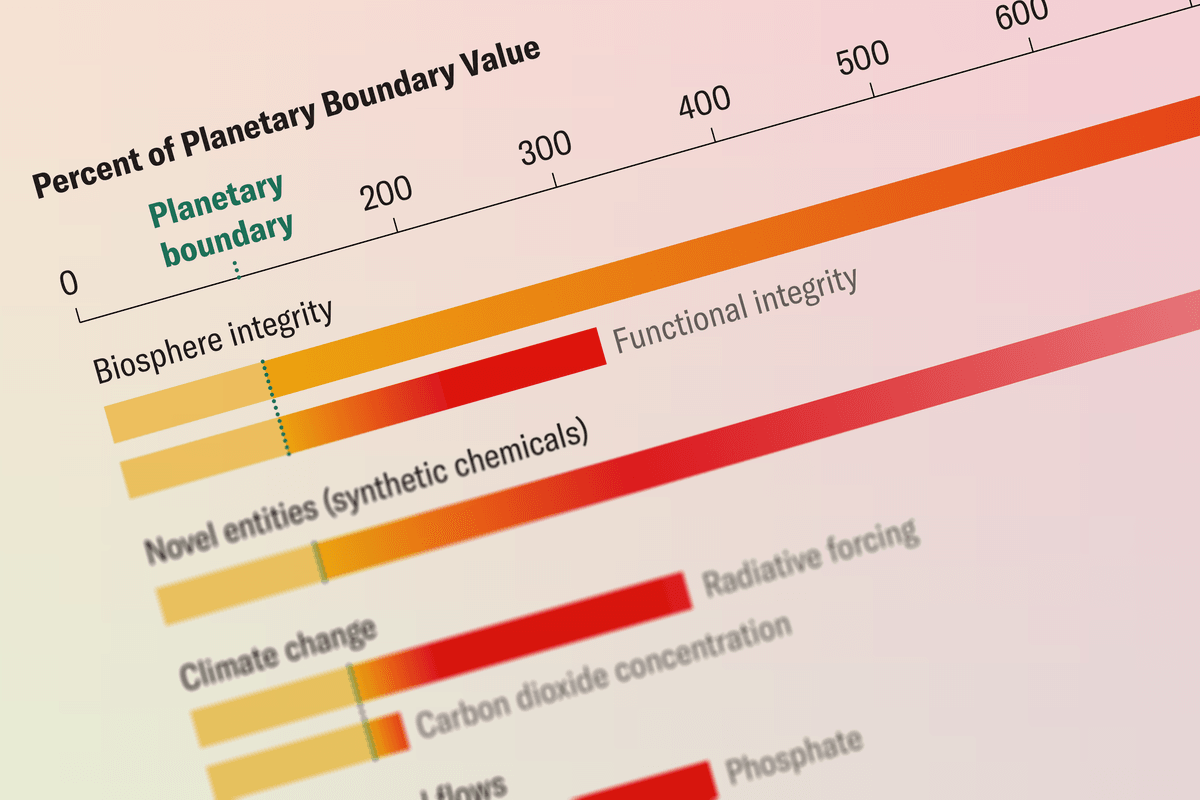
More than 60 scientists, in the Potsdam Institute's 2026 Planetary Health Check, find seven of nine planetary boundaries crossed and still worsening. Six of the seven are boundaries other than climate change, and three of those share its red danger zone.
The Scientist · Science desk
What happened
- Biogeochemical flows, novel entities and biosphere integrity join climate change in red, while ocean acidification, freshwater and land system change sit a tier lower at increasing risk.
- The report attributes the climate breach mainly to greenhouse gas emissions from burning fossil fuels and cites evidence that climate change is accelerating.
- It singles out the Amazon, in danger of passing a tipping point, and a seafloor damaged by bottom trawling that faces the developing threat of deep-sea mining.
- Stratospheric ozone depletion and atmospheric aerosol loading, the two unbreached boundaries, remain at safe levels, at least globally.
Compiled by The ScientistSomething wrong?How this is made
Why it matters
- decision Kitzmann's deadline covers the emissions curve and the nature-degradation curve together, so a plan scored on carbon alone meets only one of the two conditions he set.
- constraint With heavy fertilizer use behind the red-zone nutrient breach, the danger zone spans farm policy as well as energy policy, and no single lever reaches all four red entries.
- constraint The safe verdict for ozone and aerosols holds at the global scale, so it cannot be read as clearing any particular region of those pressures.
A tally of crossed thresholds moves only when a new line is passed. Last year's edition added ocean acidification as the seventh breach [8]. This year's shows no significant boundary changes [7], so the count reads seven in both [2]. The report grades each boundary on a traffic light: green for a safe operating space, yellow or orange for a breach with increasing risk, and red for a danger zone with a likely risk of severe, irreversible damage [11].
The nutrient breach has a different source from the climate one. Humans release an excess of nitrogen and phosphorus into the environment through heavy fertilizer use and other activities [14]. Six of the seven breaches are boundaries other than climate change [3]. The report assesses all nine as interconnected systems on which Earth's stability and resilience depend [1].
The thing this coverage doesn't tell you is how, or whether, the report puts numbers on the links between those systems. I'd read the red tier as the more informative figure in this edition [1], since the count of seven has not moved in a year [2]. The condition is uncertainty. The authors designed the categories to account for it, and Live Science notes that uncertainty is inherent in assessing complex natural systems [11].
Niklas Kitzmann, the lead editor and a researcher in the Potsdam Institute's Planetary Boundaries Science Lab, compared the assessment to giving Earth a blood test [3]. "If you had a patient with a blood test that looks like this, you would send them to the ICU right away," he told Live Science [4].
He also gave a timetable. "We still have a window to turn this around, but we do have to start bending the curves on emissions and on nature degradation within the next few years," Kitzmann said [5]. He went on: "We're rapidly running out of time." [6]
What to watch
- The 2027 Planetary Health Check, the first edition that can show how heat from the current El Nino affects the breached boundaries.
- Whether ocean acidification, freshwater change or land system change moves out of the increasing-risk tier and into red.
- Whether the full report publishes a measure of how a change in one boundary feeds into another.