Science2 publishers3 min readPublished
Extreme fire weather weakens the firebreak that Alaska's young forests provide
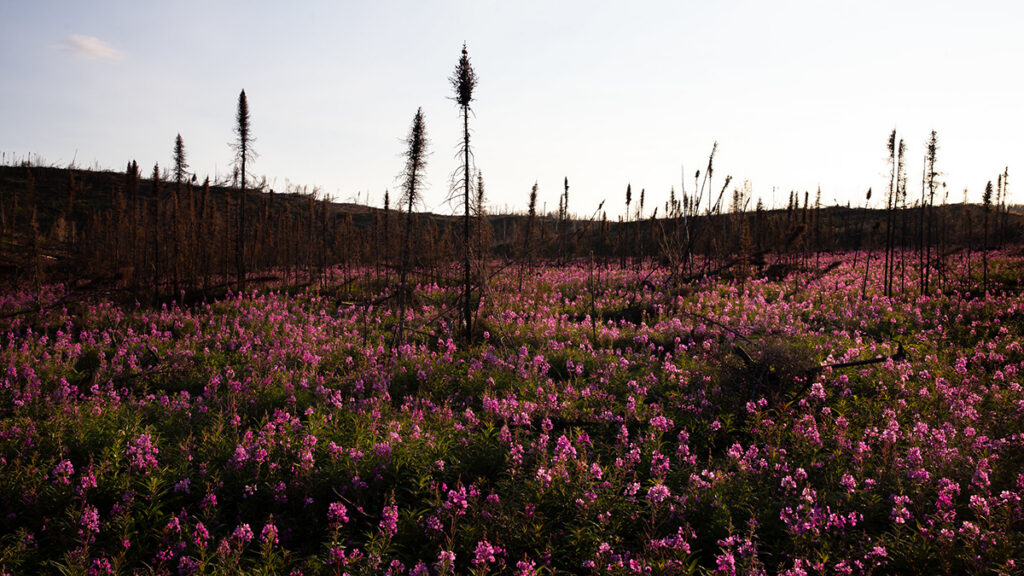
Recently burned Alaskan forest reburns 1 to 3 orders of magnitude less often than older forest, Gaglioti and colleagues find in 1984-2020 fire data. Extreme fire weather weakens that barrier most in young stands, so a scar's value as a firebreak depends on its age and the weather.
The Scientist · Science desk
What happened
- The perimeter of an earlier burn often acted as a barrier against later fires moving into it.
- In a warmer-future scenario that treats historically extreme fire years as normal, the suppressive effect of past burning was not completely negated.
- Past fires limited new fire activity about twice as strongly in Alaska as similar studies found in the contiguous western United States.
Compiled by The ScientistSomething wrong?How this is made
Why it matters
- constraint A containment plan that leans on a young burn perimeter is least reliable under extreme fire weather, because the study found suppression weakened most in young stands in those conditions.
- capability Fire managers could rate an individual burn scar's chance of stopping a new fire from two inputs, its age and the current fire weather.
- decision Alaska planners need Alaska-specific reburn estimates, since borrowing western US figures would credit their burn scars with about half the effect measured here.
One to three orders of magnitude means a factor of 10 to 1,000 [3][1]. Anywhere in that range, a fire that reached young, recently burned forest was far less likely to keep going than one that reached older forest, and the edge of the earlier burn often stopped it [3][4]. The explanation offered is fuel. Fire clears mature forest, and the young growth that replaces it is less flammable, so for a time it holds fire back [11].
The study is observational. Gaglioti and colleagues worked from remotely sensed records of Alaskan fires between 1984 and 2020. They picked out the fires that ran into earlier burns and used logistic regression to estimate how strongly young vegetation resisted [1]. The window covers 37 fire seasons [2]. The paper is in the Journal of Geophysical Research: Biogeosciences [2].
A regression of this kind shows how closely stand age tracks reburning. The claim that young fuel causes the drop rests on what is known about the vegetation, and a comparison across regions fits that claim. Past fires limited new fire activity about twice as strongly in Alaska as similar studies found in the contiguous western US [8]. The authors link the difference to two things. Deciduous trees, which are less flammable, grow back quickly in Alaska, and ladder fuel, which carries fire from the forest floor into the crowns, takes longer to return [9].
The five-fold figure is of a different kind. A simple model of landscape burning estimates that without the feedback, Alaska would have seen five times more wildfire over the past 40 years [5]. It is a computed counterfactual, since no one has observed an Alaska without burn scars.
The result depends on weather. Extreme fire weather significantly weakened the suppression, especially in younger forests [6]. According to the authors, this matches previous research [6]. To stand in for a warmer future, the team treated historically extreme fire years as normal, and under that scenario the suppressive effect of past burning was not completely negated [7].
The thing this doesn't tell you is how much of the effect survives, and the published summaries do not put a number on it. The scenario is also built from extremes already on record [7]. It does not test weather worse than those years.
For fire planners, a burn scar is still a firebreak, but its strength moves with conditions. Managers often use previously burned areas as natural firebreaks, and the authors suggest their model could estimate how likely a given scar is to stop a new fire from its age and the current fire weather [10]. I think a rating for each scar on each day is the right way to use the finding. On average rates, the youngest scars look like the best protection, and those are the scars extreme weather weakens most [3][6].
What to watch
- The full paper's estimate of how much burn-scar suppression survives when extreme fire years are treated as normal, broken out by stand age.
- Whether Alaska fire managers adopt the model to rate individual burn scars by age and fire weather during active seasons.
- Reburn data from fire seasons after 2020, outside the study window, to check whether the extreme-weather weakening holds.