Product3 publishers3 min readPublished Updated
LandSpace recovers a steel booster while Super Heavy waits on clearance
Eight months after a failed engine reignition destroyed its first attempt, LandSpace landed Zhuque-3's stainless-steel first stage in Gansu. The fix cycle is the story, not the milestone.
The Product Desk · Product desk
Drafted by a language model from the sources cited here and checked against its claim ledger before publication. How we use AISend a correction
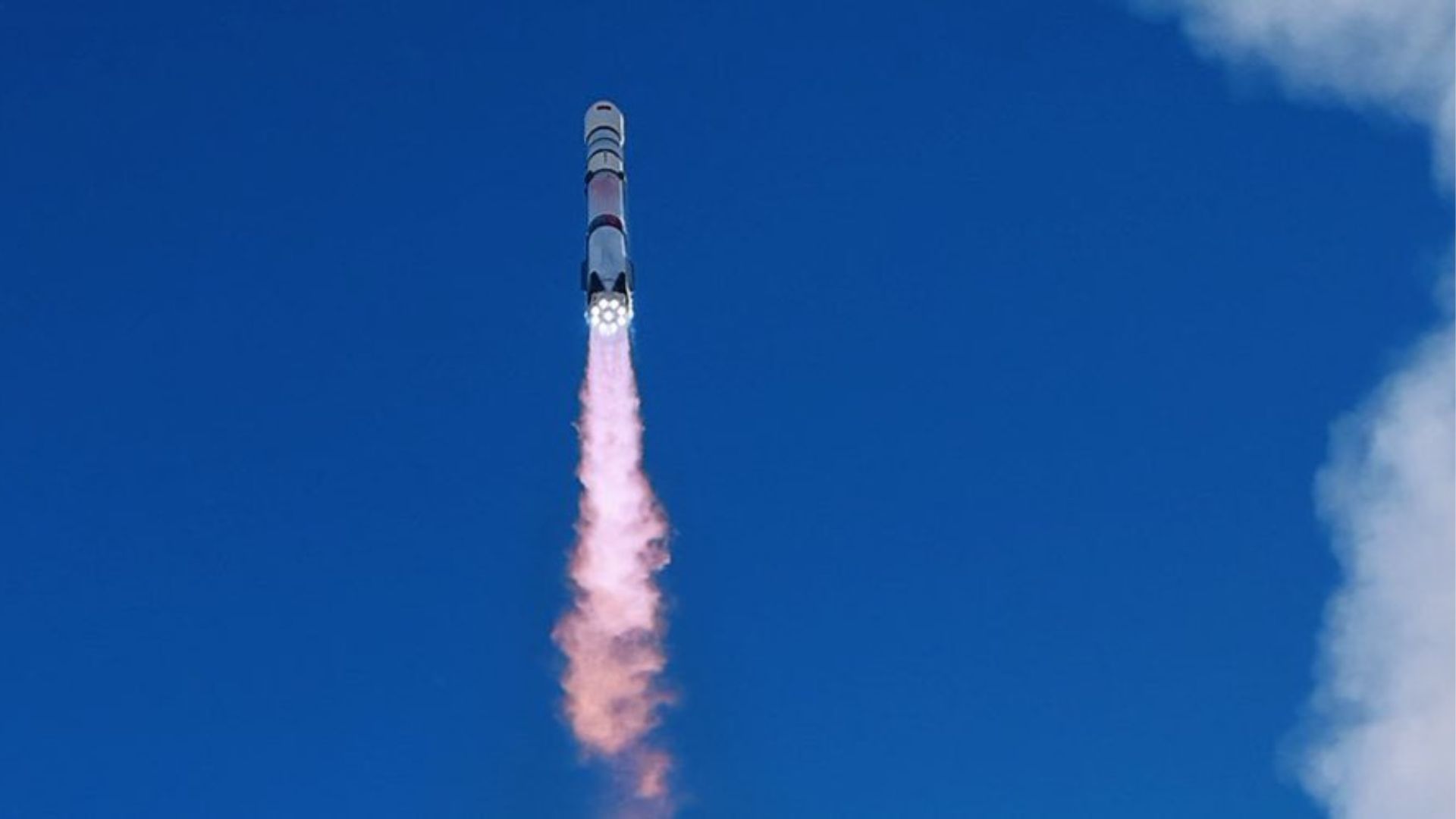
What happened
- LandSpace's Zhuque-3 rocket is 66 meters (217 feet) tall.
- According to state news agency Xinhua, the launch took place from the Jiuquan Satellite Launch Center in the Gobi Desert at 7.35 am on Wednesday, August 19.
- The Zhuque-3 first stage made a precise vertical landing in Minqin County, Gansu Province, roughly 390 kilometers (242 miles) southeast of the Gobi Desert launch site.
- The recovery marks the world's first stainless-steel booster recovery following an orbital launch.
- SpaceX's stainless-steel Super Heavy booster is awaiting regulatory approval for its own orbital recovery attempt.
Compiled by The Product DeskSomething wrong?How this is made
Why it matters
LandSpace launched its 66-meter Zhuque-3 from the Jiuquan Satellite Launch Center at 7.35 am on August 19 and brought the stainless-steel first stage back to a vertical landing in Minqin County, Gansu province, roughly 390 kilometers southeast of the pad, according to the state news agency Xinhua [1][2][3]. Interesting Engineering describes it as the first recovery of a stainless-steel booster following an orbital launch, and it happened while SpaceX's Super Heavy is still awaiting regulatory approval for its own orbital recovery attempt [4][5].
The number worth attention is eight. Eight months before this flight, LandSpace's maiden recovery attempt ended in an explosion three kilometers above the desert floor after a descent engine failed to reignite [7]. In the interval, per the same report, engineers worked through flight telemetry, rewired ignition sequences and prepared a second hull [8]. One destructive failure, one fix cycle, a landing on the second try. That loop time is what used to be treated as proprietary to a single company, and it was closed here on a revenue flight rather than a test article: the rocket delivered a Honghu-3 internet satellite to orbit before the stage came home [6].
The achievement's actual size is worth stating plainly. LandSpace is the fourth entity to recover a launch vehicle, joining SpaceX, Blue Origin and China's state space agency [9], and Zhuque-3 is the second Chinese orbital rocket to recover a first stage, after the state-owned Long March-10B's offshore net capture in July [10]. Falcon 9 flies around 150 times a year, with individual boosters reused for dozens of missions [15]. Zhuque-3's booster is reportedly designed for up to 20 flights [14], which means a single year of Falcon 9 launches at current rates would consume the entire design life of seven and a half Zhuque-3 boosters [2]. Recovery is the entry ticket. Cadence and refurbishment cost are the actual contest.
The design choices are aimed at exactly that. Stainless steel in place of aluminum-lithium alloy improves heat resistance and may lower manufacturing cost [12], and the methane-oxygen propulsion burns cleaner than Falcon 9's kerosene mix, reducing engine soot and shortening post-flight refurbishment [13]. The vehicle carries 18 tonnes to orbit in reusable mode, putting it in Falcon 9's class [11].
The demand is not speculative. China's Guowang and Qianfan constellations are meant to compete with Starlink and require tens of thousands of satellites in low Earth orbit [16]. Starlink has put more than 10,000 operational satellites up on reusable Falcon 9s; the Chinese networks have stalled at roughly 200 [17], about a fiftieth of the deployed fleet [1], with the missing piece described as cheap reusable launch capacity [18]. One landing does not touch SpaceX's 12 million-plus active customers [19].
Watch how long this recovered hull sits before it flies again, because an eight-month gap between a failure and a landing says nothing about turnaround. Watch whether the second landing succeeds and whether Guowang and Qianfan launch rates move off 200 [17]. And watch the regulatory clearance Super Heavy is waiting on [5], since the comparison changes the day that vehicle is allowed to try.