Science1 publisher3 min readPublished
A delivery fix, not a new nuclease: CRISPR screens reach primary human myeloid cells
A virus-like-particle toolkit edits primary monocytes, macrophages and dendritic cells, and pooled screens point to TNFAIP3 as a potency dial for CAR-macrophages.
The Scientist · Science desk
Drafted by a language model from the sources cited here and checked against its claim ledger before publication. How we use AISend a correction
What happened
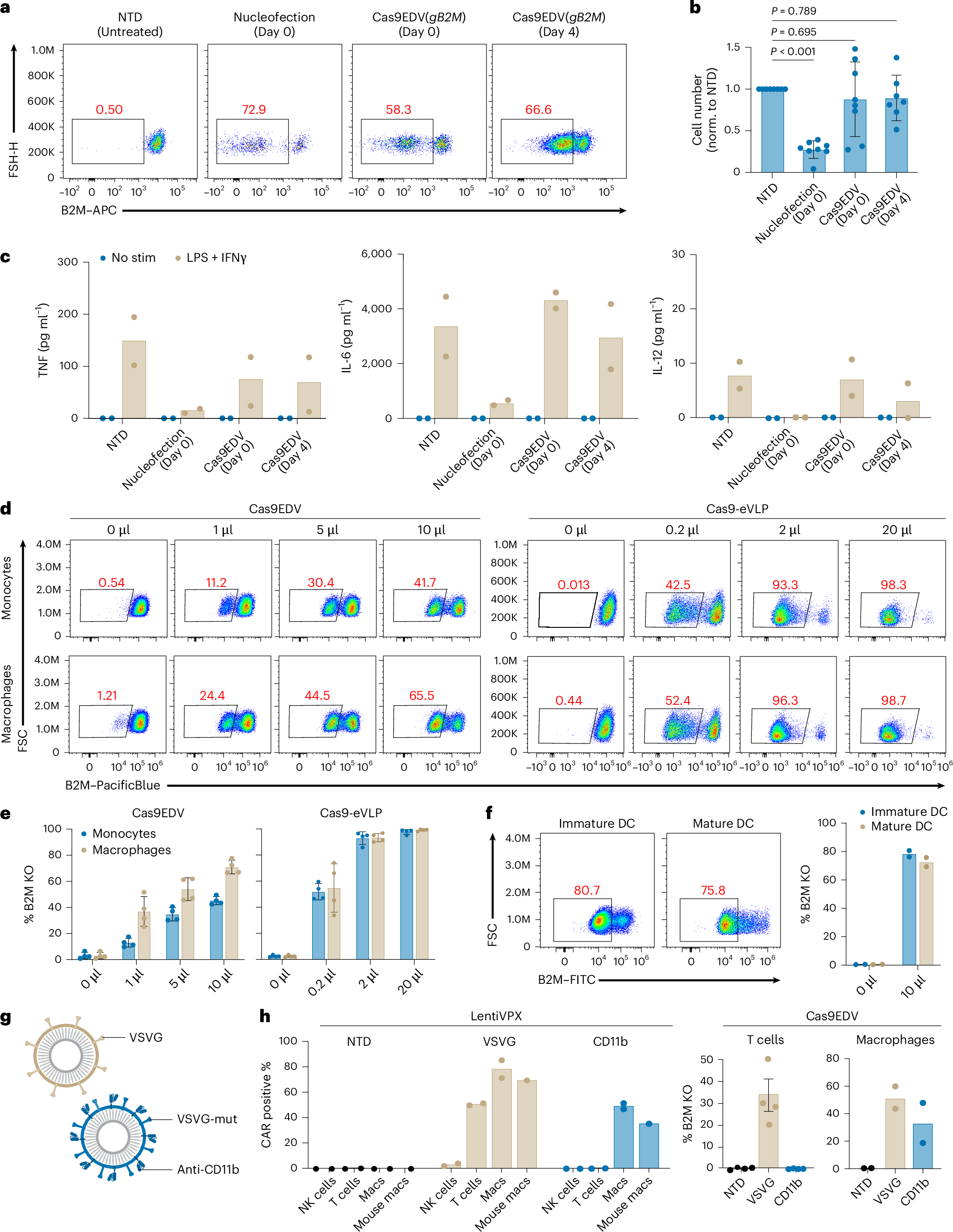
- A virus-like-particle (VLP)-based toolkit delivers diverse CRISPR editing modalities to human monocytes, macrophages and dendritic cells with high efficiency while preserving viability and innate immune responsiveness.
- VLP-mediated delivery of ribonucleoproteins supports gene knockout, base editing and epigenetic silencing.
- Combined with adeno-associated virus-mediated donor delivery, the VLP approach enables site-specific integration of large DNA sequences by homology-directed repair.
- The authors developed SLICeVLP, which pairs sgRNA delivery by VPX-lentivirus with Cas9 protein delivery by engineered VLPs.
- SLICeVLP was used for pooled loss-of-function and Perturb-seq screens in human macrophages.
Compiled by The ScientistSomething wrong?How this is made
Why it matters
A group reporting on nature.com describes a virus-like-particle (VLP) toolkit that delivers several CRISPR modalities into primary human monocytes, macrophages and dendritic cells at high efficiency while preserving viability and innate immune responsiveness [10][1]. That matters because the authors' own framing of the field is that efficient, scalable engineering and screening technologies for primary human myeloid cells remain limited, which has kept most functional genomics in this lineage confined to surrogates [8].
The bottleneck here was never the editor, it was the courier. Myeloid cells sense nucleic acids for a living, and electroporation or lentiviral transduction tends to cost you either the cells or the phenotype you wanted to measure. The reported workaround is protein-and-RNA cargo: VLP-delivered ribonucleoproteins support gene knockout, base editing and epigenetic silencing [2]. Paired with adeno-associated virus donor delivery, the same route supports site-specific integration of large DNA sequences by homology-directed repair, which is the operation a CAR or a reporter cassette actually requires [3].
The screening piece is a split-vehicle design the authors call SLICeVLP: guides arrive by VPX-lentivirus, Cas9 protein arrives by engineered VLPs [4]. Separating the recorded barcode from the transient nuclease is what makes pooled work tractable, and they ran both pooled loss-of-function and Perturb-seq screens in human macrophages [5]. The readouts were regulators of TNF and CD80 expression, and the hits converged on TNFAIP3 as a central regulator of inflammatory polarization [6].
The consequence, if it holds, is a knob rather than a discovery. TNFAIP3 ablation produced a proinflammatory macrophage state resistant to suppressive repolarization, and increased cytotoxicity in chimeric antigen receptor macrophages [7]. Resistance to repolarization is the specific failure mode that makes tumor-directed macrophage therapy disappointing in vivo, and the field is no longer purely preclinical: the paper's reference list includes a 2025 Nature Medicine phase 1 trial of CAR-macrophage therapy in HER2-overexpressing advanced solid tumors [11]. Prior functional genomics anchors in the same reference list run through induced pluripotent stem cell-derived macrophages and dendritic cells [12][13], so the claim being staked is primary-cell fidelity, not a first screen.
Read the abstract for what it does not say. It reports high efficiency without publishing an editing percentage, a donor count, or a library size in the material available [16], and the paywall keeps the methods, dose-response and off-target work behind USD 39.95 or a Nature+ subscription at $32.99 per 30 days [14]. Deleting a negative regulator of NF-kB signaling to make a cell angrier is a trade, and nothing in the abstract addresses persistence, systemic cytokine load or the durability of the edited state.
Two things are checkable now. Raw sequencing for the RNA-seq, CRISPR screens and Perturb-seq is deposited in the Gene Expression Omnibus under GSE327424 and GSE327644 [9], so the hit lists and the Perturb-seq clusters can be reanalyzed independently rather than taken on the authors' summary that the system enables unbiased functional genomics in primary myeloid cells [15]. Watch also whether anyone reproduces SLICeVLP at genome scale in cells from multiple donors, and whether TNFAIP3-edited CAR-macrophages survive an in vivo tumor model without a toxicity ceiling. A delivery toolkit becomes a program only when a second lab runs a screen with it and gets the same switch.