Science1 publisher2 min readPublished
Nitrogen-doped tin catalysts lift carbon-13 in CO2 electrolysis from 1.1% to over 14%
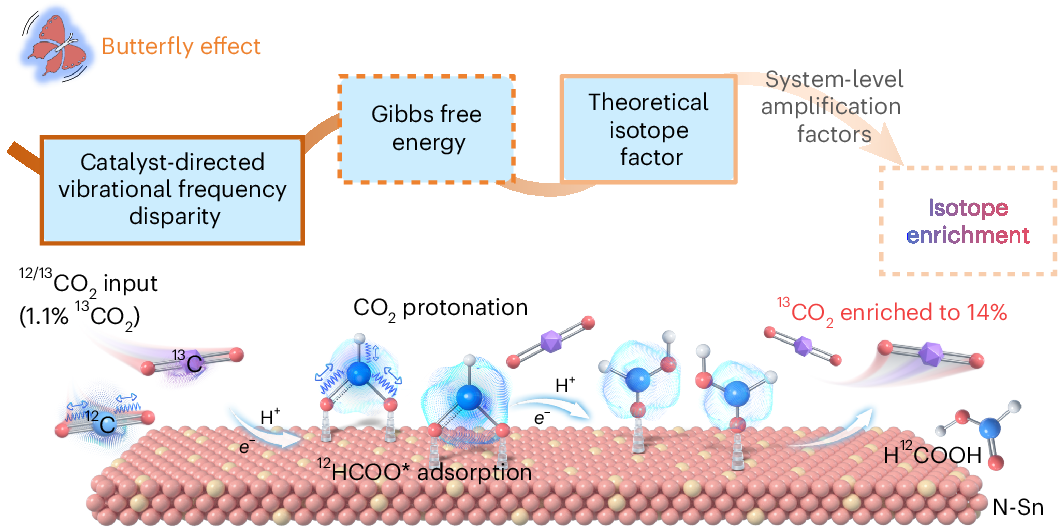
Researchers using nitrogen-doped tin catalysts in CO2 electrolysis raised carbon-13 from its natural 1.1% to over 14% of the output CO2. A computed isotope factor guided the catalyst choice, though the energy saving over existing separation methods is still to be measured.
The Scientist · Science desk
What happened
- Researchers proposed a theoretical isotope factor, delta, that ties catalyst-induced vibrational frequency differences and free energies to carbon-13 enrichment in CO2 electrolysis.
- Under scaled-up conditions at 10 amperes, the output CO2 reached more than 14.0% 13CO2, starting from the natural abundance of 1.1%.
- The authors report a separation factor above 14.1 for the process.
Compiled by The ScientistSomething wrong?How this is made
Why it matters
- capability If delta holds up, catalyst designers can rank candidate materials for isotope selectivity from computed vibrational frequencies and adsorption energies before building and testing electrodes.
- constraint Output that is about 86% something other than 13CO2 is only partly enriched, so a concentrated tracer would need further stages whose number and cost this work leaves open.
- decision Anyone weighing electrolysis against conventional carbon-13 separation for tracer supply still needs energy-per-gram figures from elsewhere, because the energy saving cited here rests on earlier electrochemical demonstrations.
Electrolysis has enriched carbon-13 before, but without a settled explanation. The authors wrote that "the chemical mechanism dominating the 13C enrichment performance remains elusive" [3]. The starting observation is older: a 2023 paper by Barecka and colleagues, cited here, reported that CO2 electroreduction favors carbon-12 over carbon-13 [8]. The new work asks how far a catalyst can widen that preference, and which properties of the catalyst set it.
The order of the work is what I find most persuasive. The abstract introduces the factor delta first and reports that it agrees with measured separation. Only then does it describe using delta to pick a modification: nitrogen added to tin, meant to shift the vibrational frequency and adsorption energy of the reaction intermediates [4][5]. In that sequence the theory chose the experiment. The authors describe the agreement between delta and measurement as "high consistency" [4].
The published figures agree with each other. Going from 1.1% to 14.0% concentrates carbon-13 about 12.7 times [1]. As a gain over the starting abundance, that is roughly 1,170%, consistent with the enrichment rate of more than 1,000% the authors report [2]. The same figure means about 86% of the output CO2 is still something other than 13CO2, so this is a partly enriched stream [3].
The low-energy case in the abstract rests on earlier work. The authors call conventional carbon-13 separation technologies energy intensive, and they credit recent electrochemical demonstrations with continuous room-temperature enrichment at substantially lower energy [1][2]. The abstract does not report the energy used per unit of enriched carbon, how much 13CO2 the cell delivered, or whether the 14% came from one pass or several. The 10 amperes the authors describe as scaled-up conditions is a current [6]. Converting it into grams of carbon-13 per day would take the gas flow and the share of charge that actually goes into the reaction.
The paper's own reference list shows who uses the tracer. It opens with carbon-13 metabolic flux analysis, including a guide for cancer biologists and a study of intact human liver tissue [9]. Those labs care about supply. A 14% stream from one tin catalyst matters to a supplier only once someone has worked out its cost.
I think delta is the result more likely to carry over. Anyone designing a catalyst can compute a predictor of isotope selectivity before building an electrode. That view holds only if delta also predicts enrichment in catalysts other than the tin-based ones it was used to design [5]. The source data are published with the paper, so others can test the fit between delta and experiment [10].
What to watch
- An energy figure per gram of enriched carbon-13 from this cell, set against the conventional separation technologies the authors call energy intensive.
- Tests of the delta factor on catalyst families other than tin, where a correct prediction would show it works as a general design rule.
- Repeated or cascaded runs that push the output beyond 14% 13CO2, with data on how long the doped catalyst stays stable at 10 amperes.