Science1 publisher2 min readPublished
SynCraft edits molecules atom by atom instead of asking an LLM to write new SMILES
A new paper reports that a model predicting executable atom-level edits outperforms state-of-the-art baselines at generating synthesizable analogues with high structural fidelity, and that open-weight backends perform comparably to proprietary ones.
The Scientist · Science desk
What happened
- The authors report that across their benchmarks the framework outperforms state-of-the-art baselines at generating synthesizable analogues while holding structural fidelity high.
- Case studies using interaction-aware prompting cover edits to PLK1 inhibitors and the rescue of high-scoring RIPK1 candidates that earlier generative-design papers had thrown away.
- The released files include the test sets, a training corpus of 3,332 synthesis-cliff pairs with reasoning traces, multi-model inference outputs and PLIP interaction-retention tables.
Compiled by The ScientistSomething wrong?How this is made
Why it matters
- capability Because open-weight backends did as well as proprietary ones, a discovery group can run the edit loop on hardware it controls and keep unpublished structures off a third-party API.
- decision Any team sitting on archives of generative output it rejected for synthesizability now has to decide whether re-editing that pile is cheaper than another round of generation.
- constraint The gain demonstrated is a gain in computed feasibility, so a chemist quoting a route and a yield remains the step that decides whether an edit was worth making.
- precedent Shipping the method as an MIT-licensed agent skill alongside the paper sets the expectation that frameworks like this arrive as something a lab installs.
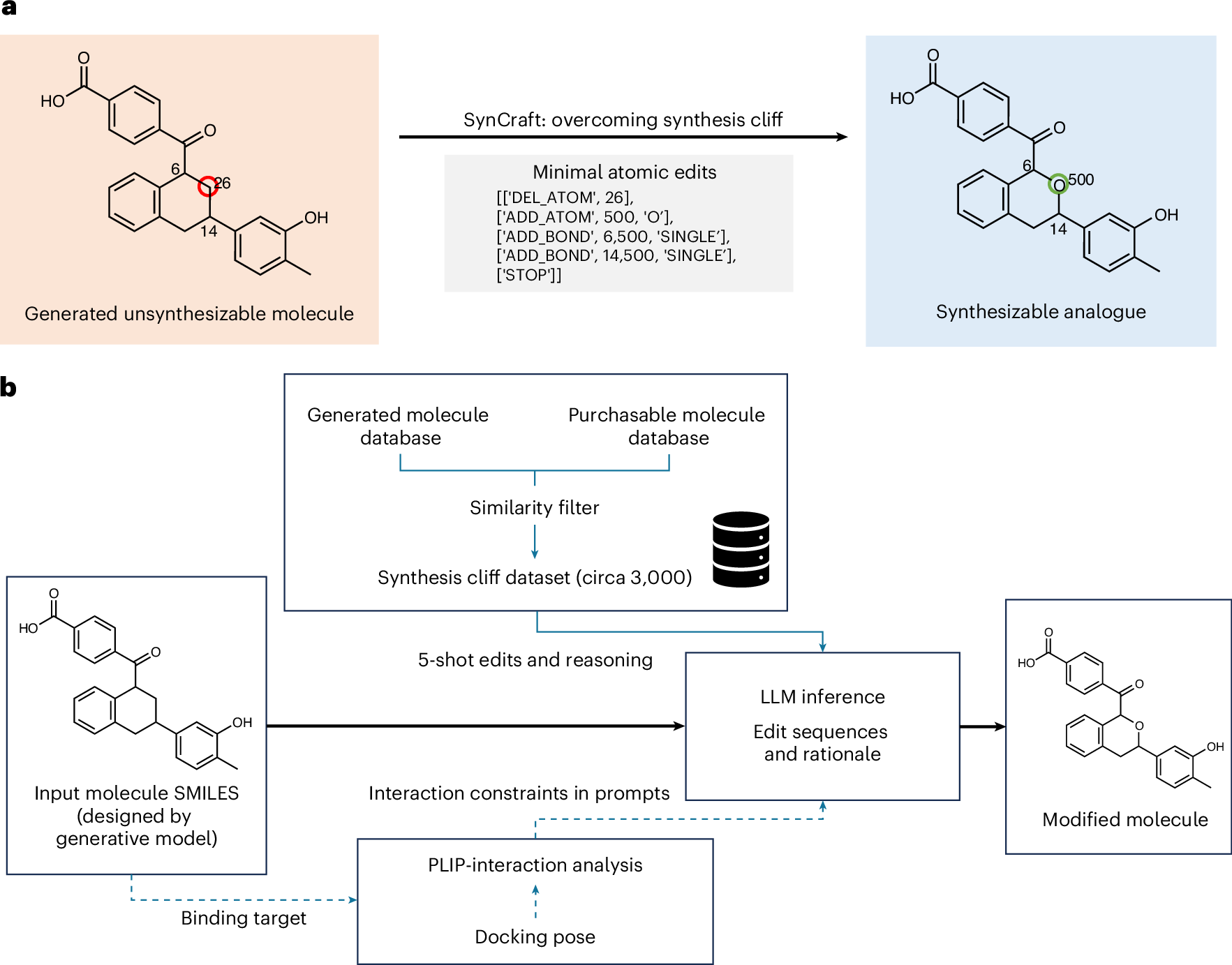
A language model asked to write a SMILES string has to get every bracket, ring-closure digit and valence right in a single pass, and one bad token produces something a cheminformatics toolkit will refuse to parse. SynCraft asks for edits. The model predicts a sequence of executable atom-level operations applied to an existing molecule, and the toolkit performs the chemistry [2]. The authors wrote that the framework "circumvents the syntactic fragility of LLMs while harnessing their chemical intuition" [3].
The thing being hunted is what they call the synthesis cliff, where minimal structural modifications yield substantial gains in synthetic feasibility [6]. They are making a claim about the shape of the scoring surface. The claim also invites a sceptical reading of the benchmark, because a feasibility score that jumps on a one-atom swap is sensitive to features that may or may not correspond to an available route. The abstract gives no benchmark figures, no name for the synthesizability metric behind them, and no compound made in a flask [14][15].
SynCraft is aimed at a specific complaint. A substantial fraction of generated molecules is synthetically inaccessible [4], and the standard remedies, post hoc filtering and projection onto predefined synthetic templates, compromise structural novelty or disrupt key pharmacophores [5]. Editing a parent locally is a plausible answer to that, and the supporting evidence released with the paper includes PLIP retention tables [11]. Those tables report interaction patterns computed from structures, and it would take an assay to report binding.
Comparable performance across proprietary and open-weight backends [8] is the finding with the most immediate operational consequence, since a group with unpublished series can then run the edit loop on machines it controls. The released training corpus is 3,332 synthesis-cliff pairs with reasoning traces [11]. For chemistry that is a small corpus, and I would expect most of the chemical knowledge to come from the backend model's pretraining, with the pairs teaching the edit format.
The case studies push the claim furthest. Using interaction-aware prompting, the authors report replicating expert medicinal chemistry intuition in editing PLK1 inhibitors and rescuing high-scoring RIPK1 candidates that had previously been discarded in the molecular generation literature [9]. Taken at face value, the reject pile from earlier generative campaigns becomes somewhere to look for candidates. The same pipeline, packaged as an agent skill, was run end to end on molecules generated for the SARS-CoV-2 main protease [10].
The implementation, the reproduction scripts for every experiment and the agentic skill package are on GitHub under an MIT licence, with a Zenodo archive [12]. The paper itself, on nature.com, sells for $39.95 [13].
What to watch
- A published synthetic route with a yield for a SynCraft-edited compound would move the claim from scored feasibility to a molecule that exists.
- An independent benchmark that names the synthesizability metric and the held-out set, with retrosynthesis planners run on the same analogues.
- Whether parity with open-weight backends holds at smaller parameter counts, which decides whether this runs on one in-house GPU or a cluster.