VIMA compares case and control tissue through learned fingerprints of small patches
VIMA, from Reshef and colleagues, fingerprints every small tissue patch with deep learning to find disease-linked structures across three diseases. Its features are learned from the data, so its tests can reach tissue structures outside any fixed list of cell types or niches.
The Scientist · Science desk
What happened
- The standard test clusters tissue into niches and compares their abundance; the authors say it loses power when annotation is coarse, clustering is hard, or labels track sample quirks.
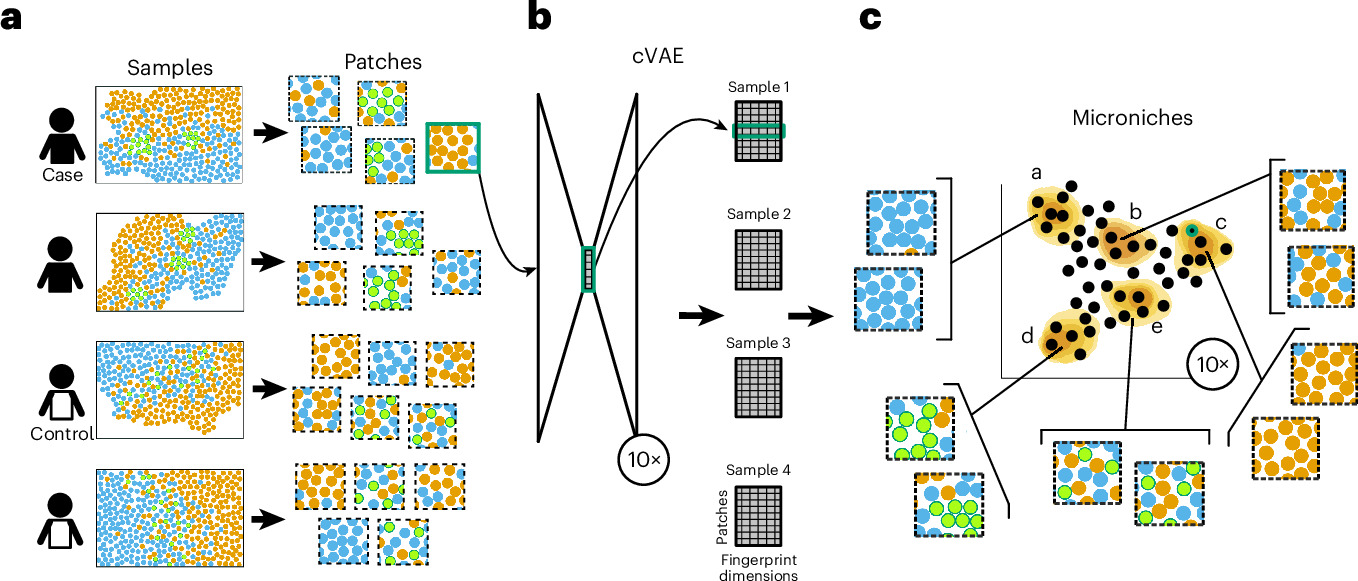
- VIMA uses a conditional variational autoencoder designed to learn fingerprints minimally influenced by sample- or batch-specific effects.
- It trains an ensemble of these networks, using the randomness of training to get complementary representations of the same data and to improve replicability.
- Similar patches are grouped into many small, overlapping microniches and meta-analysed, in place of the hard clusters that niche methods use.
- One of the real-world datasets is an ulcerative colitis tissue atlas published by Mayer and colleagues in 2023.
Why it matters
- capability Cohorts pooled across batches or collection sites become more workable for case-control tests, because the fingerprints are built to discount sample-specific effects that can pass for disease signal.
- decision A lab weighing VIMA against its existing niche pipeline has to find power figures at its own sample count in the full paper, since the published summaries assert high power without a number.
- cost Every lab that runs VIMA pays the training cost of a fresh ensemble of neural networks on its own data, because the fingerprints and microniches are learned per dataset.
Reshef and colleagues set the problem out plainly in Nature Methods [1]. Given a spatial dataset with several case and several control samples, the task is to find patterns that differ significantly between the groups after multiple-testing correction [10]. VIMA describes tissue patch by patch [6], but disease status is a property of the sample. Each microniche is judged by whether its abundance across samples tracks case-control status [7]. Fingerprinting every patch multiplies the observations per slide, but for statistical power the denominator is still the number of samples [16].
Most current methods describe a tissue region by its counts of predefined cell types and a sample by its counts of niches, and the authors say this risks overlooking important signals [9]. They name three ways the standard niche test can lose power [11]. Each has a counterpart in VIMA's design. Learned fingerprints stand in for fixed annotation [3], the conditional autoencoder targets sample-specific quirks [12], and overlapping microniches replace the hard clustering step [14].
Overlapping microniches also mean many tests on correlated groups of patches. A design like that can report more significant hits than its nominal error rate allows, so calibration is the first thing to check. The authors report confirming calibration, power and spatial accuracy in simulations [8]. A simulator holds only the structure its designers build into it. On the real datasets, the abstract says, VIMA recovered known biology and identified new spatial features of disease [2].
The thing this doesn't tell you is the size of VIMA's advantage. The abstract and the publisher's research briefing do not report cohort sizes, effect sizes or a head-to-head power figure against niche-based pipelines. The briefing says that "VIMA has high power and fidelity across a range of spatial molecular technologies and diseases" [4]. I think the design is sound, and the simulation check is the correct first test. Before swapping it into a working pipeline, I'd want power curves at the cohort sizes a typical lab actually collects. The briefing's reference list includes Wolpert's 1996 paper on "the lack of a priori distinctions between learning algorithms", the source of the "no free lunch" principle [15].
What to watch
- Head-to-head power comparisons in the full paper against niche-based pipelines on the same datasets, at realistic cohort sizes.
- Independent groups applying VIMA to multi-site cohorts and checking whether its flagged microniches replicate in new samples.
- Orthogonal validation, by targeted staining or functional assays, of the new disease-linked spatial features the authors report.
Clarity's read
What the record supports and how the coverage leans. The claims behind it follow.
Reality
- Evidence60
- Adoption
- Insufficient
- Hype gap+10
- Incentives35
- Confidence55
Claim ledger
Ranked by verification strength, evidence, and original report placement.
- [1]
VIMA is described in Reshef, Y. A. et al., 'Accurate and well-powered case-control analysis of spatial molecular data', Nature Methods (2026).
- [2]
VIMA was applied to spatial datasets spanning three diseases and spatial modalities, recapitulating known biology and identifying new spatial features of disease.
- [3]
VIMA can identify disease-associated patterns without requiring annotation of the data into cell types or niches.
- [4]
"VIMA has high power and fidelity across a range of spatial molecular technologies and diseases."
- [5]
The study used the ulcerative colitis dataset reported in Mayer, A. T. et al., Science Advances (2023), a tissue atlas of ulcerative colitis.
- [6]
VIMA trains an ensemble of variational autoencoders to summarize the contents of every small tissue patch in a dataset via numeric 'fingerprints'.
- [7]
VIMA uses the fingerprints to define many data-dependent, overlapping 'microniches' and meta-analyzes them to identify microniches whose abundance correlates significantly with case-control status.
- [8]
The authors confirm VIMA's calibration, power and spatial accuracy in simulations.
- [9]
Current approaches typically represent tissue regions by abundances of discrete cell types and samples by abundances of discrete niches; the authors say this risks overlooking important signals.
- [10]
The paper's question: given a spatial dataset with multiple case and control samples, are there patterns that are statistically significantly different between cases and controls, after multiple-testing correction?
- [11]
The standard strategy annotates samples, clusters tissue regions into niches with similar biology, and tests for differential abundance of niches in cases versus controls; it has found associations but may be under-powered if the annotation is not expressive enough, if the hard clustering step obscures case-control differences, or if the annotation is too sensitive to sample-specific idiosyncrasies.
- [12]
VIMA uses a conditional variational autoencoder (cVAE) architecture designed to learn fingerprints that are minimally influenced by sample- or batch-specific effects, to enhance sensitivity to true case-control signals.
- [13]
VIMA trains an ensemble of cVAEs, leveraging the stochasticity of neural network optimization to produce multiple representations that can capture complementary aspects of the same dataset while increasing replicability.
- [14]
Instead of clustering tissue patches into discrete groups, VIMA defines many small, potentially overlapping groups of highly similar tissue patches, termed microniches.
- [15]
The briefing cites Wolpert, D. H., 'The lack of a priori distinctions between learning algorithms', Neural Computation (1996), described as presenting the 'no free lunch' principle.
- [16]
Because case-control status is a sample-level label and VIMA tests per-sample microniche abundance against it, the unit of inference and the denominator for statistical power is the number of samples, not the number of patches.
- [17]
Each new study trains its own ensemble of networks, because the fingerprints are learned from the dataset at hand and the microniches are data-dependent.
Get this ledger inside ChatGPT. Ask about any of our stories and the answer brings its figure, each claim’s verdict and the sources. Free, no account.
Sources
1 independent publisher whose own reporting we read for this story.
- nature.comFlexible discovery of disease-associated tissue structures
2 articles · October 5, 2026
Topics and entities
Follow any of these and your For You feed starts watching them — no settings page required.
Topics
- Case-control analysisFollow
- Variational autoencodersFollow
- Spatial omicsFollow