Science1 publisher3 min readPublished
Harvard-Stuttgart theory: graphene's valley imbalance could build a superlattice of Cooper pairs
A Physical Review Letters paper argues valley-imbalanced rhombohedral tetralayer graphene can pair at several incommensurate momenta at once. It hands experimentalists a specific thing to look for.
The Scientist · Science desk
Drafted by a language model from the sources cited here and checked against its claim ledger before publication. How we use AISend a correction
What happened
- Researchers at Harvard University and the University of Stuttgart theoretically demonstrated that valley-imbalanced rhombohedral tetralayer graphene could host unconventional superconducting states.
- The paper was published in Physical Review Letters.
- The paper suggests superconductivity in this material could simultaneously condense at multiple incommensurate momenta, leading to the spontaneous formation of a superlattice of Cooper pairs.
- Scheurer said the work was inspired by an experiment showing that superconductivity can emerge out of a normal state in rhombohedral graphene, where electrons in graphene's two valleys spontaneously choose to fill one valley over the other.
- The two valleys of graphene are related by time-reversal symmetry, so an imbalance between them spontaneously breaks that symmetry.
Compiled by The ScientistSomething wrong?How this is made
Why it matters
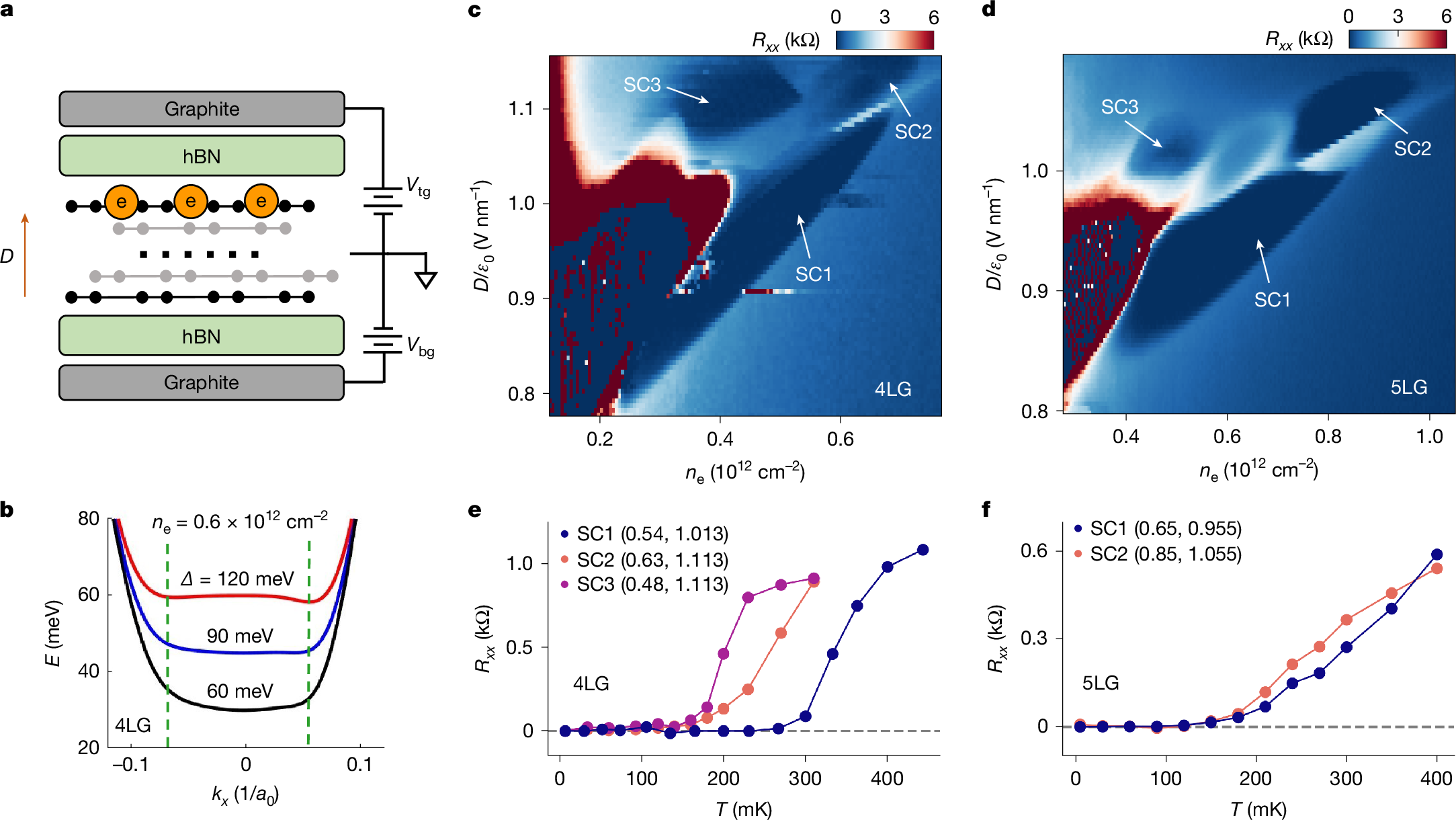
A theory group at Harvard University and the University of Stuttgart has published a classification of superconducting pairing in valley-imbalanced rhombohedral tetralayer graphene in Physical Review Letters, and it finds states that can condense at multiple incommensurate momenta simultaneously, producing a spontaneous superlattice of Cooper pairs [1][2][3]. The consequence for anyone already running these devices is a concrete target rather than a new material to grow: the work was prompted by an experiment in which superconductivity emerged from a normal state where electrons spontaneously filled one graphene valley over the other [4].
Graphene's two valleys are related by time-reversal symmetry, so an imbalance between them breaks that symmetry spontaneously [5]. Mathias Scheurer, the corresponding author, told Phys.org that virtually all theoretical work on conventional and unconventional superconductivity begins by assuming this symmetry is not broken, which makes the valley-polarized case a hole in the theory rather than a variation on it [6].
In a conventional superconductor the two paired electrons carry opposite momenta, so the pair's net momentum vanishes [7]. The framework built by Scheurer with Maine Christos and Pietro M. Bonetti also admits pairs with nonzero net momentum, and it separates commensurate patterns, whose periodicity is compatible with the crystal lattice, from incommensurate ones, whose periodicity is not [8][9][10]. Three authors, two institutions, one classification scheme [11].
The method was a numerical search for solutions of the linearized gap equation, which predicts which pairing states are energetically favorable under given experimental conditions [12]. Because the precise degree of symmetry breaking in the experiment was unknown, Christos said the team scanned a wide range of initial conditions and interactions to cover as many experimental scenarios as possible [13]. For the initial conditions they judge most likely in rhombohedral graphene, the resulting superconductor carried a particular topology that they show analytically is determined by the underlying interactions [14]. A separate free energy calculation indicated the state may also spontaneously break translational symmetry [15].
Worth being clear about what is on offer: a classification plus gap-equation solutions, with the topology result contingent on the interaction assumptions the authors consider most plausible [14][13]. The group arrived here from earlier work on transport signatures of valley-imbalanced superconductors, motivated by the observation that valley imbalance stabilises nonreciprocal critical currents, meaning critical currents that differ in the forward and reverse directions [16]. That is the nearest thing in this line of work to an existing measurable handle.
Three things to watch. Whether experiments can pin down the degree of valley imbalance in these stacks, which the authors had to treat as unknown [13]. Whether the predicted breaking of translational symmetry shows up as an actual superlattice signature rather than a free energy possibility [15]. And whether nonreciprocal critical currents in valley-imbalanced samples behave as the framework requires [16]. The general justification offered for this field, that understanding unconventional superconductors could eventually yield materials that work with less refrigeration [17], is not what this paper delivers; it is a symmetry and momentum classification, not a temperature claim [8][9].